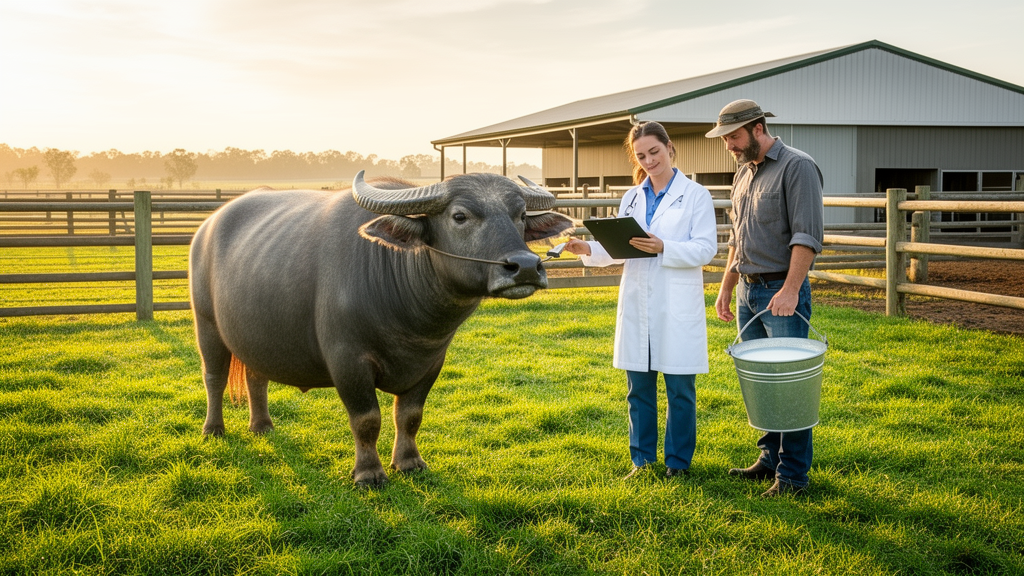
India’s long-running buffalo breeding program has generated an estimated 449.92 billion rupees in additional revenue from milk sales alone, according to a new analysis of more than three decades of progeny records. The study, published in Dairy Science and Management, traced the cumulative effect of selecting sires through a national progeny testing program and found that the daughters of systematically chosen bulls have been producing measurably more milk than they otherwise would, generation after generation, since the early 1990s.
The research team, led by Supriya Chhotaray of the Indian Council of Agricultural Research, analyzed records from 4,300 first-lactation daughters sired by 214 bulls, collected between 1992 and 2018 under the Network Project on Buffalo Improvement, known as NPBI. The program, launched in 1993 by the Indian Council of Agricultural Research, evaluates bulls based on how their daughters perform and then uses only the top performers for further breeding. The new study is described as the first to convert the genetic gain from such a program directly into monetary value.
The central finding is a realized genetic gain of 1.29 kilograms of milk per animal per year, a figure the researchers obtained by regressing the estimated breeding values of the animals against their year of birth. Expressed against the herd average first-lactation yield of 2,291.704 kilograms, that gain amounts to 0.056 percent annually per animal. While the percentage looks modest, the authors emphasize that genetic gain is stable and additive: unlike improvements from better feed or management, which must be maintained continuously, the genetic contribution is passed on and compounds across generations.
The phenotypic trend, which captures both genetic and environmental influences, was considerably larger at 35.19 kilograms per animal per year, or 1.53 percent of the herd average annually. The gap between the two figures illustrates a key principle of quantitative genetics: most of the year-to-year variation in milk yield reflects environmental factors such as feeding, season and management, while only a small, permanent fraction accumulates genetically. The study estimated the heritability of first-lactation 305-day or less milk yield at 0.242, meaning roughly a quarter of the variation in the trait is attributable to additive genetics.
To estimate breeding values, the researchers used a linear mixed animal model implemented in the software WOMBAT, adjusting the records for fixed effects including season of calving, period of calving and age at first calving. Records with extreme ages at first calving, below 36 or above 70 months, were removed as probable recording errors. The additive genetic variance was estimated at 41,081.7, the residual variance at 128,340 and the phenotypic variance at 169,421. One bull from the tenth evaluation set topped the combined ranking with roughly 22 percent superiority over the herd average.
The economic estimate rests on a geometric progression model. The researchers assumed that each daughter of a superior sire produces an average of five progenies over five lactations, that half of all progeny are female, and that a sire transmits only half of its genetic superiority to each daughter, with the advantage halving again in each subsequent generation. Milk prices were drawn from the Gujarat Cooperative Milk Marketing Federation for the corresponding years, and the costs of producing and maintaining superior bull semen were calculated and deducted from the final figure. Under these assumptions, the daughters’ milk yield alone has generated 449.92 billion rupees since the program began.
The analysis also quantified the value of a single outstanding bull. The all-time top-ranked progeny-tested bull, which had 60 daughters recorded for its evaluation, has generated an estimated 82.22 million rupees through the milk yield of the daughters born from it. The field progeny testing program, which began in 2001 to record daughters in farmers’ own villages rather than only in institutional herds, added a total of 1.7 million rupees over the baseline return from milk sales in the participating villages. In the 2021-22 fiscal year alone, the study estimated 3.7 million rupees in additional revenue from the genetic intervention, based on 220,178 doses of Murrah buffalo semen sold or distributed that year and an assumed 46.9 percent conception rate.
The expected genetic gain, calculated using the Rendel and Robertson path method restricted to the sire-to-cow pathway, was 35.88 kilograms per animal per year, or 1.59 percent of the herd average annually. The realized gain fell short of this expectation, and the authors attribute the shortfall to the small size of the participating breeding herds and incomplete pedigree and performance records in the field herds. In a conventional progeny-testing program with 200 to 500 cows, the maximum expected genetic gain is around 1 percent or slightly higher, which puts the program’s realized rate in context. The average superiority of sires above the herd mean across all sets was 4.5 percent.
The study’s scope has clear limits. The authors restricted their analysis to the sire-to-daughter pathway, noting that roughly 43 percent of genetic gain in such programs is realized through the sire-to-son path, which was outside the scope of this study and would likely add further economic value if quantified. Revenue from the sale of semen doses, live animals, male calves and heifers was excluded, as were phenotypic improvements from feeding, management, hormonal treatments and reproductive advances. The authors acknowledge that the economic impact might have been overestimated under their simplified assumptions, even as they argue the estimates are nominal compared with the program’s full economic footprint.
The Murrah breed, prized for its high milk yield and fat content, accounts for a substantial share of India’s buffalo herd, and buffaloes overall contribute roughly 45 percent of the country’s total milk production. India produced 230.58 million tonnes of milk in 2022-23, yet productivity per animal remains low, which makes genetic improvement of high-performing breeds a central strategy for the country’s dairy sector. The researchers argue that the NPBI model, which coordinates institutional herds across centers including CIRB Hisar, GADVASU Ludhiana, NDRI Karnal, IVRI Izatnagar, LUVAS Hisar and ICAR Research Complex for the eastern region in Patna, offers a template that could be extended to other dairy cattle and buffalo breeds, particularly where smallholder farmers keep only two to three animals each and individual herd records are too sparse for accurate genetic evaluation on their own.
Subject of Research: Genetic gain and economic impact of a progeny testing program for Murrah buffalo milk yield in India
Article Title: Economic impact of systematic sire selection on livelihoods of Murrah buffalo farmers
Article References: Chhotaray, S., Vohra, V., Kumar, S., Bharadwaj, A., & Datta, T. K. (2025). Economic impact of systematic sire selection on livelihoods of Murrah buffalo farmers. Dairy Science and Management, 2(1), Article 20. https://doi.org/10.1186/s44363-025-00022-w
Image Credits: AI Generated
DOI: 10.1186/s44363-025-00022-w
Keywords: Murrah buffalo, progeny testing, genetic gain, milk yield, India dairy, sire selection, buffalo breeding, economic impact, smallholder farmers, animal genetics, NPBI, livestock improvement
Cite Scienmag News
Juliet Wilcox. (October 28, 2026). Buffalo breeding program delivers 450 billion rupees in milk gains. Scienmag. https://scienmag.com/buffalo-breeding-program-delivers-450-billion-rupees-in-milk-gains/
Juliet Wilcox. "Buffalo breeding program delivers 450 billion rupees in milk gains." Scienmag, 28 October 2026, https://scienmag.com/buffalo-breeding-program-delivers-450-billion-rupees-in-milk-gains/. Accessed 29 October 2026.
Juliet Wilcox. "Buffalo breeding program delivers 450 billion rupees in milk gains." Scienmag. October 28, 2026. https://scienmag.com/buffalo-breeding-program-delivers-450-billion-rupees-in-milk-gains/