Wednesday, October 28, 2026
Science
No Result
View All Result
  • Login
  • HOME
  • SCIENCE NEWS
  • CONTACT US
  • HOME
  • SCIENCE NEWS
  • CONTACT US
No Result
View All Result
Scienmag
No Result
View All Result
Home Science News Space

Quantum chaos shapes proton tunneling in giant planet chemistry

October 28, 2026
in Space
Grant Pearson
By Grant Pearson Scienmag Editorial Profile - Observational Astronomy
Reading Time: 2 mins read
0
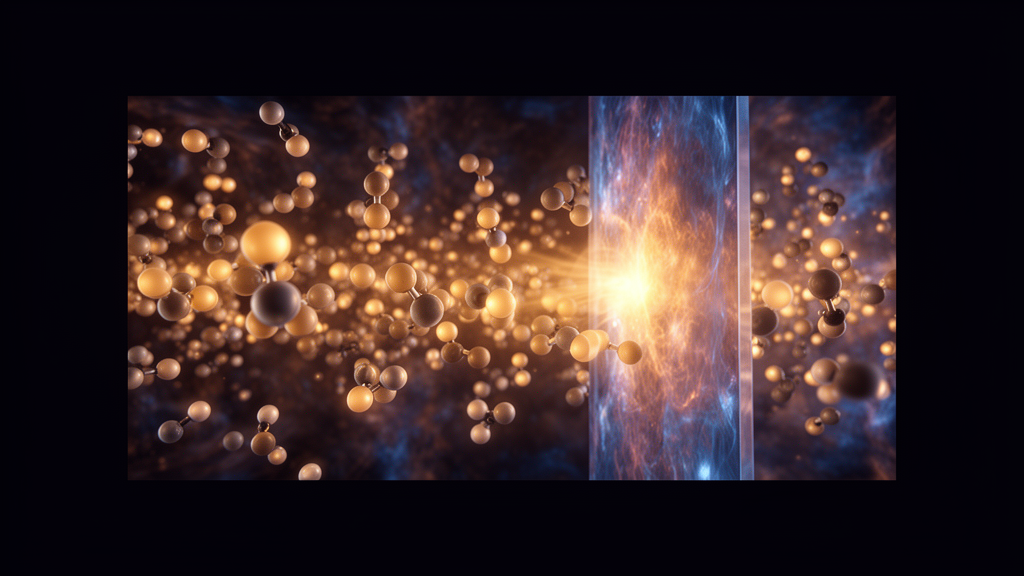
Quantum chaos shapes proton tunneling in giant planet chemistry

Quantum chaos shapes proton tunneling in giant planet chemistry

65
SHARES
587
VIEWS
Share on FacebookShare on Twitter
ADVERTISEMENT

Researchers have introduced a new diagnostic framework showing that quantum chaos is suppressed at the transition state of proton-transfer reactions, a finding that could change how reaction rates are modeled in the ultracold atmospheres of giant planets. The study, published in Discover Space on 1 July 2026, focuses on the formation of H3+ and the proton-bound cluster H5+, two species central to the chemistry of Jovian atmospheres.

Accurate modeling of ion-molecule reaction networks is essential for understanding the chemical evolution of planetary ionospheres, particularly for giant planets where proton-transfer chains drive atmospheric composition. Yet predicting reaction rates in these environments has remained difficult because of the non-trivial interplay between vibrational dynamics and quantum tunneling. The new work addresses this challenge by combining multireference electronic structure theory with two analytical tools: Adiabatic Gauge Potentials (AGP) and Random Matrix Theory (RMT).

Using this framework, the team characterized the microscopic dynamics of proton transport in their model systems. Their central result is that the transition state acts as a dynamical bottleneck where quantum chaos is notably suppressed, with the level-spacing statistic averaging approximately 0.36. According to the study, this suppression effectively enhances tunneling probabilities, meaning that protons can pass through classically forbidden barriers more readily than a purely chaotic picture would suggest.

The researchers also introduced a so-called “fragility index,” derived from the slope of the Adiabatic Gauge Potential, to quantify how specific vibrational modes reintroduce chaos into the dynamics and thereby suppress reactivity. In other words, certain patterns of molecular vibration can restore chaotic behavior at the bottleneck, reducing the likelihood that tunneling will occur. This provides a quantitative way to identify which vibrational pathways gate a reaction.

The authors describe the approach as a generalizable, data-driven metric for identifying vibrationally gated pathways in complex astrochemical networks. By flagging where chaos is suppressed or restored along a reaction coordinate, the diagnostic could help refine kinetic models of planetary and interstellar plasmas, where proton-transfer reactions play a major role in atmospheric composition. The work is presented as a theoretical and computational study using H3+ and H5+ as representative model systems relevant to Jovian atmospheres, so its conclusions apply to the modeled systems rather than to direct atmospheric measurements. As a Brief Report, the study offers a framework and demonstration rather than observational validation, and its usefulness for real planetary ionospheres will depend on future applications to broader reaction networks.

Subject of Research: Quantum chaos and tunneling in proton-transfer reactions relevant to giant planet atmospheres

Article Title: Chaos gated tunneling drives molecular reactivity in astrophysical environments

Article References: Dastider, S. G., Prashant, K., Shruti, P., Sudheesh, C., & Cyriac, J. (2026). Chaos gated tunneling drives molecular reactivity in astrophysical environments. Discover Space, 130(1), Article 15. https://doi.org/10.1007/s11038-026-09595-1

Image Credits: AI Generated

DOI: 10.1007/s11038-026-09595-1

Keywords: quantum chaos, proton tunneling, astrochemistry, H3+, H5+, Jovian atmosphere, ion-molecule reactions, transition state, Random Matrix Theory, Adiabatic Gauge Potentials, planetary ionospheres, vibrational dynamics

Cite Scienmag News

Grant Pearson. (October 28, 2026). Quantum chaos shapes proton tunneling in giant planet chemistry. Scienmag. https://scienmag.com/quantum-chaos-shapes-proton-tunneling-in-giant-planet-chemistry/

Grant Pearson. "Quantum chaos shapes proton tunneling in giant planet chemistry." Scienmag, 28 October 2026, https://scienmag.com/quantum-chaos-shapes-proton-tunneling-in-giant-planet-chemistry/. Accessed 28 October 2026.

Grant Pearson. "Quantum chaos shapes proton tunneling in giant planet chemistry." Scienmag. October 28, 2026. https://scienmag.com/quantum-chaos-shapes-proton-tunneling-in-giant-planet-chemistry/
Tags: Adiabatic Gauge Potentialsastrochemistryenhancement of proton tunneling probabilitiesgiant planet chemical evolutionH3+H5+ion-molecule reaction networksion–molecule reactionsJovian atmospheremultireference electronic structure theoryplanetary ionospheresproton transfer reaction modelingproton tunnelingproton tunneling dynamicsquantum chaosQuantum chaos in planetary ionospheresrandom matrix theoryRandom Matrix Theory applicationssuppression of quantum chaostransition statetransition state dynamicsultracold atmospheric chemistryvibrational dynamics
Share26Tweet16
Previous Post

Gold’s Toughest Ores Get a Cyanide-Free Makeover in New Review

Next Post

Radioactive iodine therapy leaves measurable DNA damage in thyroid cancer patients

Related Posts

CubeSat GNSS telemetry tracks thermospheric drag response to solar EUV forcing
Space

CubeSat GNSS telemetry tracks thermospheric drag response to solar EUV forcing

October 28, 2026
Lightweight AI learns to spot radio interference at a small urban telescope array
Space

Lightweight AI learns to spot radio interference at a small urban telescope array

October 28, 2026
Galaxy Rotation Curves Collapse onto One Curve Twice as Far Out as Before
Space

Galaxy Rotation Curves Collapse onto One Curve Twice as Far Out as Before

October 28, 2026
Comets likely could not have delivered life’s building blocks to Earth, modelling study finds
Space

Comets likely could not have delivered life’s building blocks to Earth, modelling study finds

October 28, 2026
Ionospheric TEC anomalies precede large earthquakes by up to two months
Space

Ionospheric TEC anomalies precede large earthquakes by up to two months

October 28, 2026
Small, cheap laser ranging station Omni-SLR matches costly systems at night, tests show
Space

Small, cheap laser ranging station Omni-SLR matches costly systems at night, tests show

October 28, 2026
Next Post
Radioactive iodine therapy leaves measurable DNA damage in thyroid cancer patients

Radioactive iodine therapy leaves measurable DNA damage in thyroid cancer patients

  • Mothers who receive childcare support from maternal grandparents show more optimized

    Mothers who receive childcare support from maternal grandparents show more parental warmth, finds NTU Singapore study

    27656 shares
    Share 11059 Tweet 6912
  • University of Seville Breaks 120-Year-Old Mystery, Revises a Key Einstein Concept

    1061 shares
    Share 424 Tweet 265
  • Bee body mass, pathogens and local climate influence heat tolerance

    682 shares
    Share 273 Tweet 171
  • Researchers record first-ever images and data of a shark experiencing a boat strike

    546 shares
    Share 218 Tweet 137
  • Groundbreaking Clinical Trial Reveals Lubiprostone Enhances Kidney Function

    531 shares
    Share 212 Tweet 133
Science

Embark on a thrilling journey of discovery with Scienmag.com—your ultimate source for cutting-edge breakthroughs. Immerse yourself in a world where curiosity knows no limits and tomorrow’s possibilities become today’s reality!

RECENT NEWS

  • Systematic review maps end-of-life psychosocial and spiritual needs in physical disability
  • Text Message Campaign Reached Only a Third of Patients Overdue for Colorectal Cancer Screening
  • FOXO1 Emerges as Candidate Regulator and Biomarker in Hip Dysplasia
  • Regulators, developers and clinicians in Shenzhen voice concerns over medical AI governance

Categories

  • Agriculture
  • Anthropology
  • Archaeology
  • Athmospheric
  • Biology
  • Biotechnology
  • Blog
  • Bussines
  • Cancer
  • Chemistry
  • Climate
  • Earth Science
  • Editorial Policy
  • Marine
  • Mathematics
  • Medicine
  • Pediatry
  • Policy
  • Psychology & Psychiatry
  • Science Education
  • Science News
  • Social Science
  • Space
  • Technology and Engineering

Subscribe to Blog via Email

Enter your email address to subscribe to this blog and receive notifications of new posts by email.

Join 5,151 other subscribers

© 2025 Scienmag - Science Magazine

Welcome Back!

Login to your account below

Forgotten Password?

Retrieve your password

Please enter your username or email address to reset your password.

Log In
No Result
View All Result
  • HOME
  • SCIENCE NEWS
  • CONTACT US

© 2025 Scienmag - Science Magazine

Discover more from Science

Subscribe now to keep reading and get access to the full archive.

Continue reading