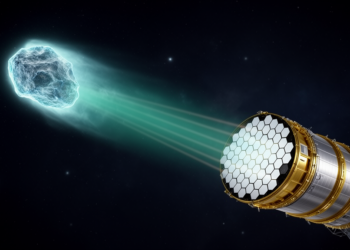
A century-old idea about how life got its molecular start on Earth has run into a serious problem. According to a new study led by the University of Cambridge, comets almost certainly could not have delivered the fragile organic building blocks of life to our planet’s surface, because they strike the atmosphere too fast and at too steep an angle to survive the journey intact. The findings, published in the journal Scientific Reports, suggest that cometary delivery of prebiotic molecules would have been, at best, a one-off fluke rather than the steady rain of life’s ingredients that scientists had long theorised.
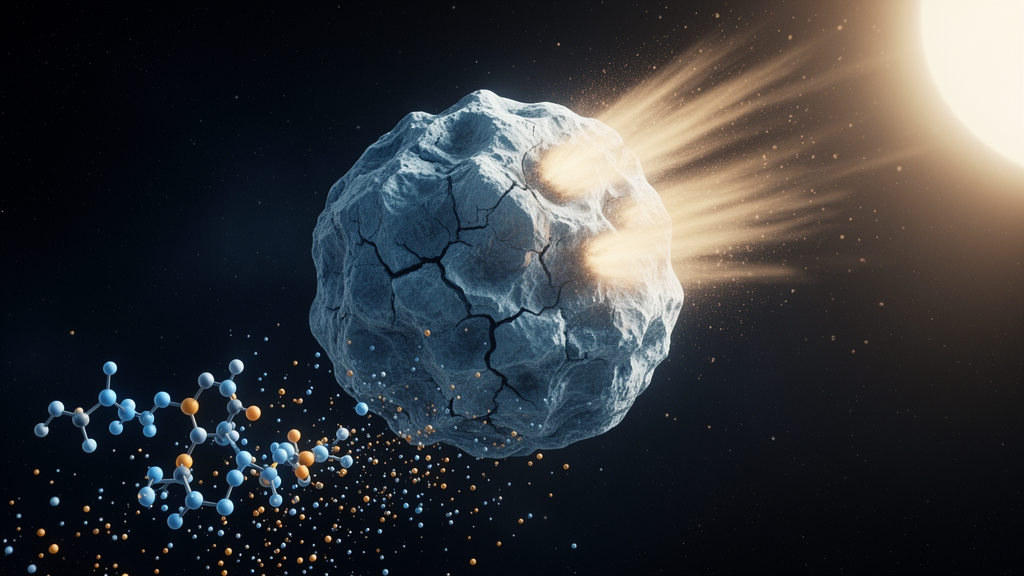
Comets have occupied a special place in origin-of-life research for generations. These icy bodies, often described as giant dirty snowballs, are known to carry carbon-bearing and nitrogen-bearing molecules, including compounds considered essential starting points for the chemistry that eventually led to living cells. Because of this inventory, many researchers assumed that impacts by comets during Earth’s early history could have seeded the planet with the molecular raw materials needed for life to begin. The new work, however, used computer modelling to test that assumption directly, and the results point in a very different direction.
The researchers, led by Dr Richard Anslow from Cambridge’s Institute of Astronomy, focused their simulations on hydrogen cyanide, or HCN, an important prebiotic molecule that is regularly found on Solar System comets. Their modelling showed that when a comet strikes Earth, the extreme conditions of impact would almost certainly vaporise any fragile organic molecules it carried. Even in the rare event that HCN molecules did survive an impact, the simulations indicated that impacts delivering a useful concentration of the compound were extremely uncommon, leaving the planet with very few chances to receive meaningful doses of prebiotic chemistry from space.
Timing made the odds even worse. The number of comets hitting Earth declined rapidly during the planet’s first 500 million years, meaning there were, at most, a handful of opportunities in Earth’s early history for HCN to arrive on a comet. And even if a surviving payload of HCN did reach the surface, the study found it would not have stayed concentrated for long. Any prebiotic chemistry relying on that delivery would therefore have needed to progress very quickly from the moment of impact, a requirement the researchers describe as highly unlikely given what is known about the chemistry involved.
“Historically, scientists thought that comets were important for the origin of life on Earth, because they carried carbon and nitrogen-bearing molecules, so these giant space snowballs were almost like a ‘get out of jail free card’ that brought all the molecules a planet would need to seed life,” said Anslow, the study’s lead author. “It’s kind of a romantic idea, but our results suggest it’s highly unlikely.” His team’s conclusion does not amount to an absolute impossibility, but it dramatically lowers the probability that this pathway played any meaningful role in life’s beginnings on our planet.
The new study builds on earlier work from the same group. In 2023, Anslow and several of his current co-authors theorised that in planetary systems where worlds orbit closely together, comets might slow down by bouncing from one planet to the next, delivering organic molecules as they went. That scenario offered a possible route around the velocity problem, since gentler impacts would give fragile molecules a better chance of survival. The new research set out to determine whether such a bouncing mechanism could plausibly have operated in our own Solar System, where the planets are relatively widely spaced.
To answer that question, the team combined recent advances in comet impact simulations, models of comet-atmosphere interactions, and dynamic modelling of the origin and evolution of comets. Taken together, these tools showed just how rare the favourable scenario would be. While the successful delivery of prebiotic molecules to Earth cannot be ruled out completely, the researchers found it would be extremely unlikely. “It would really have to be a one-in-a-million occurrence, because not only would you need an impact at just the right speed and just the right angle, you would also need everything to happen after that point, in terms of the concentration and the speed at which the chemical origins of life got going,” said Anslow. “We can’t rule out for certain that it happened that way. But it seems to be a really rare occurrence – at best, a one-off fluke.”
If comets did not supply Earth’s molecular seeds, where did they come from? The researchers point to several alternative possibilities. One is that the necessary molecules were synthesised following the impact of asteroids, which strike Earth far more frequently than comets and may have delivered material under less destructive conditions. Another is that the chemical precursors of life formed from processes that occurred on Earth itself, without any outside interference, through chemistry native to the young planet. The study does not settle which of these routes was responsible, but it removes a long-favoured candidate from the list of likely explanations.
There is one intriguing twist in the results. Although cometary delivery of HCN and other prebiotic molecules to Earth appears highly unlikely, the researchers found that Mars, our neighbouring planet, could be a somewhat better candidate. Because Mars is smaller than Earth and currently has a much thinner atmosphere, comets would be far more likely to reach its surface intact, particularly during the period of the Solar System’s development when comets were much more frequent visitors. Slower, shallower impacts on the Red Planet would give organic molecules a greater chance of surviving arrival. “This is not to say it definitely happened on Mars, of course, but suggests it would be unlikely if it happened on Earth and didn’t happen on Mars,” said Anslow. “Or the other, perhaps more likely, alternative, is that it didn’t happen on either planet.”
Beyond our own Solar System, the findings could sharpen the search for life elsewhere. The researchers suggest their results will be useful when astronomers begin studying other planetary systems with instruments more capable than today’s, especially the successors to the James Webb Space Telescope, such as the proposed Habitable Worlds Observatory. Identifying systems in which closely spaced planets allow bouncing comets to exist could give future scientists one way to narrow the enormous search space, focusing attention on environments where cometary delivery of prebiotic molecules remains physically plausible. The work was supported in part by the Royal Society, the Leverhulme Centre for Life in the Universe, and the Science and Technology Facilities Council, part of UK Research and Innovation.
Subject of Research: Whether comets could have delivered prebiotic molecules such as hydrogen cyanide to early Earth
Article Title: Comets probably didn’t seed life on Earth after all, new study suggests
Article References: Comets probably didn’t seed life on Earth after all, new study suggests. Original publication (Bibliographic details unavailable.)
Image Credits: AI Generated
DOI: Not provided
Keywords: comets, origin of life, prebiotic molecules, hydrogen cyanide, early Earth, Mars, University of Cambridge, Scientific Reports, impact simulations, astrobiology, Solar System, Richard Anslow
Cite Scienmag News
Grant Pearson. (October 28, 2026). Comets likely could not have delivered life’s building blocks to Earth, modelling study finds. Scienmag. https://scienmag.com/comets-likely-could-not-have-delivered-lifes-building-blocks-to-earth-modelling-study-finds/
Grant Pearson. "Comets likely could not have delivered life’s building blocks to Earth, modelling study finds." Scienmag, 28 October 2026, https://scienmag.com/comets-likely-could-not-have-delivered-lifes-building-blocks-to-earth-modelling-study-finds/. Accessed 28 October 2026.
Grant Pearson. "Comets likely could not have delivered life’s building blocks to Earth, modelling study finds." Scienmag. October 28, 2026. https://scienmag.com/comets-likely-could-not-have-delivered-lifes-building-blocks-to-earth-modelling-study-finds/