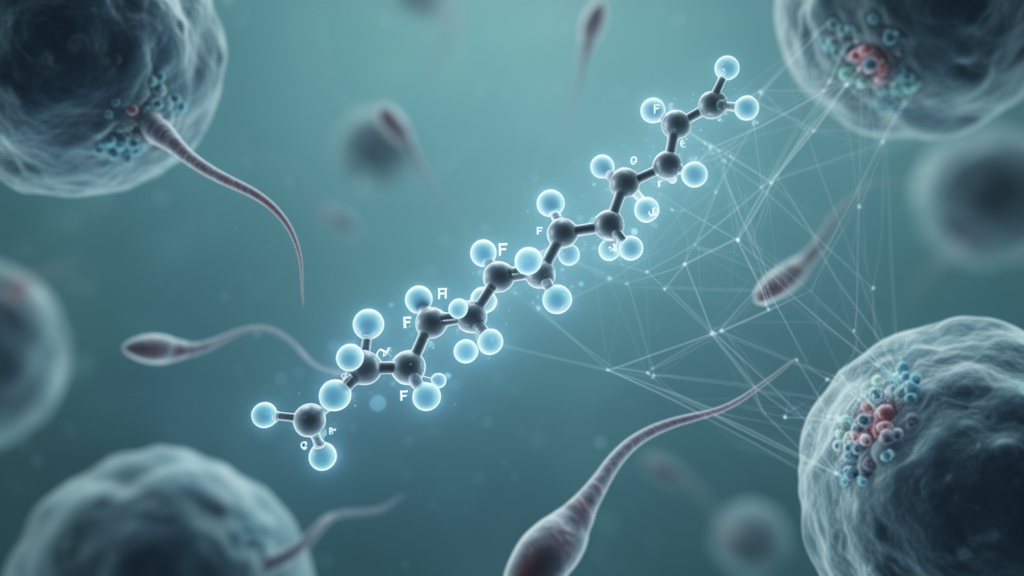
Perfluorooctanoic acid, better known as PFOA, has earned its nickname as a “forever chemical” through sheer persistence: the compound resists degradation, accumulates in water, soil and living tissue, and has been detected in human samples around the world. A new computational and laboratory study published in Basic and Clinical Andrology now offers one of the most detailed molecular maps yet of how this ubiquitous pollutant might interfere with male reproductive health. Rather than examining a single outcome, the research team built a unified framework linking PFOA to three distinct conditions at once: erectile dysfunction, male infertility and testicular dysfunction.
The study, led by Tao Zhou and colleagues, relied on an approach called network toxicology, which integrates information from toxicological databases, predicted chemical targets, protein interaction networks and functional annotation resources to characterize chemical–target–pathway–disease relationships at a systems level. The researchers argue this strategy has advantages over traditional toxicology, which typically focuses on single targets or single pathways and can be time-consuming and costly. By casting a wider computational net, the team hoped to capture the full range of molecular machinery that PFOA might perturb across multiple reproductive endpoints simultaneously.
To assemble their target lists, the researchers first retrieved the chemical structure of PFOA from PubChem and submitted it to the admetSAR 3.0 platform, which predicted a reproductive toxicity probability of 30.1 percent, suggesting the compound may possess potential reproductive toxicity. They then identified putative PFOA targets using three resources: the Comparative Toxicogenomics Database, SwissTargetPrediction and TargetNet, with the latter restricted to human genes showing an area under the curve of at least 0.7. After merging and deduplicating results from all three sources, the team arrived at 105 PFOA-related genes. Disease-associated gene lists came from GeneCards, where searches for erectile dysfunction, male infertility and testicular dysfunction yielded 1,687, 2,315 and 3,064 genes respectively; the top 50 percent by relevance score were retained for each phenotype.
Intersection analysis between the PFOA gene set and each disease set produced strikingly different overlaps: 15 genes shared with erectile dysfunction, 25 with male infertility and 42 with testicular dysfunction. When the researchers intersected PFOA-related genes with all three phenotype sets simultaneously, just 10 genes emerged as common to every category: AR, ESR1, BCL2, NOS1, NOS2, NOS3, ACE, SIRT1, TLR9 and SHBG. Protein–protein interaction networks constructed with the STRING database and analyzed in Cytoscape showed these ten core genes were highly connected, occupying central positions that suggest they may play key regulatory roles in PFOA-associated reproductive toxicity.
Enrichment analyses using Gene Ontology and KEGG pathway databases revealed what these shared genes actually do. The genes were significantly associated with reproductive system development, gonadal development, sex differentiation, hormone and nuclear receptor regulation, calcium and nitric oxide signaling, mitochondrial and redox processes, and apoptosis and inflammation-related pathways. For erectile dysfunction specifically, the enriched pathways included arginine biosynthesis and arginine and proline metabolism, which feed into nitric oxide synthesis and endothelium-dependent vasodilation, a central mechanism of erection. The hypoxia-inducible factor 1 and relaxin signaling pathways, both involved in endothelial homeostasis and vascular smooth muscle regulation, also appeared, alongside estrogen signaling, apelin signaling and fluid shear stress and atherosclerosis pathways.
The male infertility analysis told a complementary story. Genes were enriched in responses to bacterial-derived molecules and lipopolysaccharide, hinting that PFOA may affect fertility by inducing inflammatory responses or immune dysregulation in the reproductive system. Enrichment in gonadal development, primary sexual characteristic development and sex differentiation suggested possible interference with spermatogenesis, while rhythmic processes and negative regulation of calcium ion transport pointed to potential disruption of endocrine rhythms and calcium signaling homeostasis. Molecular function terms included calmodulin binding, oxidoreductase activity, nuclear receptor activity, steroid binding and heme binding, supporting possible perturbation of steroid hormone synthesis, cytochrome P450 function and energy metabolism. Disease-related pathways such as prostate cancer, chemical carcinogenesis and tuberculosis also surfaced, which the authors interpret as reflecting chronic inflammation, immune dysregulation, DNA damage responses and apoptosis imbalance.
To probe whether PFOA physically interacts with the ten core proteins, the team performed molecular docking using CB-Dock2, downloading protein structures from the RCSB Protein Data Bank. The results showed that, with the exception of NOS1, all remaining proteins exhibited a strong binding tendency, with Vina scores below −7 kcal/mol, the threshold the authors define as suggesting tight binding. SHBG showed the most favorable binding energy at −9.3 kcal/mol, followed by AR at −9.2, SIRT1 at −9.1 and ESR1 at −8.9 kcal/mol. These four proteins are central to hormonal regulation and metabolism, and the docking results support the possibility that PFOA may act as a potential endocrine disruptor by binding stably to sex hormone–binding globulin and the androgen and estrogen receptors. Nitric oxide synthase family members NOS2 and NOS3 showed binding energies of −8.4 and −8.3 kcal/mol respectively, while NOS1 was considerably weaker at −4.8 kcal/mol. BCL2, ACE and TLR9 also bound favorably at −7.8, −8.1 and −8.0 kcal/mol.
The team then moved from computation to the laboratory, conducting preliminary in vitro experiments with Leydig cells and rat corpus cavernosum endothelial cells, both obtained commercially and treated with PFOA at concentrations of 5, 10 and 20 micromoles per liter. Quantitative PCR revealed distinct patterns in each cell type. In Leydig cells, AR and ESR1 mRNA levels showed an overall upward trend with increasing PFOA concentrations, with the most pronounced increases in the high-concentration group, while TLR9 was significantly upregulated in a concentration-dependent manner. NOS3 and SIRT1 showed no obvious changes, and BCL2 displayed a downward trend only after high-concentration exposure. In the endothelial cells, AR and ESR1 were again elevated, but NOS3 mRNA expression gradually decreased with increasing PFOA concentration, suggesting the compound may suppress endothelial nitric oxide synthesis pathways. BCL2 progressively decreased and TLR9 showed marked upregulation, while SIRT1 again remained unchanged.
The cell-type difference in NOS3 response caught the authors’ attention. In the discussion, they note that this suggests the effects of PFOA on nitric oxide–related injury may exhibit clear cell-type specificity: in corpus cavernosum endothelial cells, which primarily reflect endothelial function, PFOA is more likely to manifest as NOS3 inhibition and impaired nitric oxide signaling, whereas in Leydig cells the dominant changes may relate more to endocrine and inflammatory disturbances. The authors also caution that the upregulation of AR and ESR1 does not necessarily indicate physiological enhancement, but may instead reflect stress-associated remodeling or imbalanced activation of receptor networks that ultimately disrupts hormonal homeostasis. As for SIRT1, the absence of expression changes does not rule out involvement; the authors suggest it may function more as a background regulator whose role would be better captured by measurements of reactive oxygen species, mitochondrial membrane potential and energy metabolism.
Synthesizing all these strands, the researchers propose a multi-pathway synergistic model in which PFOA may impair male reproductive health through a sequence running from hormonal imbalance to aberrant nitric oxide signaling to dysregulated apoptosis and inflammation. In this framework, PFOA first acts on the AR, ESR1 and SHBG endocrine axis, disrupting the balance between estrogen and androgen signaling and receptor-mediated transcriptional regulation. It may then affect nitric oxide production and vascular function through the NOS family, calcium signaling and arginine metabolism, before metabolic stress and mitochondrial dysfunction trigger inflammatory responses and disturb apoptotic regulation, ultimately producing the different phenotypic outcomes across tissues. The authors are careful to flag the limitations inherent to this approach: the PFOA targets came from database retrieval and algorithm-based prediction and may be affected by data coverage, evidence levels and model bias, and these data lack information on dose, exposure duration and tissue specificity. Molecular docking provides only a structural-level inference of binding tendency, and the in vitro work is preliminary. The team emphasizes that animal experiments and large-scale epidemiological studies are still required to validate the conclusions, positioning the current findings as a theoretical framework and a source of candidate targets for future mechanistic research and risk assessment rather than established clinical evidence.
Subject of Research: Network toxicology analysis of molecular pathways linking PFOA exposure to male reproductive dysfunction
Article Title: Integrative network toxicology analysis reveals mechanistic links between PFOA exposure and male reproductive dysfunction
Article References: Zhou, T., Zhang, X., Yang, J., & Wang, J. (2026). Integrative network toxicology analysis reveals mechanistic links between PFOA exposure and male reproductive dysfunction. Basic and Clinical Andrology, 36(1), Article 26. https://doi.org/10.1186/s12610-026-00328-y
Image Credits: AI Generated
DOI: 10.1186/s12610-026-00328-y
Keywords: PFOA, forever chemicals, male reproductive health, network toxicology, endocrine disruption, erectile dysfunction, male infertility, testicular dysfunction, molecular docking, nitric oxide signaling, apoptosis, inflammation
Cite Scienmag News
Ophelia Keating. (October 28, 2026). Network toxicology study maps how PFOA may disrupt male reproductive health at the molecular level. Scienmag. https://scienmag.com/network-toxicology-study-maps-how-pfoa-may-disrupt-male-reproductive-health-at-the-molecular-level/
Ophelia Keating. "Network toxicology study maps how PFOA may disrupt male reproductive health at the molecular level." Scienmag, 28 October 2026, https://scienmag.com/network-toxicology-study-maps-how-pfoa-may-disrupt-male-reproductive-health-at-the-molecular-level/. Accessed 28 October 2026.
Ophelia Keating. "Network toxicology study maps how PFOA may disrupt male reproductive health at the molecular level." Scienmag. October 28, 2026. https://scienmag.com/network-toxicology-study-maps-how-pfoa-may-disrupt-male-reproductive-health-at-the-molecular-level/