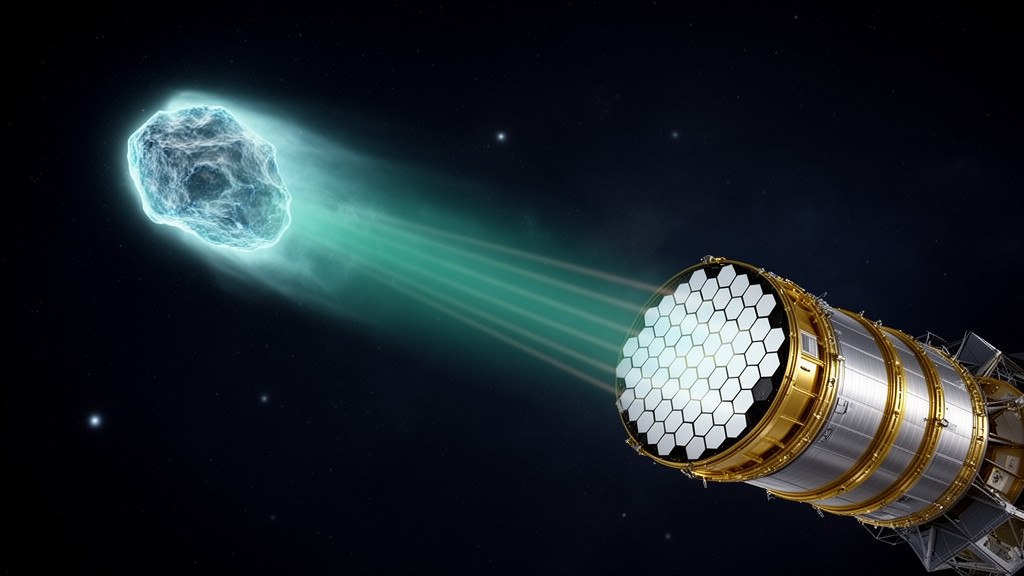
The interstellar object 3I/ATLAS has delivered one of the most striking chemical measurements yet made of material from another planetary system. Using the James Webb Space Telescope, astronomers have detected deuterated methane in its coma and found that the deuterium-to-hydrogen (D/H) ratio of its methane is (3.18 ± 0.30)%, a value higher than any methane measurement made anywhere in the Solar System.
It also represents an exceedingly rare detection of deuterated organic molecules in an interstellar object, offering a direct chemical glimpse into the conditions under which ices formed around the object’s parent star.
The measured methane D/H ratio is a factor of 13 ± 2 higher than the value measured in comet 67P/Churyumov–Gerasimenko by the Rosetta spacecraft, the only other comet for which CH3D has been detected. That comparison makes 3I/ATLAS an outlier even among comets, with a methane D/H ratio higher than any measured in the Solar System.
Interestingly, the comparison between 3I/ATLAS and 67P/Churyumov–Gerasimenko shows a familiar pattern. Both objects display a higher degree of methane deuteration than water deuteration, a trend also seen in other Solar System bodies and in the nearby interstellar medium, where deuteration in organic molecules exceeds that of water by up to an order of magnitude.
While the methane D/H ratio remains observationally unconstrained in extrasolar sources to date, the enriched value measured in 3I/ATLAS resembles those measured in methanol and formaldehyde towards pre- and protostellar environments, regions where new stars and planets are still taking shape.
The research team, led by Nathan X. Roth and including Martin Cordiner, Stefanie Milam and colleagues across multiple institutions, interprets the elevated methane D/H ratio as consistent with the hypothesis that the object’s ices formed in a cold, low-metallicity interstellar or protostellar environment under a high cosmic ray irradiation rate.
Because interstellar objects are interlopers from other planetary systems, their volatile compositions provide a rare opportunity to sample planet-forming material from beyond the Solar System without waiting for a spacecraft mission.
The measurement also highlights the power of the James Webb Space Telescope for interstellar object science.
As 3I/ATLAS continues its journey through and out of the Solar System, the enriched methane D/H ratio now stands as a chemical record of its birthplace: a cold, irradiated, metal-poor environment in which deuterium was woven into organic ice far more heavily than in the comets of our own Solar System.
Subject of Research: Deuterium enrichment in methane measured in the coma of interstellar object 3I/ATLAS
Article Title: An enriched methane D/H ratio in the interstellar object 3I/ATLAS
Article References: Roth, N. X., Cordiner, M., Milam, S., Villanueva, G., Charnley, S., Biver, N., Bockelée-Morvan, D., Bodewits, D., Crovisier, J., Drozdovskaya, M. N., Farnocchia, D., Furuya, K., Kelley, M. S. P., Micheli, M., Noonan, J. W., Opitom, C., Schwamb, M. E., & Thomas, C. A. (2026). An enriched methane D/H ratio in the interstellar object 3I/ATLAS. Nature Astronomy. https://doi.org/10.1038/s41550-026-03002-5
Image Credits: AI Generated
DOI: 10.1038/s41550-026-03002-5
Keywords: 3I/ATLAS, interstellar object, James Webb Space Telescope, methane, deuterium, D/H ratio, comet 67P, Rosetta, astrochemistry, protostellar environments, cosmic rays, Nature Astronomy
Cite Scienmag News
Grant Pearson. (October 28, 2026). JWST finds methane in interstellar object 3I/ATLAS is unusually rich in deuterium. Scienmag. https://scienmag.com/jwst-finds-methane-in-interstellar-object-3i-atlas-is-unusually-rich-in-deuterium/
Grant Pearson. "JWST finds methane in interstellar object 3I/ATLAS is unusually rich in deuterium." Scienmag, 28 October 2026, https://scienmag.com/jwst-finds-methane-in-interstellar-object-3i-atlas-is-unusually-rich-in-deuterium/. Accessed 28 October 2026.
Grant Pearson. "JWST finds methane in interstellar object 3I/ATLAS is unusually rich in deuterium." Scienmag. October 28, 2026. https://scienmag.com/jwst-finds-methane-in-interstellar-object-3i-atlas-is-unusually-rich-in-deuterium/