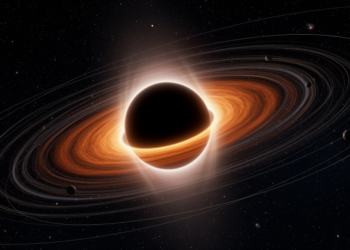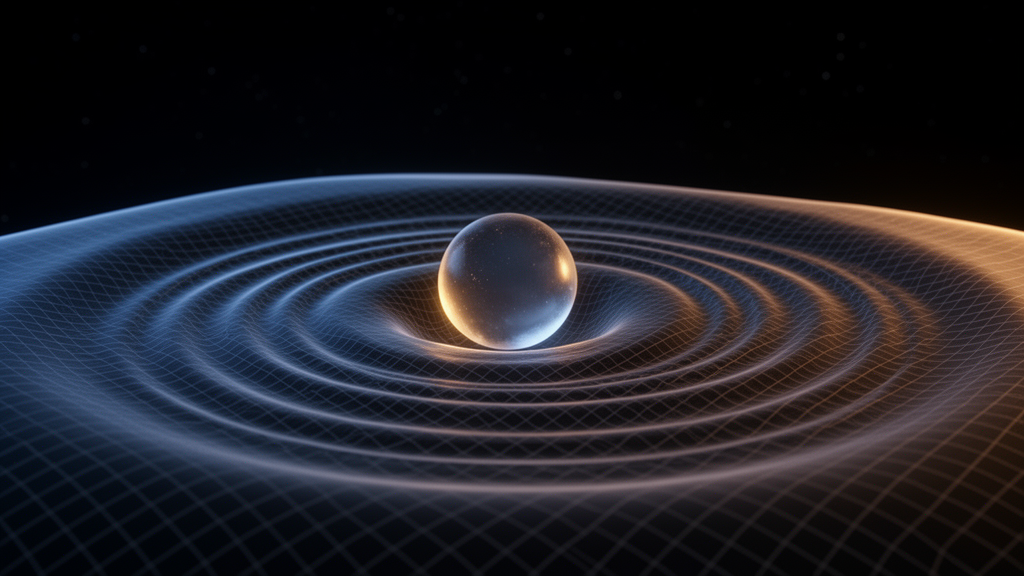
A new theoretical study has put one of the more exotic alternatives to Einstein’s general relativity through its paces, confronting the theory’s black hole solutions with the sharpest observational tests available, from the orbit of Mercury to the path of the star S2 around the supermassive black hole at the center of our galaxy. The verdict is nuanced: the theory survives, but only if a free parameter in the equations takes on values so enormous that its effects become almost invisible in the Solar System, while a second branch of solutions shows a surprising connection to cosmology.
The theory in question is known as non-minimally coupled Weyl connection gravity, developed by Mohsen Khodadi, Margarida Lima and Cláudio Gomes and published in The European Physical Journal C. It builds on Weyl’s original idea of a geometry in which the lengths of objects are not preserved when transported through spacetime. In this framework, non-metricity is encoded through a Weyl vector field, and the matter Lagrangian couples non-minimally to the curvature of this generalized connection. The authors were drawn to the model partly because it yields second-order metric field equations, avoiding the Ostrogradsky instabilities that plague many higher-derivative theories, and because its weak-field limit recovers general relativity for physically motivated choices of the Weyl vector.
The starting point for the analysis is a pair of static, spherically symmetric vacuum solutions of the theory’s field equations, both resembling the Schwarzschild metric that describes the spacetime outside a spherical mass in general relativity. Each solution contains a free parameter called omega, which has dimensions of length and characterizes the strength of the Weyl connection. Like the cosmological constant in Schwarzschild–de Sitter spacetime or the electric charge in Reissner–Nordström black holes, omega arises as an integration constant of the vacuum solution but simultaneously acts as a parameter of the theory, one whose value is not predicted theoretically and must therefore be pinned down by observation.
The two solutions differ in the configuration of the Weyl vector. In the first, the vector is purely radial; in the second, it has both temporal and radial components. This seemingly technical distinction has dramatic consequences. In Solution I, the correction to the metric contains an unsuppressed linear term proportional to 2r/omega, which dominates in the Solar System regime and makes all observables scale as one over omega. In Solution II, the linear term is suppressed by an extra factor of M/omega, so the quadratic term, minus r-squared over four omega-squared, dominates instead, and observables scale as one over omega squared. That difference in scaling translates directly into how strongly observations can constrain each branch.
The authors computed corrections to four classical tests of gravity: the gravitational redshift of light climbing out of the Sun’s gravitational field, the perihelion advance of Mercury, the deflection of starlight by the Sun, and the radar echo delay measured by the Cassini spacecraft. For Solution I, the most stringent bound comes from Mercury’s perihelion precession, which accumulates over roughly 415 orbits per century and is known to an accuracy of about a thousandth of an arcsecond per century from radio tracking data.
Solution II fares considerably better under the same scrutiny. Because its corrections scale as one over omega squared, the same tests produce bounds that are weaker by many orders of magnitude: about 10 to the 20 meters from Mercury’s perihelion, 10 to the 18 meters from radar delay, and only around 10 to the 10 meters from light deflection, the least sensitive test. Interestingly, the two branches also differ in sign. Solution I’s correction to the perihelion precession is retrograde, opposing the standard relativistic advance, while Solution II’s is prograde, reinforcing it.
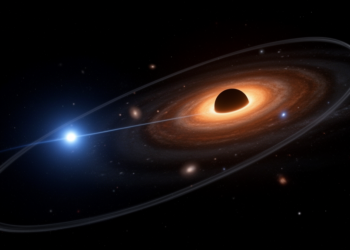
To push beyond the weak-field regime, the authors turned to the Galactic Center, where the star S2 swings around the black hole Sagittarius A* on a highly eccentric 16-year orbit with a pericenter distance of roughly 120 astronomical units. There the gravitational potential is about a hundred thousand times stronger than in Solar System tests. The GRAVITY instrument at the Very Large Telescope and the Keck Observatory have monitored S2 for decades, detecting both gravitational redshift and Schwarzschild precession of about 12 arcminutes per orbit, consistent with general relativity at the 10-sigma level. The precession parameter has been measured as 1.10 plus or minus 0.19, and the combined redshift and transverse Doppler effect, corresponding to roughly 200 kilometers per second divided by the speed of light, is known to about 10 percent statistical accuracy.
Applying these data to the two solutions produces complementary constraints. For Solution I, the S2 periastron precession requires omega greater than roughly 10 to the 21 meters, while the S2 gravitational redshift pushes the bound to about 10 to the 24 meters. For Solution II, the corresponding limits are about 10 to the 17 meters from precession and 10 to the 22 meters from redshift. Although none of these stellar-orbit bounds surpasses the Mercury perihelion constraint, they extend the testing of the theory into a gravitational environment that Solar System experiments simply cannot reach, and they confirm the same retrograde-versus-prograde distinction between the two branches seen in the weak-field analysis.
Perhaps the most intriguing result concerns the asymptotic structure of the solutions. Both metrics acquire a quadratic term in radius at large distances, mimicking the presence of a cosmological constant even though none appears explicitly in the gravitational action. Matching these terms to the Schwarzschild–(anti-)de Sitter family defines an effective cosmological constant: negative and equal to minus three over omega squared for Solution I, and positive and equal to three over four omega squared for Solution II. Using the tightest observational bounds, the effective cosmological constant of Solution I is forced to be at most about 2.49 times 10 to the minus 60 per square meter, roughly eight orders of magnitude smaller than the observed value of about 1.1 times 10 to the minus 52 per square meter. Solution II, by contrast, could accommodate an effective cosmological constant as large as about 3.20 times 10 to the minus 41 per square meter, comfortably above the observed value and therefore leaving room for the theory to account for the late-time accelerated expansion of the Universe without introducing vacuum energy by hand.
The authors are careful to stress that this correspondence should be read as an effective geometrical analogy rather than an identification of the Weyl-induced term with the vacuum energy driving cosmic acceleration. They also examined a subtle ambiguity in how particle trajectories are parametrized: in a geometry with non-metricity, proper time and the affine parameter of autoparallel transport need not coincide, a point that goes back to one of Einstein’s original objections to Weyl’s theory. Repeating the perihelion calculation with the affine parametrization changed the predicted correction for Solution I only by a factor of two, while for Solution II the two descriptions coincide in the weak-field regime, leaving all observational bounds robust. Looking ahead, the authors note that improved measurements, from the BepiColombo mission for Mercury’s perihelion to next-generation very long baseline interferometry and the upcoming pericenter passage of S2 expected around 2034, could tighten these constraints further. For now, the theory survives every test thrown at it, but only in a corner of its parameter space where its Weyl-induced deviations from Einstein’s gravity are suppressed to near invisibility, with Solution II emerging as the more cosmologically promising branch.
Subject of Research: Observational constraints on non-minimally coupled Weyl connection gravity from Solar System tests and stellar orbits near the Galactic Center
Article Title: Non-minimally coupled Weyl connection gravity in the Solar System and at the Galactic Center
Article References: Khodadi, M., Lima, M., & Gomes, C. (2026). Non-minimally coupled Weyl connection gravity in the Solar System and at the Galactic Center. The European Physical Journal C, 86(10), Article 1226. https://doi.org/10.1140/epjc/s10052-026-16513-2
Image Credits: AI Generated
DOI: 10.1140/epjc/s10052-026-16513-2
Keywords: Weyl connection gravity, general relativity, non-metricity, black hole solutions, Solar System tests, Mercury perihelion precession, gravitational redshift, light deflection, radar echo delay, Sagittarius A*, S2 star, cosmological constant
Cite Scienmag News
Grant Pearson. (October 28, 2026). Weyl Gravity’s Hidden Length Scale Faces Its Toughest Tests Yet. Scienmag. https://scienmag.com/weyl-gravitys-hidden-length-scale-faces-its-toughest-tests-yet/
Grant Pearson. "Weyl Gravity’s Hidden Length Scale Faces Its Toughest Tests Yet." Scienmag, 28 October 2026, https://scienmag.com/weyl-gravitys-hidden-length-scale-faces-its-toughest-tests-yet/. Accessed 29 October 2026.
Grant Pearson. "Weyl Gravity’s Hidden Length Scale Faces Its Toughest Tests Yet." Scienmag. October 28, 2026. https://scienmag.com/weyl-gravitys-hidden-length-scale-faces-its-toughest-tests-yet/