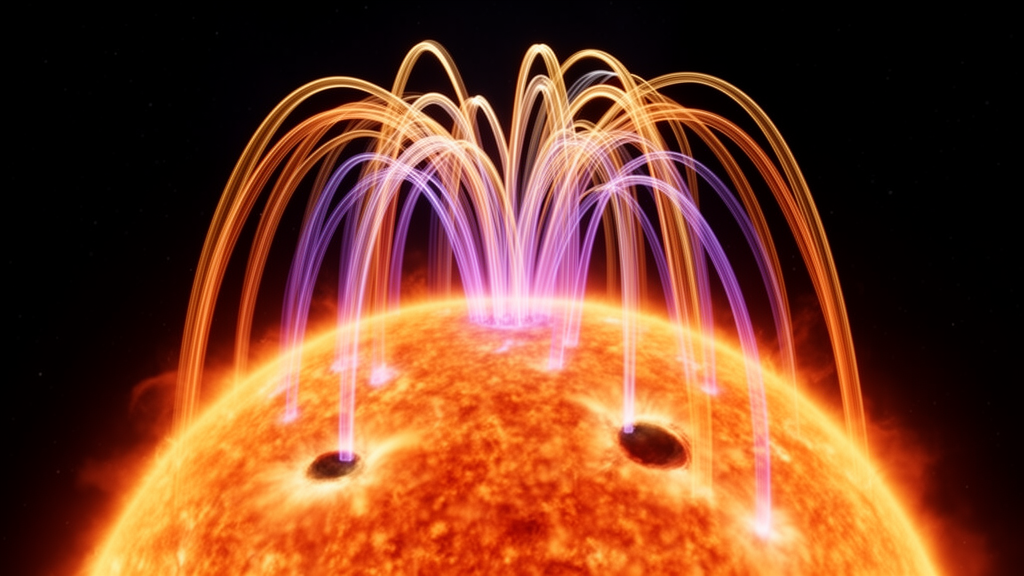
For the first time, researchers have produced global, three-dimensional estimates of the magnetic field threading through the Sun’s corona, including regions beyond the Sun’s visible edge. The achievement, described in a paper published in The Astrophysical Journal Letters, came from applying a new reconstruction method to existing observations from the Mauna Loa Solar Observatory (MLSO), a facility operated by the U.S. National Science Foundation National Center for Atmospheric Research (NSF NCAR). Rather than relying on a new instrument, the team extracted information encoded in light and waves emitted by the corona itself, turning existing data into a three-dimensional map of a field that has resisted direct measurement for decades.
The corona, the Sun’s upper atmosphere, has been observed structurally for many years, but the full magnetic field responsible for shaping it could not previously be measured. That gap has been a persistent bottleneck for solar physics, because the coronal magnetic field governs phenomena that matter far beyond the Sun. Solar magnetic eruptions are the root cause of extreme space weather, which can impact critical infrastructure technologies on Earth. Better measurements of the coronal field are therefore considered an important step toward more accurate models of solar activity and, ultimately, improved predictions of eruptions.
“By applying a novel method to observations from the Mauna Loa Solar Observatory, we produced the first determinations of the coronal magnetic field’s strength and 3D direction across the regions where MLSO observations are available,” said Daniela Lacatus, an NSF NCAR researcher and co-author of the study. “These results help to overcome a major bottleneck in measuring the coronal magnetic field that has persisted for decades.” The technique delivers both the strength and the three-dimensional direction of the field across the portion of the corona covered by the observatory’s data.
The work builds on two earlier research efforts. The first produced the initial two-dimensional global maps of the coronal magnetic field using data from the Upgraded Coronal Multi-channel Polarimeter (UCoMP) at MLSO. The second was a technique known as the IQUD inversion, which had already shown promise in both theoretical and statistical tests. Combining the two, the research team used data from the original Coronal Multi-channel Polarimeter (CoMP) recorded on October 14, 2016, and from UCoMP recorded on June 1, 2022. The key insight is that waves travelling through the corona carry information about the magnetic field that guides them; the method pulls that information out of the observations and uses it to reconstruct the three-dimensional coronal magnetic field.
“For the first time, we can begin to see the Sun’s hidden magnetic architecture in three dimensions not by building a new type of ground or space instrument, but by decoding the light and waves already coming from the Sun’s corona,” said Alin Paraschiv, an NSF NSO researcher and the study’s lead author. “For a star whose magnetic activity influences everything from the solar wind to the auroras dancing across Earth’s skies, being able to measure more of that hidden architecture could transform our understanding of how the Sun works.”
The study was conducted by researchers from NSF NCAR, the U.S. National Science Foundation National Solar Observatory (NSF NSO), and Southwest Research Institute, with funding from the National Science Foundation. The team describes the work as a transition from a theoretically demonstrated technique to an observationally demonstrated capability. That distinction matters: the initial magnetic-field maps have limitations, and additional development and validation will be necessary before the approach can become a routine capability. The current results are a demonstration of what the method can do, not a finished operational product.
To encourage further progress, the team has made its analysis software and datasets openly available, allowing other scientists to test, refine and extend the method. MLSO data from both CoMP and UCoMP are publicly available, and researchers should, in theory, be able to generate three-dimensional coronal maps by applying the IQUD inversion to any day on which suitable observations exist from either instrument. The method itself, however, has not yet been integrated as a data product into operational observatory pipelines, and the researchers hope it will one day become a standard data product in the advanced COSMO observatory network, the planned follow-on to the current MLSO facility.
“When we did the validations, we were so excited to see that the results look reasonable and comparable to what we’d expect,” said Lacatus. “People have already told us how excited they are about this and we really want them to come test the method to help us see where it can be tweaked and refined. We’ve proved the method can work and now we just need to make it broadly available to the community.”
“It’s very exciting to see MLSO data used as a pathfinder to advance our ability to predict solar eruptions,” said Tom Berger, MLSO director. “The team has done an amazing job at demonstrating how our advanced COSMO coronagraph network – the follow-on to the current MLSO facility – will enable new observations of the Sun’s magnetic field, filling a critical gap in our observations of space weather drivers.” For now, the result stands as a first global, three-dimensional look at the magnetic field that shapes the Sun’s corona, achieved with instruments already running and offered openly to the research community.
Subject of Research: Three-dimensional reconstruction of the Sun's coronal magnetic field from Mauna Loa Solar Observatory polarimetric observations
Article Title: Coronal magnetic fields in 3D
Article References: Coronal magnetic fields in 3D. Original publication (Bibliographic details unavailable.)
Image Credits: AI Generated
DOI: Not provided
Keywords: solar physics, coronal magnetic field, Mauna Loa Solar Observatory, space weather, NSF NCAR, UCoMP, CoMP, IQUD inversion, solar eruptions, The Astrophysical Journal Letters, magnetic field reconstruction, heliophysics
Cite Scienmag News
Grant Pearson. (October 28, 2026). Scientists reconstruct the Sun’s hidden coronal magnetic field in three dimensions. Scienmag. https://scienmag.com/scientists-reconstruct-the-suns-hidden-coronal-magnetic-field-in-three-dimensions/
Grant Pearson. "Scientists reconstruct the Sun’s hidden coronal magnetic field in three dimensions." Scienmag, 28 October 2026, https://scienmag.com/scientists-reconstruct-the-suns-hidden-coronal-magnetic-field-in-three-dimensions/. Accessed 28 October 2026.
Grant Pearson. "Scientists reconstruct the Sun’s hidden coronal magnetic field in three dimensions." Scienmag. October 28, 2026. https://scienmag.com/scientists-reconstruct-the-suns-hidden-coronal-magnetic-field-in-three-dimensions/