A new theoretical study now argues that the two may betray themselves in an unexpected way: through the character of chaos. By tracking the motion of a test particle rattling around near the throat of a traversable wormhole, researchers report a dynamical fingerprint that differs sharply from the chaos generated near a black hole’s event horizon, offering what they describe as a new criterion for telling black hole mimickers apart in strong-field astrophysical observations.
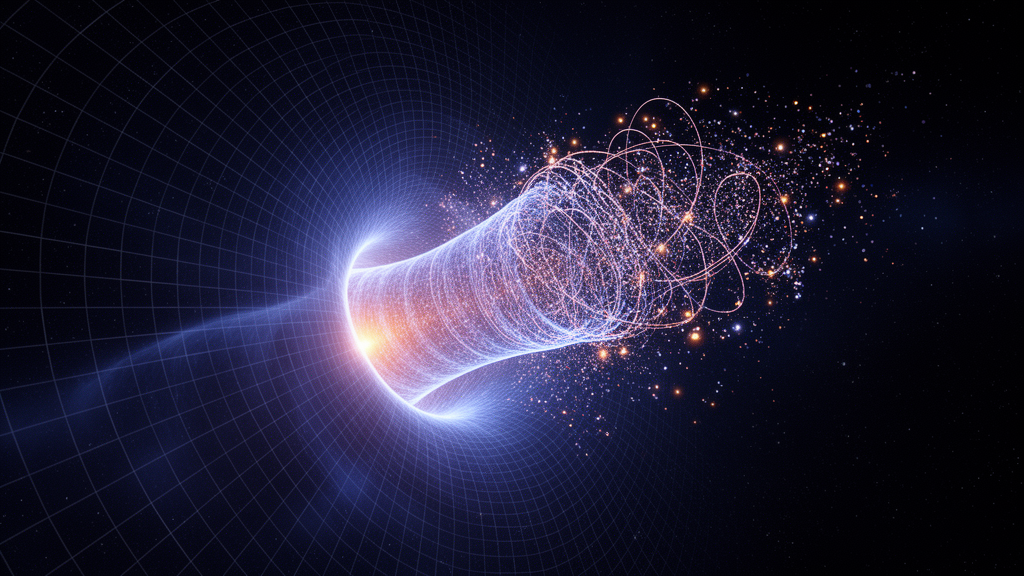
The work, published in The European Physical Journal C by Xin Zhao, Xing-Kun Zhang, Ya-Peng Hu and Yu-Sen An, examines a particle moving in the background of a Morris–Thorne wormhole, the canonical traversable wormhole geometry proposed in 1988. Unlike a black hole, such a wormhole has no event horizon; instead it possesses a throat, a narrowest point of spacetime at radius r0 where the shape function satisfies b(r0) = r0, connecting two asymptotically flat regions. In principle, signals and matter can pass from one side to the other, something strictly forbidden at a horizon.
The motivation comes from a striking result in recent gravitational physics. Previous studies showed that when a particle near a black hole horizon is pulled by an external force, its motion becomes chaotic, and the associated Lyapunov exponent, the rate at which nearby trajectories diverge, is universally set by the black hole’s surface gravity, independent of the details of the force or the particle’s mass. That exponent saturates a conjectured upper bound on chaos, the Maldacena–Shenker–Stanford bound, originally formulated for quantum many-body systems. This universality forged a direct link between horizon geometry and chaos, and prompted the authors to ask whether such chaos is a unique signature of horizons or whether other ultra-dense objects without them, the so-called black hole mimickers, could produce something similar.
The team’s answer begins with a one-dimensional stability analysis. Writing down the Lagrangian for a massive particle constrained to radial motion under an external potential, they expand it around the particle’s equilibrium position and identify a quantity, lambda squared, whose sign determines stability: positive means instability, negative means the particle oscillates stably about equilibrium. For an ultrastatic wormhole, where the redshift function vanishes, they show that near the throat the leading term in lambda squared vanishes because of the defining throat condition, and the remaining sign is fixed entirely by the second derivative of the external potential. For a conventional confining potential such as a harmonic oscillator, lambda squared is negative, so the equilibrium orbits near the throat are linearly stable. As the equilibrium position approaches the throat, the exponent itself tends to zero.
This stands in qualitative contrast to the Schwarzschild black hole, where the same analysis yields a non-vanishing leading term equal to the square of the surface gravity, reproducing the known result that horizon-adjacent particle chaos is governed by kappa. In the authors’ words, the black hole horizon can be seen as a nest of chaos, whereas the wormhole’s radial motion is far more stable. Yet the team is careful to stress that local linear stability against infinitesimal perturbations does not guarantee freedom from global nonlinear instability, and real astrophysical particles do not move in one dimension alone. That caveat sets up the heart of the paper: a full two-dimensional treatment.
Adding an angular direction transforms the picture. The authors derive the Hamiltonian equations of motion for a particle in the r–theta plane of the ultrastatic wormhole and find a strong nonlinear coupling between radial and angular motion induced directly by the curved spacetime geometry, a coupling that cannot be analytically decoupled. To keep the particle near the throat long enough to diagnose chaos, they introduce a two-dimensional isotropic harmonic potential, a setup widely used in earlier black hole studies. Crucially, the harmonic potential alone corresponds to an integrable system that cannot generate chaos by itself, so any regular-to-chaotic transition they observe must be attributable to the strong gravitational field near the throat. The potential is also weak enough that its backreaction on the background spacetime is negligible.
The numerical results are vivid. Integrating the Hamiltonian equations with a high-precision adaptive Runge–Kutta–Fehlberg scheme and projecting the phase space onto Poincaré sections, the team explored energies from 5 up to 100.9, just below the critical energy of 101 above which the particle could escape through the throat. At low energy the phase space is dominated by smooth, nested closed curves, the Kolmogorov–Arnold–Moser tori that hallmark regular, quasi-periodic motion. As energy rises, those tori progressively break apart and chaotic regions grow. At the highest energy, the once-smooth tori are torn into diffuse chaotic scatter, yet a dense cluster of unbroken KAM tori stubbornly survives in the central region of phase space near the equilibrium point, exactly where the one-dimensional analysis predicted local stability.
Quantitative confirmation comes from the maximum Lyapunov exponent. For regular tori orbits the exponent decays as a power law proportional to one over time, signalling that nearby trajectories do not diverge exponentially. For chaotic orbits it plateaus at a strictly positive constant, the unmistakable signature of sensitivity to initial conditions. The plateau value grows with energy and then saturates: at t = 10,000 the exponent reaches roughly 0.050 for the highest energies studied, and further calculations at energies of 100 to 100.8 show Poincaré sections that barely change, with exponents converging to the same plateau, confirming chaos saturation in the high-energy regime.
To check that none of this is an artefact of one particular geometry, the authors repeated the entire analysis with a second wormhole shape function, an exponentially decaying profile, and found extremely consistent behaviour: the same progression from regular tori to coexisting chaos and surviving tori, and the same saturation of the maximum Lyapunov exponent at high energy, trending toward the same upper bound under both shape functions. This robustness, they argue, indicates that the chaotic saturation near a traversable wormhole throat is bounded by an intrinsic ceiling rather than by the details of the geometry.
The broader implication is that an event horizon is not a necessary condition for this kind of transition to chaos; the strong gravitational field near a wormhole throat suffices to break integrability. But the way chaos develops differs fundamentally from the black hole case, where widespread chaos prevails under the same confining potential. In the wormhole, local radial stability preserves islands of regularity even amid high-energy chaos. The authors suggest this contrast could serve as a dynamical discriminator between black holes and their mimickers in strong-field observations, and they outline extensions to massless photons, which would connect the chaos to wormhole shadow profiles relevant for radio telescopes, to particles that actually traverse the throat, and to asymmetric wormhole configurations. For now, the result is purely theoretical, with no experimental data attached, but it adds a new, chaos-based thread to the effort to answer one of gravitational astronomy’s most tantalising questions: what, exactly, is lurking behind the signals we observe.
Subject of Research: Nonlinear chaotic dynamics of test particles near the throat of a traversable wormhole under an external harmonic potential
Article Title: Chaotic particle dynamics near a traversable wormhole throat
Article References: Zhao, X., Zhang, X.-K., Hu, Y.-P., & An, Y.-S. (2026). Chaotic particle dynamics near a traversable wormhole throat. The European Physical Journal C, 86(10), Article 1227. https://doi.org/10.1140/epjc/s10052-026-16511-4
Image Credits: AI Generated
DOI: 10.1140/epjc/s10052-026-16511-4
Keywords: traversable wormhole, chaos, black hole mimickers, KAM tori, Lyapunov exponent, Poincaré section, event horizon, Morris–Thorne wormhole, Hamiltonian dynamics, surface gravity, theoretical physics, strong-field astrophysics
Cite Scienmag News
Grant Pearson. (October 28, 2026). Chaos Without a Horizon: Particles Turn Chaotic Near Wormhole Throats. Scienmag. https://scienmag.com/chaos-without-a-horizon-particles-turn-chaotic-near-wormhole-throats/
Grant Pearson. "Chaos Without a Horizon: Particles Turn Chaotic Near Wormhole Throats." Scienmag, 28 October 2026, https://scienmag.com/chaos-without-a-horizon-particles-turn-chaotic-near-wormhole-throats/. Accessed 29 October 2026.
Grant Pearson. "Chaos Without a Horizon: Particles Turn Chaotic Near Wormhole Throats." Scienmag. October 28, 2026. https://scienmag.com/chaos-without-a-horizon-particles-turn-chaotic-near-wormhole-throats/