Researchers have analyzed how the total electron content of the ionosphere behaved before, during and after five significant earthquakes in Japan, and tested whether a geostatistical technique called Universal Kriging can predict the observed variations. The study, published in Discover Space, examined earthquakes that struck Japan between 2004 and 2024, with magnitudes ranging from 6.2 to 7.5 Mw, and compared the model’s predictions against a simple 30-day median baseline and the empirical IRI-2020 reference model.
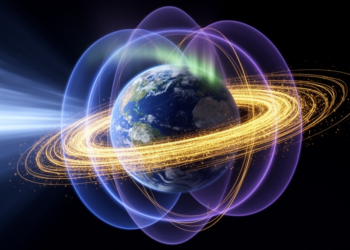
Earthquakes release enormous amounts of energy when accumulated stress in the Earth’s crust is suddenly released. Some of that energy generates acoustic and gravity waves that travel upward through the atmosphere, disturbing the density of ionospheric plasma and producing fluctuations in total electron content, or TEC, a measure of the number of electrons along a path through the ionosphere, which extends roughly 60 to 1,000 kilometers above the surface. Because TEC also responds strongly to solar radiation, solar wind and geomagnetic storms, distinguishing earthquake-related disturbances from ordinary space weather is one of the central challenges in this field.
The research team, led by R. Mukesh and S. Kiruthiga with Sarat C. Dass and M. Vijay, used true TEC data from the USUD GNSS station in Japan, obtained through the Ionolab service. Alongside the TEC measurements, they compiled four space weather parameters from the Omniweb server: the F10.7 solar radio flux, the Dst disturbance storm time index, the Ap geomagnetic activity index and the solar wind speed. By checking whether these indices indicated disturbed or quiet conditions at the time of each TEC fluctuation, the authors could judge whether an anomaly was plausibly attributable to solar or geomagnetic activity rather than to the earthquake itself.
The five events analyzed were the 6.6 Mw Niigata earthquake of October 23, 2004; the 7.3 Mw Kamaishi earthquake of December 7, 2012; the 7.1 Mw Honshu earthquake of October 26, 2013; the 6.2 Mw Anamizu earthquake of May 5, 2023; and the 7.5 Mw Suzu earthquake of January 1, 2024. For each event, the researchers constructed a Universal Kriging model using only 60 days of TEC data preceding the earthquake, then predicted TEC for a window spanning two days before to two days after the main shock. Universal Kriging is an advanced interpolation method that models both a deterministic trend and the spatial correlation of residuals using a semivariogram, allowing estimates at unsampled points that account for the structured dependence of TEC in space and time.
To quantify performance, the team computed four statistical indicators: the percentage root mean square error (PRMSE), the mean absolute gross error (MAGE), the centered root mean square difference (CRMSD) and the mean normalized bias (MNB). Together these measure the overall error magnitude, the average absolute deviation, the variability of fluctuations after removing mean bias, and the direction and size of any systematic overestimation or underestimation. The same metrics were applied to the 30-day median TEC, which serves as a smooth baseline of typical ionospheric behavior, and to the IRI-2020 empirical model.
The results showed a consistent pattern across all five events. The median TEC generally delivered lower absolute error and bias than the Universal Kriging predictions, while the UK model was more effective at capturing the variability and structure of the TEC fluctuations. Both approaches, however, clearly outperformed the IRI-2020 model. For the Niigata earthquake, the UK model’s PRMSE values ranged from 1.825 to 6.526 over the five-day window, compared with 1.290 to 4.681 for the median, and the regression analysis yielded a correlation coefficient of about 0.95 with a coefficient of determination near 0.91, meaning the model explained roughly 91 percent of the observed variability.
The Kamaishi earthquake of December 7, 2012, stood out as the most intriguing case. During the early hours of December 7, the true TEC showed observable fluctuations while every space weather indicator was quiet: the Ap index was below 7 nT, Dst remained above minus 20 nT, solar wind speed stayed under 400 km/s and F10.7 was below 120 sfu. With no significant solar or geomagnetic disturbances to explain the deviations, the authors suggest these TEC variations may be associated with earthquake-related effects, pointing to possible seismo-ionospheric coupling. The regression analysis for this event produced a Pearson correlation of 0.932 and an R-squared of 0.868.
For the other four earthquakes, the observed TEC deviations were linked to solar and geomagnetic activity. Around the Niigata event, enhancements in true TEC coincided with elevated F10.7 values and solar wind speeds above 400 km/s on some days. During the Honshu earthquake period, F10.7 remained above 120 sfu while solar wind speed stayed low, suggesting solar activity as the likely driver of the fluctuations. Before the Suzu earthquake, a strong geomagnetic storm developed on December 31, 2023, with the Ap index spiking above 100 nT, Dst dropping to about minus 100 nT and solar wind speed exceeding 500 km/s, one day before the main shock. In the Anamizu period, geomagnetic storms occurred on April 23-24 and May 7-8, 2023, and TEC variations on the event day coincided with F10.7 above 120 sfu.
As an additional check on spatial representativeness, the team repeated the Honshu analysis using data from the MIZU station, which lies about 380 kilometers from the epicenter compared with 575 kilometers for USUD. The two stations’ true TEC records followed similar patterns, and the regression statistics were closely matched: MIZU gave a Pearson correlation of 0.9773 and R-squared of 0.955, against 0.9818 and 0.9640 for USUD. The error metrics were also nearly identical, with median-model average PRMSE of 1.884 versus 1.90 for the UK model at MIZU, supporting the conclusion that the results were not an artifact of a single observing station.
Across the five events, the UK model’s average error metrics were small: for Niigata, average PRMSE, MAGE, CRMSD and MNB were 4.311, 2.867, 2.362 and 0.128 respectively; for Kamaishi, 2.971, 1.023, 0.982 and 0.086; for Honshu, 1.903, 1.324, 1.628 and 0.038; for Anamizu, 2.919, 3.911, 2.923 and 0.062; and for Suzu, 3.972, 2.013, 2.516 and 0.065. The authors emphasize that their model was built with only 60 days of data, requiring significantly less computational data and processing time than approaches that use three months or more, and that the differences between median TEC and UK-predicted TEC were minimal compared with IRI-2020. They suggest that coupling Universal Kriging with machine learning models and additional solar, geomagnetic and geophysical parameters could enhance prediction ability, and that integrating TEC analysis with space weather indices may support the use of ionospheric TEC as an auxiliary indication for earthquake monitoring strategies. The findings remain an association-based analysis of five events at a single primary station, and the authors note that the Kamaishi case indicates only a possible, not a confirmed, seismic link.
Subject of Research: Prediction of ionospheric total electron content variations during five Japanese earthquakes using Universal Kriging
Article Title: Analysis and prediction of ionospheric TEC during five earthquakes in Japan using Universal Kriging and comparison with median/IRI-2020 TEC
Article References: Mukesh, R., Kiruthiga, S., Dass, S. C., & Vijay, M. (2026). Analysis and prediction of ionospheric TEC during five earthquakes in Japan using Universal Kriging and comparison with median/IRI-2020 TEC. Discover Space, 130(1), Article 6. https://doi.org/10.1007/s11038-026-09588-0
Image Credits: AI Generated
DOI: 10.1007/s11038-026-09588-0
Keywords: ionosphere, total electron content, Universal Kriging, earthquakes, Japan, TEC anomalies, IRI-2020, geomagnetic indices, solar activity, seismo-ionospheric coupling, GNSS, space weather
Cite Scienmag News
Russell Cooper. (October 29, 2026). Kriging model tracks ionospheric disturbances around five Japanese earthquakes. Scienmag. https://scienmag.com/kriging-model-tracks-ionospheric-disturbances-around-five-japanese-earthquakes/
Russell Cooper. "Kriging model tracks ionospheric disturbances around five Japanese earthquakes." Scienmag, 29 October 2026, https://scienmag.com/kriging-model-tracks-ionospheric-disturbances-around-five-japanese-earthquakes/. Accessed 29 October 2026.
Russell Cooper. "Kriging model tracks ionospheric disturbances around five Japanese earthquakes." Scienmag. October 29, 2026. https://scienmag.com/kriging-model-tracks-ionospheric-disturbances-around-five-japanese-earthquakes/