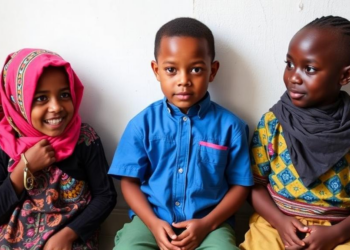
The study, led by Liru Hu and colleagues, focuses on two turn-based dimensions of participation equity in collaborative learning. Participation equality is measured by students’ shares of speaking turns, while opportunity equality is measured by their shares of addressed opportunities. The team used the standard deviation of these rates to quantify departures from an idealized triadic turn-taking baseline in which each member of a three-person group would participate equally.
The empirical dataset came from 117 fourth-grade primary school students in two classes in mainland China, who worked in heterogeneous triads on mathematical and reading tasks. Using agent-based modeling and Monte Carlo simulation, the researchers estimated local turn-taking parameters from the observed data, generated reference distributions under an ideal-equity baseline, and ran sensitivity analyses to examine the stability of the model. The results support the internal stability of the model and provide turn-count-specific reference values for interpreting participation and opportunity inequality.
A key finding is the importance of turn count when evaluating structural patterns in triadic classroom dialogue: the reference values are calibrated to specific numbers of turns, meaning that the same raw distribution of speaking turns can look very different depending on how many turns a group has exchanged. The authors present these benchmarks as preliminary, context-specific reference values for identifying departures from the idealized baseline rather than universal standards.
The team also cautions that the reference values describe structural participation patterns rather than collaboration quality, and that they require recalibration and independent validation before being applied in other educational settings. Even so, the approach gives researchers and educators a concrete, simulation-grounded way to ask how unequal a given group’s participation actually is, and to compare observed classroom dialogue against an explicit model of what equal participation would look like.
Subject of Research: Benchmarking participation and opportunity inequality in small-group student collaboration using turn-taking simulation.
Article Title: How unequal is unequal? Turn-taking simulation for benchmarking participation and opportunity inequality in small-group collaboration
Article References: Hu, L., Wu, J., Yu, F., Wang, D., An, S., & Zhang, Y. (2026). How unequal is unequal? Turn-taking simulation for benchmarking participation and opportunity inequality in small-group collaboration. PLOS One, 21(10), e0361205. https://doi.org/10.1371/journal.pone.0361205
Image Credits: AI Generated
DOI: 10.1371/journal.pone.0361205
Keywords: participation equity, collaborative learning, turn-taking, agent-based modeling, Monte Carlo simulation, small-group collaboration, classroom dialogue, primary school students, opportunity equality, reference values, unequal, simulation
Cite Scienmag News
Reid Dalton. (October 29, 2026). Simulation benchmarks reveal how unequal turn-taking becomes in small student groups. Scienmag. https://scienmag.com/simulation-benchmarks-reveal-how-unequal-turn-taking-becomes-in-small-student-groups/
Reid Dalton. "Simulation benchmarks reveal how unequal turn-taking becomes in small student groups." Scienmag, 29 October 2026, https://scienmag.com/simulation-benchmarks-reveal-how-unequal-turn-taking-becomes-in-small-student-groups/. Accessed 29 October 2026.
Reid Dalton. "Simulation benchmarks reveal how unequal turn-taking becomes in small student groups." Scienmag. October 29, 2026. https://scienmag.com/simulation-benchmarks-reveal-how-unequal-turn-taking-becomes-in-small-student-groups/