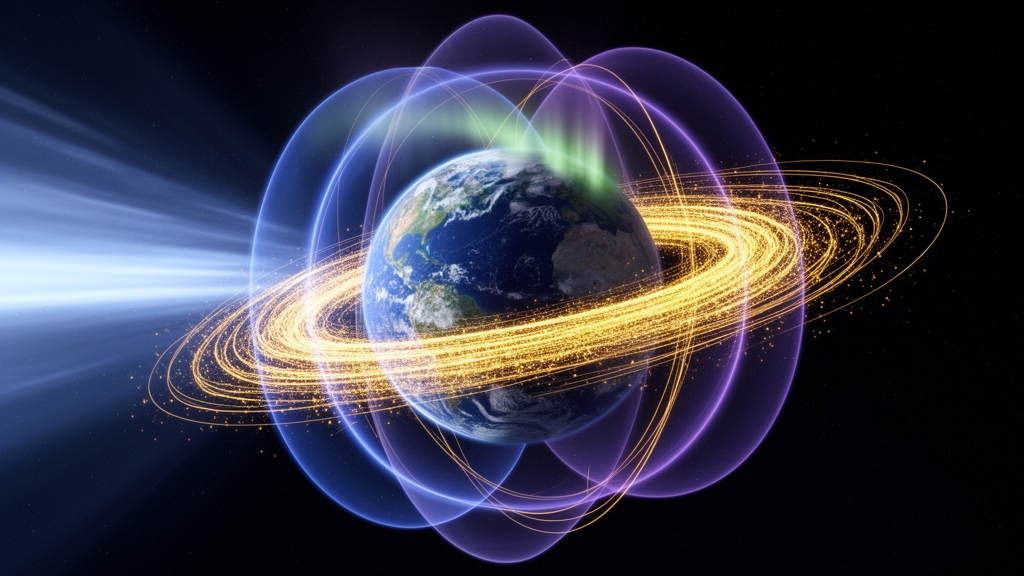
Earth is wrapped in an invisible shield that was long thought to keep the most energetic electrons in the radiation belts from approaching any closer to our planet. In May 2024, that assumption was put to the test. During a geomagnetic superstorm, Japan’s Arase space probe detected a large flux of ultra-relativistic electrons well inside this so-called impenetrable barrier, and new research led by Nagoya University now offers evidence that the particles were accelerated locally rather than sneaking in from the outer radiation belt.
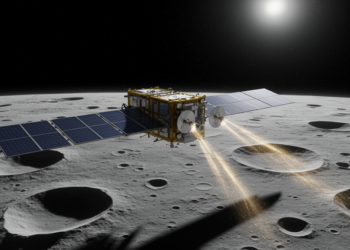
The findings, published in Geophysical Research Letters by a team led by Yoshizumi Miyoshi of the Institute for Space-Earth Environmental Research at Nagoya University, describe an observational study based on data collected by the Arase probe, operated by JAXA, during and after the May 2024 storm.
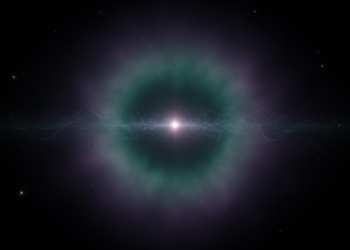
To understand why the observation matters, it helps to know the setting. Earth’s magnetic field traps energetic charged particles, protons and electrons alike, in two donut-shaped regions known as the Van Allen radiation belts. These particles can damage hardware and electronics in spacecraft flying through the belts. At the inner edge of the second belt, roughly 3 Earth-radii from Earth’s center, extremely high-energy electrons appear to hit an invisible wall. First discovered in 2014, the barrier’s source is not completely understood. One candidate is plasmaspheric hiss, low-frequency radio waves in the magnetosphere that produce static noise when played through a speaker. Human-made very-low-frequency transmissions, used to communicate with undersea submarines, may also help shape the boundary by scattering radiation-belt electrons into the atmosphere.
Under typical conditions, this region of space is devoid of extremely fast-moving electrons. But the May 2024 superstorm, unleashed by high solar activity, changed that. Night skies over Hokkaido and as far south as Hyogo prefecture glowed with aurora borealis, and Arase, positioned within the barrier region, recorded a large flux of electrons moving close to the speed of light. Some exceeded three megaelectronvolts, energies high enough to penetrate some satellite shields. The impenetrable barrier, it seemed, had been broken.
A central question was how the electrons got there. “One of the key questions was how these highly energetic electrons appeared inside the barrier,” Miyoshi said. “Were they transported inward from the outer radiation belt, or were they accelerated locally within this region?”
The first clue came from electron phase space density, a quantity describing how electrons are distributed according to their energies and motion. Using measurements from multiple Arase orbits, the researchers examined how phase space density varied with distance from Earth while accounting for changes in the electrons’ motion. They found that a distinct local peak in phase space density developed near the usual barrier boundary and grew stronger over time. A growing local peak is evidence that electrons were gaining energy in place, not merely being transported inward from the outer belt.
The energy source appears to have been chorus waves, natural low-frequency electromagnetic waves that ripple through Earth’s magnetic field. Arase detected intense waves that repeatedly swept upward in frequency. “When converted into audio, it sounds like a bird song,” Miyoshi said. Chorus waves can transfer energy to electrons when their oscillations match the electrons’ spiraling motion around magnetic field lines.
Why were the chorus waves so effective in May 2024? The storm had dramatically eroded Earth’s plasmasphere, a region filled with relatively cool charged particles. Its outer boundary retreated unusually close to Earth, leaving the region around the barrier much less densely populated with plasma. That allowed hotter electrons to reach farther inward and generate chorus waves. Moreover, the depleted plasma did not recover quickly. “Typically, the plasmasphere recovers on a timescale of about two days,” Miyoshi said. “During the May 2024 superstorm, however, it took approximately 4.3 to 4.7 days for the plasma density to recover to more than half of its pre-storm level in the observed region.” This unusually slow recovery allowed low-density plasma conditions to persist for several days, potentially providing favorable conditions for chorus-wave activity and continued acceleration of energetic electrons inside the barrier.
Miyoshi said the findings demonstrate that even regions of near-Earth space previously considered relatively protected from extremely energetic electrons can experience substantial radiation enhancements during severe space weather events. “This discovery highlights the need to understand and predict how energetic electrons behave under extreme space weather conditions,” he said. “Such knowledge is important for assessing radiation risks to spacecraft and improving future space weather predictions.” The results also provide new insights into how Earth’s magnetosphere responds to extreme solar activity, underscoring the importance of continuous observations of the near-Earth space environment.
Subject of Research: Local acceleration of multi-MeV electrons inside Earth's impenetrable barrier during the May 2024 geomagnetic superstorm
Article Title: 2024 solar storm triggered ultra-relativistic electrons inside Earth’s “impenetrable barrier”
Article References: 2024 solar storm triggered ultra-relativistic electrons inside Earth’s “impenetrable barrier”. Original publication (Bibliographic details unavailable.)
Image Credits: AI Generated
DOI: Not provided
Keywords: Van Allen belts, impenetrable barrier, May 2024 superstorm, chorus waves, Arase probe, space weather, plasmasphere, ultra-relativistic electrons, magnetosphere, Nagoya University, radiation belts, geomagnetic storm
Cite Scienmag News
Grant Pearson. (October 29, 2026). May 2024 superstorm accelerated killer electrons inside Earth’s impenetrable barrier. Scienmag. https://scienmag.com/may-2024-superstorm-accelerated-killer-electrons-inside-earths-impenetrable-barrier/
Grant Pearson. "May 2024 superstorm accelerated killer electrons inside Earth’s impenetrable barrier." Scienmag, 29 October 2026, https://scienmag.com/may-2024-superstorm-accelerated-killer-electrons-inside-earths-impenetrable-barrier/. Accessed 29 October 2026.
Grant Pearson. "May 2024 superstorm accelerated killer electrons inside Earth’s impenetrable barrier." Scienmag. October 29, 2026. https://scienmag.com/may-2024-superstorm-accelerated-killer-electrons-inside-earths-impenetrable-barrier/