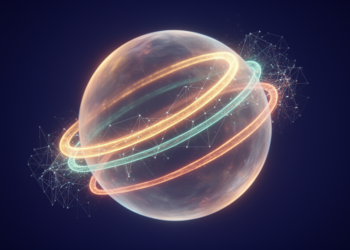
A new theoretical study published in Astrophysics and Space Science compares a family of mathematical models that describe how dynamical plasma structures arise in the Sun. The work, by Sergey N. Artekha and appearing in volume 371 of the journal, lays out a hierarchy of models of increasing complexity, from a minimal ideal-hydrodynamics description to a full magnetohydrodynamic (MHD) treatment, and traces how the resulting flow patterns develop from the first moments of structure generation to their most mature stage.
The starting point of the analysis is the physical mechanism behind structure formation. According to the abstract, two processes are central: the Schwarzschild criterion for convective instability, under which a superadiabatic temperature gradient makes overheated plasma begin to rise, and the presence of excess energy in the form of heat or magnetic fields. In the simplest framework, ideal hydrodynamics, the model applies to the initial stage of generation of plasma structures, and the author constructs rigorous analytical solutions assembled from building blocks. An intermediate, refined model then considers rotating plasma at the growth stage, in which a unidirectional differential rotation emerges.
The most complete model in the comparison solves the full system of Navier-Stokes MHD equations for an axisymmetric plasma. It includes equations for the stream function, the azimuthal velocity component, the density change, the flow function of the poloidal magnetic field, and the azimuthal component of the magnetic field. This full model follows the development of structures in rotating plasma from the very beginning to the highest development stage. The velocity field is adjusted to satisfy boundary conditions, and the velocity components change in a coordinated manner as the structure evolves.
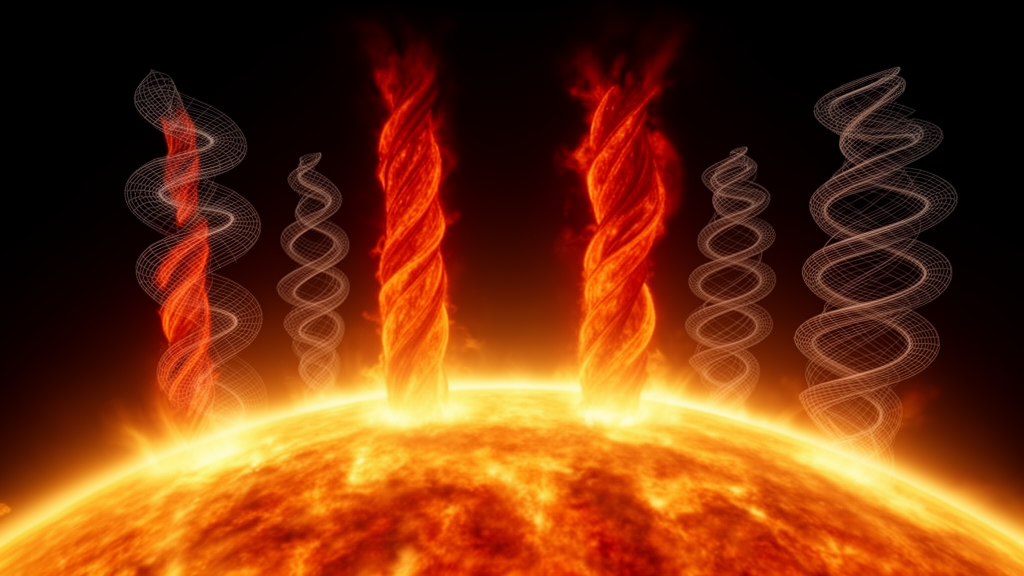
A key result concerns the role of magnetism. The study reports that a stationary axisymmetric ambient magnetic field and its gradients have little effect on the plasma structure and the velocity field in the configurations examined. Despite the differences in complexity among the models, the movement structures they produce are similar: radial flows converge towards the axis at the bottom of the structure, while near the top there is an outflow towards the periphery. The maximum vertical velocity component is reached at the center of the axis, on the symmetry axis of the structure.
The paper also discusses applications of these models to solar structures, including jets. Because the work is a modeling comparison, its findings concern the behavior of the mathematical solutions themselves rather than direct observations of specific solar events. The abstract notes that the models are intended to capture mechanisms of generation of dynamical plasma structures driven by convection and excess thermal or magnetic energy, with the full MHD formulation providing the most complete description of the coupled velocity and magnetic field evolution in rotating plasma.
Subject of Research: Mathematical modeling of dynamical plasma structure generation in the solar atmosphere using ideal hydrodynamic and magnetohydrodynamic frameworks.
Article Title: Comparison of models for dynamical structures of solar plasma
Article References: Artekha, S. N. (2026). Comparison of models for dynamical structures of solar plasma. Astrophysics and Space Science, 371(10), Article 129. https://doi.org/10.1007/s10509-026-04660-7
Image Credits: AI Generated
DOI: 10.1007/s10509-026-04660-7
Keywords: solar plasma, magnetohydrodynamics, Navier-Stokes equations, convective instability, Schwarzschild criterion, differential rotation, plasma structures, solar jets, axisymmetric models, Astrophysics and Space Science, Comparison, models
Cite Scienmag News
Grant Pearson. (October 29, 2026). Models compared for how solar plasma structures grow and rotate. Scienmag. https://scienmag.com/models-compared-for-how-solar-plasma-structures-grow-and-rotate/
Grant Pearson. "Models compared for how solar plasma structures grow and rotate." Scienmag, 29 October 2026, https://scienmag.com/models-compared-for-how-solar-plasma-structures-grow-and-rotate/. Accessed 30 October 2026.
Grant Pearson. "Models compared for how solar plasma structures grow and rotate." Scienmag. October 29, 2026. https://scienmag.com/models-compared-for-how-solar-plasma-structures-grow-and-rotate/