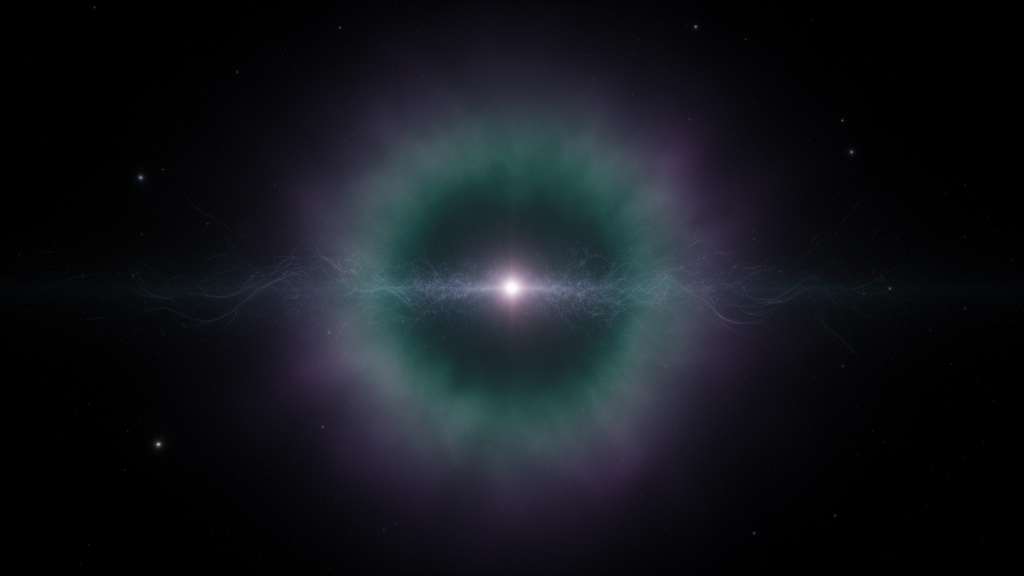
In 2017, the High Altitude Water Cherenkov Observatory reported something unexpected: vast clouds of very-high-energy gamma-ray emission surrounding two nearby, middle-aged pulsars, Geminga and Monogem. The glow, spanning several degrees on the sky and tens of parsecs in physical size, was far larger than the compact X-ray nebulae at the pulsars’ hearts. These structures, now called TeV halos, provided the first clear observational evidence for an extended inverse Compton component produced by electron-positron pairs diffusing away from pulsars, a component whose existence under conditions of suppressed diffusion had been anticipated theoretically decades earlier. A comprehensive new review published in Discover Space by Luiz Augusto Stuani Pereira surveys how this once-anomalous signal has grown into one of the most active fields in high-energy astrophysics.
The emission mechanism is well understood in outline. Pulsars, rapidly rotating and highly magnetized neutron stars, convert rotational kinetic energy into winds of relativistic particles. When electrons and positrons escape the pulsar wind nebula into the surrounding interstellar medium, they scatter ambient photons, chiefly the cosmic microwave background and interstellar infrared light, up to teraelectronvolt energies. The morphology of the resulting halo is governed by a single key quantity: the diffusion coefficient of the medium. Fitting the HAWC surface brightness profiles, the collaboration inferred diffusion coefficients at 100 TeV of roughly 4.5 × 10^27 cm² s⁻¹ for Geminga and 3.2 × 10^27 cm² s⁻¹ for Monogem, values approximately 100 to 1000 times lower than the Galactic average inferred from cosmic-ray secondary-to-primary ratios. This locally suppressed diffusion is the defining, and most debated, characteristic of TeV halos.
Subsequent measurements have sharpened the picture considerably. An improved HAWC analysis using about 2398 days of data above 1 TeV detected Geminga at 20.9 sigma and Monogem at 14.7 sigma, extended the spectral coverage to roughly 1.8 to 75 TeV for Geminga, and revealed quadrant-to-quadrant asymmetries in the inferred diffusion coefficient. Those asymmetries have been interpreted as evidence for anisotropic particle transport, in which the orientation of the local interstellar magnetic field imposes a preferred diffusion direction. If the mean field lies close to the line of sight, slow perpendicular diffusion is projected onto the sky, producing both the apparent suppression and the observed asymmetries. Whether such geometric alignment can explain the halo population as a whole remains contested, since most detected halos show no clear elongation.
The Tibet ASγ experiment has pushed the Geminga halo into the ultra-high-energy domain, detecting it above 100 TeV and measuring its morphology at three energies between roughly 16 and 250 TeV. The inferred diffusion coefficient is about one percent of the Galactic average, with an energy dependence consistent with Kolmogorov magnetohydrodynamic turbulence, allowing the turbulence spectrum to be probed on sub-parsec scales for the first time. Notably, the collaboration concluded that the escaping pairs carry insufficient energy to amplify by themselves the strong turbulence required to suppress diffusion, a result that challenges self-generated turbulence scenarios. Meanwhile, evidence for a degree-scale GeV halo around Geminga in Fermi-LAT data remains tentative, with its significance depending strongly on the interstellar emission model and analysis setup.
The census of halos is expanding rapidly. LHAASO’s first catalog reports 90 gamma-ray sources, 43 of which exhibit statistically significant emission above 100 TeV, and approximately half of these ultra-high-energy sources are spatially coincident with known pulsars. Candidates such as LHAASO J0621+3755 around the middle-aged pulsar PSR J0622+3749 show hard spectra and a striking absence of bright GeV emission, features that favor the halo interpretation over a conventional pulsar wind nebula. HAWC stacking analyses of middle-aged pulsars detect a statistically significant average halo signal, suggesting that TeV halos may be a common outcome of pulsar evolution rather than a peculiarity of a few exceptional sources. For millisecond pulsars, however, the picture is unsettled: one stacked analysis reported evidence for TeV emission, while a dedicated HAWC study found no evidence, leaving the existence of millisecond-pulsar halos an open question.
Theoretically, halo formation is tied to the late evolution of pulsar wind nebulae inside their supernova remnants. In the standard sequence, a young nebula confined within expanding ejecta is crushed by the reverse shock, and the middle-aged pulsar, moving with natal kick velocities of 100 to 500 kilometers per second, escapes to form a bow-shock nebula while escaped pairs diffuse freely into the interstellar medium. The widely used two-zone diffusion model divides this environment into an inner slow-diffusion zone of radius roughly 30 to 100 parsecs and an outer region with standard Galactic diffusion. Combining HAWC and Fermi-LAT data constrains Geminga’s slow zone to about 30 to 70 parsecs. Crucially, the slow zone delays but does not prevent the escape of positrons, which matters for one of the field’s central puzzles: the cosmic-ray positron excess.
Since PAMELA first reported a rising positron fraction above about 10 GeV, confirmed by Fermi-LAT, AMS-02, and DAMPE, pulsars have been leading candidates for the source of the extra positrons. TeV halos robustly demonstrate that pulsars do release high-energy pairs into their surroundings, supporting the basic premise of the pulsar explanation. The review, however, is careful to distinguish robust evidence from model-dependent inference: the quantitative contribution of individual pulsars depends on the slow-zone size, the energy dependence of diffusion, injection timing, and magnetic-field geometry, and direct GeV constraints on Geminga remain limited. The contribution of individual nearby pulsars should therefore be regarded as an open question.
The review also critically examines whether hadrons, protons and nuclei accelerated by pulsars, contribute to halo emission. For the prototypical middle-aged halo pulsars, whose spin-down luminosities are a few times 10^34 erg per second, the available potential drop limits present-day proton energies to a few hundred teraelectronvolts, so any pion-decay gamma rays would not exceed roughly 30 TeV. Energetic arguments compound the problem: because the diffusion coefficient rises with energy, PeV protons escape the slow-diffusion zone within thousands of years, and the resulting hadronic luminosity falls three to four orders of magnitude below the inverse Compton luminosity of the Geminga halo. PeV proton acceleration remains plausible mainly in young, energetic nebulae such as the Crab, and neutrino searches with IceCube have found no significant excess from TeV-bright pulsar wind nebulae. A hard spectral feature at ultra-high energies, the review stresses, is neither a necessary nor a sufficient signature of hadronic emission, since a second leptonic population can mimic it.
The next decade promises decisive tests. The Cherenkov Telescope Array Observatory, with angular resolution reaching about 0.02 degrees at the highest energies and a low-energy threshold near 20 GeV, will resolve halo substructure, measure energy-dependent morphology, and bridge the spectral gap between Fermi-LAT and current atmospheric Cherenkov telescopes. Population studies predict its Galactic Plane Survey will detect around 170 pulsar wind nebulae and up to 100 pulsar halos, nearly an order of magnitude more than currently accessible, enabling the first systematic test of whether slow diffusion is universal. The Southern Wide-field Gamma-ray Observatory, planned for the high Andes, will for the first time provide wide-field coverage of the inner Galaxy, where the densest concentration of energetic pulsars resides, with sensitivity above 50 TeV approaching or exceeding LHAASO’s. Together with next-generation neutrino telescopes, which could test hadronic interpretations of the brightest ultra-high-energy pulsar-associated sources, these instruments aim to answer the questions the first decade of TeV halo science has posed: what physically suppresses diffusion around pulsars, how universal the phenomenon is, and what role pulsars ultimately play in the cosmic-ray positron excess measured at Earth.
Subject of Research: TeV halos around pulsars and the prospects for next-generation gamma-ray observatories
Article Title: TeV halos around pulsars and prospects for next generation gamma ray observatories
Article References: Pereira, L. A. S. (2026). TeV halos around pulsars and prospects for next generation gamma ray observatories. Discover Space, 130(1), Article 20. https://doi.org/10.1007/s11038-026-09602-5
Image Credits: AI Generated
DOI: 10.1007/s11038-026-09602-5
Keywords: TeV halos, pulsars, gamma-ray astronomy, cosmic rays, HAWC, LHAASO, CTAO, SWGO, inverse Compton, diffusion, positron excess, neutrinos
Cite Scienmag News
Grant Pearson. (October 29, 2026). Suppressed Cosmic Diffusion Around Pulsars Revealed by TeV Halos. Scienmag. https://scienmag.com/suppressed-cosmic-diffusion-around-pulsars-revealed-by-tev-halos/
Grant Pearson. "Suppressed Cosmic Diffusion Around Pulsars Revealed by TeV Halos." Scienmag, 29 October 2026, https://scienmag.com/suppressed-cosmic-diffusion-around-pulsars-revealed-by-tev-halos/. Accessed 30 October 2026.
Grant Pearson. "Suppressed Cosmic Diffusion Around Pulsars Revealed by TeV Halos." Scienmag. October 29, 2026. https://scienmag.com/suppressed-cosmic-diffusion-around-pulsars-revealed-by-tev-halos/