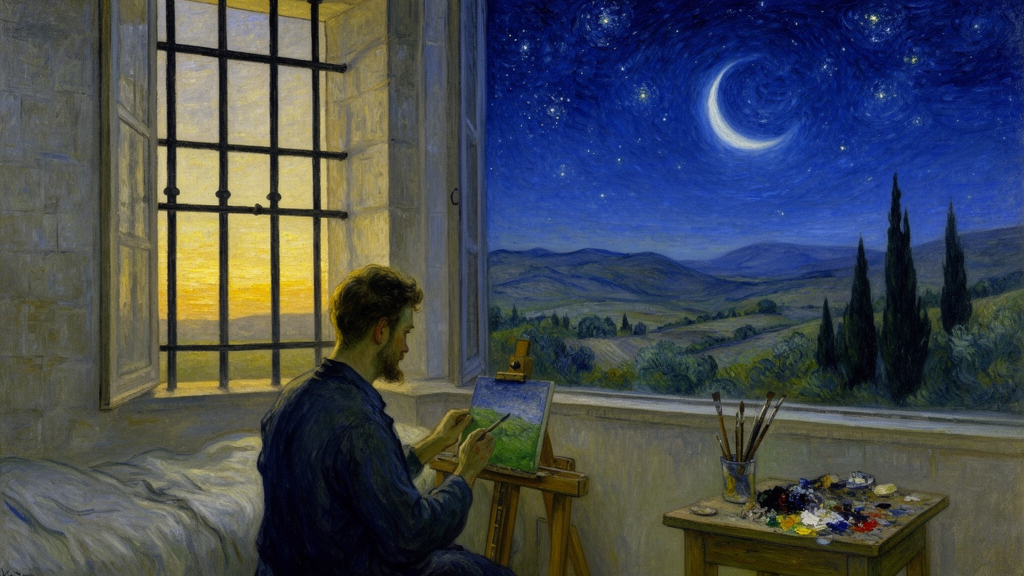
Vincent van Gogh’s The Starry Night, one of the most analysed paintings in the history of art, may record a real pre-dawn sky rather than a purely imagined one. A new study published in Scientific Reports, a Nature Portfolio journal, finds that the arrangement of stars and the Moon in the 1889 canvas matches, in both observation and shape, the sky over Saint-Rémy-de-Provence around 22 July 1889. In the early hours of that period, a waning crescent moon, the planet Venus and the Hyades star cluster in Taurus appeared close together within the painter’s field of view. The research, described by its authors as the first astronomical re-examination of the painting in roughly 40 years, was carried out jointly by SLLAB, a South Korean space-science company, and the School of Space Research at Kyung Hee University.
The question of whether The Starry Night depicts an actual sky is not new. Astronomical readings of the painting began with Albert Boime at the University of California, Los Angeles, in 1984 and Charles Whitney at Harvard in 1986. Because the two scholars reached conflicting conclusions, however, neither interpretation displaced the prevailing religious and symbolic readings of the work. In the roughly four decades since those early studies, no investigation had treated the painting’s sky with observational geometry, according to the team behind the new paper. That gap is what the Korean group set out to close, combining on-site fieldwork in France with quantitative analysis of the positions of the stars painted on the canvas.
The study was led by first author Elijah Jeong-hyun Kim, chief executive officer of SLLAB and a doctoral candidate at Kyung Hee University’s School of Space Research. Kim describes a long familiarity with the night sky as the starting point of the project. “To an observational astronomer, the cluster of stars in The Starry Night is the Hyades in Taurus. But the moment I read the earlier studies explaining it as Aries, I heard the painting calling to me,” Kim said. Having built many telescopes and spent years observing the night sky, the team judged the constellation Aries, proposed in earlier interpretations, an unlikely source of inspiration for the painter. The research began with two field trips to France in 2019 and builds on Kim’s popular-science book published in 2025, gathering additional evidence and extending it with quantitative data.
A central issue in Van Gogh scholarship is the dating of the painting. The canvas has conventionally been dated from a letter the artist wrote to his brother Theo around 18 June 1889. But the team points to a problem with that date: the waning gibbous moon of that period cannot account for the slender crescent depicted in the painting. Around 22 July, by contrast, the Hyades rose in the east alongside Venus, and the Moon’s shape was close to the crescent on the canvas. In other words, the celestial configuration painted by Van Gogh fits the sky of late July far better than the sky of mid-June, when the letter was written.
That proposed late-July date, however, collides with a long-standing assumption in Van Gogh biography: the period around 22 July has generally been believed to fall within one of the painter’s seizures, raising the question of whether he could have been observing the sky at all. By cross-analysing the original French and Dutch letters, contemporary weather records and the letters’ remarks on cicadas, the team proposes that the seizure actually began later, in late July. This re-dating, if accepted by art historians, would place the possible period of observation and the astronomical evidence in the same window, offering a possible resolution to an apparent contradiction between the written record and the painted sky.
The observational case rests on geometric comparison. In Arles, the team verified the painter’s field of view in Starry Night over the Rhône (1888) with photographs taken on site. In Saint-Rémy, they located the spot from which Van Gogh drew the landscape beneath The Starry Night and reconstructed his view from that vantage point. Procrustes shape analysis, a statistical method for comparing the shapes of sets of points after allowing for rotation, scaling and translation, then confirmed the correspondence between the five central stars of The Starry Night and the Hyades cluster. The match was even closer in the pen drawing Van Gogh made after the painting. According to the authors, these results suggest that the sky in the painting was grounded in actual observation rather than pure imagination.
The same analytical method was extended to another well-known canvas. Using the identical approach, the team proposes that the stars in Café Terrace at Night (1888), painted during Van Gogh’s Arles period, may correspond to the Summer Triangle, a prominent asterism formed by bright stars in three summer constellations. If the identification holds, it would extend the argument from a single late painting to a broader pattern in which the artist incorporated real celestial configurations into works often regarded as expressive or symbolic compositions. The team frames both results as proposals grounded in quantitative comparison rather than as definitive attributions.
Kim hopes the work will stimulate a broader re-examination of the Saint-Rémy period. “I hope this work prompts a renewed, multidisciplinary look at the sequence and working methods of the Saint-Rémy paintings, and at Van Gogh’s movements that summer,” Kim said. “Our conversation with Van Gogh’s other skies is still ongoing. We plan to tell those stories one by one.” The study, titled “The actual sky of Van Gogh’s Starry Night: a multidisciplinary reconstruction”, is authored by Elijah Jeong-hyun Kim, Suna Kang, Jungwoo Song and Ho Jin, and the team has released its code and data publicly through a GitHub repository and the Zenodo research data platform, allowing independent researchers to examine the analysis.
The institutional background of the research is notable. SLLAB, founded in 2000, is a South Korean company that designs and builds robotic telescopes of up to 2.0 metres in aperture, equipped with precision tracking solutions for astronomical and satellite observation, and it operates its own manufacturing plant, test facilities and research institute. The School of Space Research at Kyung Hee University conducts education and research across space exploration science, including space payload development, space weather theory and modelling, satellite observation data analysis, and space exploration and mission design. The collaboration between a commercial space company and an academic space research school is an unusual provenance for a contribution to Van Gogh studies, and the authors’ declared competing interests reflect that structure: Kim is the founder and chief executive of SLLAB, while Kang and Song serve respectively as a director and a manager of the company, which may pursue commercial activities derived from this work, including publications, educational programs, exhibitions and media productions. Co-author Ho Jin declared no competing interests.
Whether the astronomical case persuades art historians remains to be seen, but the study offers a concrete, testable claim: that the five central stars of The Starry Night align with the Hyades in Taurus, that the crescent Moon and Venus fit the pre-dawn sky of around 22 July 1889, and that the conventional June dating derived from the letter to Theo cannot reproduce the Moon’s slender crescent. The paper is classified by the journal as data and statistical analysis, and its conclusions rest on the combination of on-site reconstruction, letter analysis, weather records and shape analysis rather than on any single line of evidence. For a painting that has been read for more than a century primarily through symbolism and religious interpretation, the study reopens a question first posed in the 1980s and left unresolved: not what The Starry Night means, but what, precisely, Van Gogh saw.
Subject of Research: Astronomical reconstruction of the sky depicted in Van Gogh's painting The Starry Night
Article Title: The sky in Van Gogh’s The Starry Night matches the pre-dawn sky of around July 22, 1889
Article References: The sky in Van Gogh’s The Starry Night matches the pre-dawn sky of around July 22, 1889. Original publication (Bibliographic details unavailable.)
Image Credits: AI Generated
DOI: Not provided
Keywords: Van Gogh, The Starry Night, astronomy, Hyades, Venus, Saint-Rémy, Scientific Reports, Procrustes analysis, art history, Moon, 1889, Kyung Hee University
Cite Scienmag News
Grant Pearson. (October 28, 2026). Astronomers match Van Gogh’s Starry Night sky to July 1889 dawn. Scienmag. https://scienmag.com/astronomers-match-van-goghs-starry-night-sky-to-july-1889-dawn/
Grant Pearson. "Astronomers match Van Gogh’s Starry Night sky to July 1889 dawn." Scienmag, 28 October 2026, https://scienmag.com/astronomers-match-van-goghs-starry-night-sky-to-july-1889-dawn/. Accessed 29 October 2026.
Grant Pearson. "Astronomers match Van Gogh’s Starry Night sky to July 1889 dawn." Scienmag. October 28, 2026. https://scienmag.com/astronomers-match-van-goghs-starry-night-sky-to-july-1889-dawn/