Thursday, October 29, 2026
Science
No Result
View All Result
  • Login
  • HOME
  • SCIENCE NEWS
  • CONTACT US
  • HOME
  • SCIENCE NEWS
  • CONTACT US
No Result
View All Result
Scienmag
No Result
View All Result
Home Science News Space

New Framework Brings Linearized Gravity Into Factorization Algebras

October 28, 2026
in Space
Grant Pearson
By Grant Pearson Scienmag Editorial Profile - Observational Astronomy
Reading Time: 2 mins read
0
New Framework Brings Linearized Gravity Into Factorization Algebras

New Framework Brings Linearized Gravity Into Factorization Algebras

65
SHARES
587
VIEWS
Share on FacebookShare on Twitter
ADVERTISEMENT

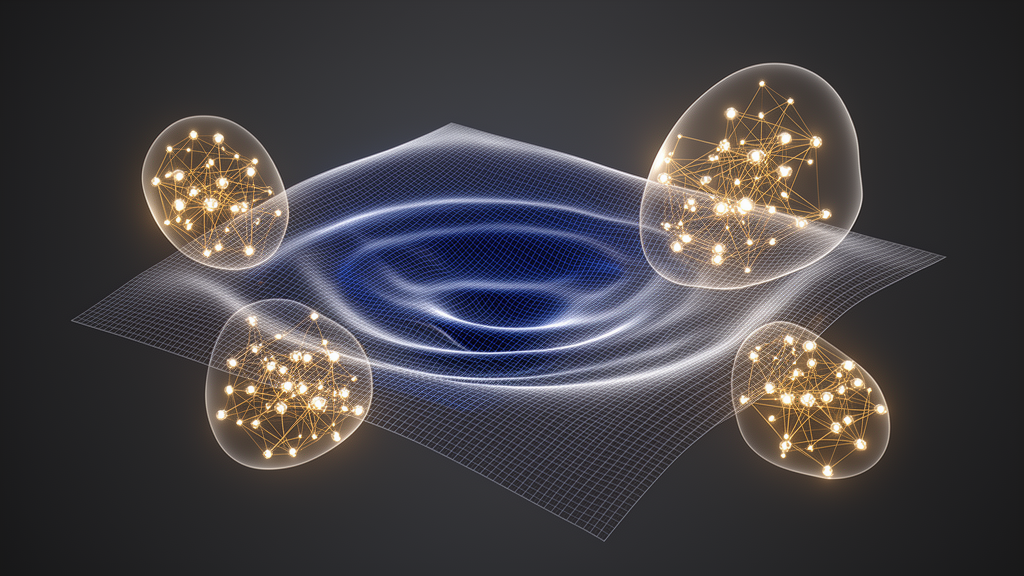
A new paper published in General Relativity and Gravitation sets out to connect gravitational theory with factorization algebras, a fast-developing mathematical framework for organizing the observables of quantum field theories. The work, authored by Filip Dul, appears as volume 58, article number 123, and was published on 21 October 2026.

The central contribution is a translation of the causal structure of Lorentzian manifolds into categorical language. In the globally hyperbolic case, the author identifies a convenient equivalence of coverages, providing structural groundwork for treating spacetime regions algebraically.

The paper then shows that both perturbative general relativity and perturbative conformal gravity can be formulated as Batalin-Vilkovisky classical field theories. Establishing these gravitational theories within the Batalin-Vilkovisky framework places them on footing compatible with the factorization algebra approach.

The main result concerns linearized general relativity. The author demonstrates that the observables of this theory define a factorization algebra with particularly nice properties on the category of Ricci flat globally hyperbolic manifolds. This restricts attention to spacetimes that are both globally hyperbolic and Ricci flat.

Beyond the core construction, the paper presents several conjectures that arise in specific cases. These conjectures are primarily motivated by the study of black hole entropy interpreted as a conserved Noether charge, linking the algebraic framework to one of the central open problems in gravitational physics. The paper opens with an epigraph from Herman Melville's Moby-Dick, and the abstract frames the work as a step toward bringing gravitational theories into the factorization algebra framework rather than a complete treatment.

Subject of Research: Factorization algebras for perturbative and linearized gravity on globally hyperbolic manifolds

Article Title: Factorization algebras for linearized gravity

Article References: Dul, F. (2026). Factorization algebras for linearized gravity. General Relativity and Gravitation, 58(10), Article 123. https://doi.org/10.1007/s10714-026-03622-2

Image Credits: AI Generated

DOI: 10.1007/s10714-026-03622-2

Keywords: factorization algebras, linearized gravity, general relativity, conformal gravity, Batalin-Vilkovisky formalism, globally hyperbolic manifolds, Ricci flat spacetimes, Lorentzian causal structure, black hole entropy, Noether charge, mathematical physics, quantum field theory

Cite Scienmag News

Grant Pearson. (October 28, 2026). New Framework Brings Linearized Gravity Into Factorization Algebras. Scienmag. https://scienmag.com/new-framework-brings-linearized-gravity-into-factorization-algebras/

Grant Pearson. "New Framework Brings Linearized Gravity Into Factorization Algebras." Scienmag, 28 October 2026, https://scienmag.com/new-framework-brings-linearized-gravity-into-factorization-algebras/. Accessed 29 October 2026.

Grant Pearson. "New Framework Brings Linearized Gravity Into Factorization Algebras." Scienmag. October 28, 2026. https://scienmag.com/new-framework-brings-linearized-gravity-into-factorization-algebras/

Tags: algebraic treatment of spacetime regionsBatalin-Vilkovisky formalismBatalin-Vilkovisky formalism in gravityblack hole entropyblack hole entropy and Noether chargecategorical translation of spacetime structuresconformal gravityfactorization algebra approach to quantum field theoriesfactorization algebrasgeneral relativityglobally hyperbolic manifoldsgravitational factorization algebraslinearized general relativitylinearized gravityLorentzian causal structureLorentzian manifolds causal structuremathematical frameworks for quantum gravitymathematical physicsNoether chargeobservables in quantum gravityperturbative general relativity and conformal gravityquantum field theoryRicci flat globally hyperbolic manifoldsRicci flat spacetimes
Share26Tweet16
Previous Post

Maize Genotype and Nitrogen Rate Steer Soil Nitrification Differently

Next Post

New Clamp Method Measures Direct Tensile Strength in Short Rock Cores

Related Posts

Quantum-Corrected Black Holes Reshape Orbits and Oscillation Frequencies in New Theoretical Study
Space

Quantum-Corrected Black Holes Reshape Orbits and Oscillation Frequencies in New Theoretical Study

October 29, 2026
Seafloor Seismometers Trace 2024 Japan Quake to a Curved Hidden Fault
Space

Seafloor Seismometers Trace 2024 Japan Quake to a Curved Hidden Fault

October 29, 2026
S2’s Long Orbit Around the Milky Way’s Black Hole Framed as Primary-Centric
Space

S2’s Long Orbit Around the Milky Way’s Black Hole Framed as Primary-Centric

October 29, 2026
New time-domain method reads Earth’s mantle from gapped observatory records
Space

New time-domain method reads Earth’s mantle from gapped observatory records

October 29, 2026
Exact Wave Solutions Reveal How Streaming Dust Shapes Solitons in Collisional Plasmas
Space

Exact Wave Solutions Reveal How Streaming Dust Shapes Solitons in Collisional Plasmas

October 29, 2026
Black Hole Page Curve Emerges From Limited Information Flow, Model Shows
Space

Black Hole Page Curve Emerges From Limited Information Flow, Model Shows

October 29, 2026
Next Post
New Clamp Method Measures Direct Tensile Strength in Short Rock Cores

New Clamp Method Measures Direct Tensile Strength in Short Rock Cores

  • Mothers who receive childcare support from maternal grandparents show more optimized

    Mothers who receive childcare support from maternal grandparents show more parental warmth, finds NTU Singapore study

    27656 shares
    Share 11059 Tweet 6912
  • University of Seville Breaks 120-Year-Old Mystery, Revises a Key Einstein Concept

    1061 shares
    Share 424 Tweet 265
  • Bee body mass, pathogens and local climate influence heat tolerance

    682 shares
    Share 273 Tweet 171
  • Researchers record first-ever images and data of a shark experiencing a boat strike

    546 shares
    Share 218 Tweet 137
  • Groundbreaking Clinical Trial Reveals Lubiprostone Enhances Kidney Function

    531 shares
    Share 212 Tweet 133
Science

Embark on a thrilling journey of discovery with Scienmag.com—your ultimate source for cutting-edge breakthroughs. Immerse yourself in a world where curiosity knows no limits and tomorrow’s possibilities become today’s reality!

RECENT NEWS

  • New Standard Sets Unified Rules for Growing Breast Cancer Organoids
  • Next-generation KRAS inhibitor divarasib extends survival in advanced lung cancer
  • Planned Systematic Review to Assess Biodegradable Polymer Foams for Heavy Metal Removal
  • Springtail Hox Protein Reveals Evolutionary Middle Ground in Losing Abdominal Limbs

Categories

  • Agriculture
  • Anthropology
  • Archaeology
  • Athmospheric
  • Biology
  • Biotechnology
  • Blog
  • Bussines
  • Cancer
  • Chemistry
  • Climate
  • Earth Science
  • Editorial Policy
  • Marine
  • Mathematics
  • Medicine
  • Pediatry
  • Policy
  • Psychology & Psychiatry
  • Science Education
  • Science News
  • Social Science
  • Space
  • Technology and Engineering

Subscribe to Blog via Email

Enter your email address to subscribe to this blog and receive notifications of new posts by email.

Join 5,150 other subscribers

© 2025 Scienmag - Science Magazine

Welcome Back!

Login to your account below

Forgotten Password?

Retrieve your password

Please enter your username or email address to reset your password.

Log In
No Result
View All Result
  • HOME
  • SCIENCE NEWS
  • CONTACT US

© 2025 Scienmag - Science Magazine

Discover more from Science

Subscribe now to keep reading and get access to the full archive.

Continue reading