


Interstellar Grain Chemistry Model Uses Absorbing Markov Chains to Track Surface Reactions
Astrophysicists at the University of Liège have developed DESTINY, an astrochemical model using absorbing Markov chains to track chemical reactions ...
Astrophysicists at the University of Liège have developed DESTINY, an astrochemical model using absorbing Markov chains to track chemical reactions ...

Astronomers analyzing James Webb Space Telescope data have identified CW-LRD-z10, the most distant candidate Little Red Dot observed to date.

The European Space Agency's Euclid space telescope has detected the most distant quasar known to date, powered by a 360-million-solar-mass ...

Radiation-hydrodynamic cosmological simulations show that heavy black hole seeds naturally form in early protoclusters, explaining both overmassive black holes and ...
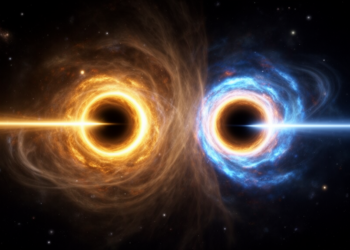
Astronomers using the James Webb Space Telescope and Gemini North have discovered Nāpōwawāʻenakaulua, the oldest and most compact quasar pair ...

New research suggests that ultraviolet light may have cleared gas and dust in early galaxies, allowing them to appear brighter ...

New simulations show that Lyman-alpha radiation from young stars can blast gas and dust out of early galaxies, clearing the ...
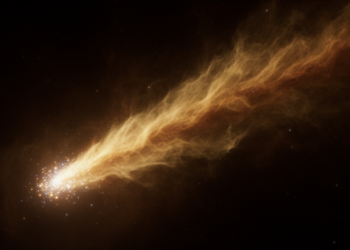
Hubble has captured the mysterious Cat's Tail dust cloud around Beta Pictoris in visible light for the first time, revealing ...
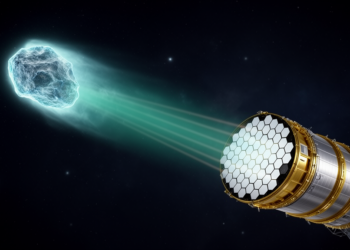
JWST spectra of interstellar object 3I/ATLAS reveal a methane D/H ratio of (3.18 ± 0.30)%, the highest measured in any ...
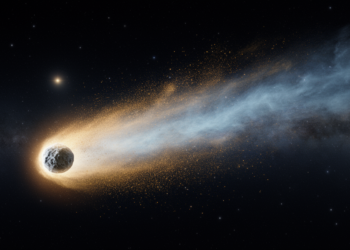
JWST observations of interstellar comet 3I/ATLAS reveal micron-sized, dust-rich water ice grains whose spectra resemble icy bodies beyond Neptune, suggesting ...


Embark on a thrilling journey of discovery with Scienmag.com—your ultimate source for cutting-edge breakthroughs. Immerse yourself in a world where curiosity knows no limits and tomorrow’s possibilities become today’s reality!