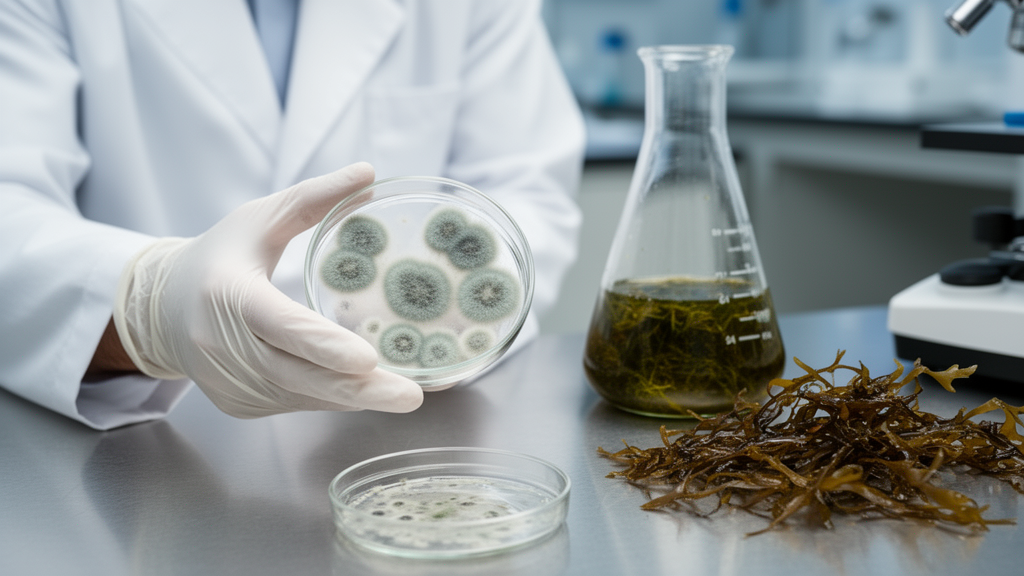
Hydroalcoholic extracts made from plant waste materials and a common green seaweed can inhibit the growth of Aspergillus flavus in laboratory tests, with an extract from the seaweed Ulva proving the most potent, according to an in vitro study published in Scientific Reports. The fungus is a major agricultural concern because it contaminates cereals, particularly maize, with mycotoxins, and the researchers frame their work as a step toward environmentally friendly crop protection strategies at a time when climate change is expected to intensify the problem. The team tested four extracts: leaves of the tree Ailanthus altissima, trub from hop (Humulus lupulus) processing, olive (Olea europaea) leaves, and the thallus of Ulva sp., a green macroalga.
All of these are waste or low-value biomass streams, which is central to the study’s sustainability argument: rather than synthesizing new antifungal molecules, the approach repurposes residues that agriculture and food processing already generate. When the extracts were applied to A. flavus cultures in vitro, three of the four suppressed fungal growth. The olive leaf extract was the exception and did not inhibit the fungus under the tested conditions.
The Ulva extract showed the highest efficacy, with an EC50 of 14.2 milligrams per milliliter, meaning that concentration was required to halve the measured fungal response in the assay. To understand why the seaweed outperformed the plant extracts, the researchers quantified total phenolic content (TPC) and total flavonoid content (TFC) in each extract. The results were counterintuitive.
The Ulva extract had a total phenolic content of 3.80 micrograms of gallic acid equivalents per milligram of dry weight, nearly three times lower than the roughly 11 micrograms GAE per milligram measured for both the hop trub and the Ailanthus leaf extracts. Despite this lower phenolic load, the seaweed extract was the most effective at stopping fungal growth, indicating that total phenolic content alone does not predict antifungal performance. Chemical profiling suggested the answer lies in the specific composition rather than the bulk quantity of phenolics.
The plant-derived extracts were enriched in glycosylated flavonols, whereas the Ulva extract contained characteristic phenolic compounds including rosmarinic acid and p-hydroxybenzoic acid, alongside a dominant polysaccharide fraction. That polysaccharide fraction was examined with nuclear magnetic resonance spectroscopy. Proton and carbon-13 NMR analysis confirmed the presence of sulfated ulvans, the signature sulfated polysaccharides of Ulva, identified through their characteristic building blocks: rhamnose, xylose, and uronic acid units.
The authors attribute the superior antifungal activity of the seaweed extract to this unique chemical makeup, combining specific phenolics with sulfated polysaccharides. The study also measured the germination of A. flavus conidia, the fungal spores that initiate contamination, alongside mycelial growth, giving a two-stage picture of fungal development under extract treatment in the laboratory.
The study is strictly an in vitro investigation. The assays measured fungal growth and conidia germination under controlled laboratory conditions, not disease control on plants in the field or on harvested grain in storage. The authors describe the findings as highlighting the potential of plant residues and seaweed biomass as sustainable sources of antifungal compounds, and they position Ulva extracts as promising candidates for developing eco-friendly strategies against A. flavus infections, supporting greener crop protection and possible future applications in agricultural and post-harvest systems.
Whether Ulva-based formulations can deliver comparable protection outside the petri dish remains a question for future field and post-harvest trials, but the chemical lead identified here, sulfated ulvans paired with specific phenolic acids, gives researchers a concrete starting point for designing bio-based antifungal treatments from renewable biomass.
Subject of Research: In vitro antifungal activity of plant waste and seaweed extracts against Aspergillus flavus
Article Title: In vitro antifungal effect of plant-based and Ulva sp. extracts on Aspergillus flavus growth and conidia germination
Article References: Boscarol, G., Di Francesco, A., Braidot, E., Vuerich, M., Boscutti, F., Volpe, V., Fabro, M., Vrhovšek, U., Moret, E., Ballico, M., & Petrussa, E. (2026). In vitro antifungal effect of plant-based and Ulva sp. extracts on Aspergillus flavus growth and conidia germination. Scientific Reports. https://doi.org/10.1038/s41598-026-77811-z
Image Credits: AI Generated
DOI: 10.1038/s41598-026-77811-z
Keywords: Aspergillus flavus, Ulva, antifungal, mycotoxins, sulfated ulvans, phenolics, maize, food safety, plant waste, seaweed, crop protection, NMR
Cite Scienmag News
Roger Howard. (October 27, 2026). Seaweed Extract Shows Strongest Lab Activity Against Mycotoxin-Producing Fungus. Scienmag. https://scienmag.com/seaweed-extract-shows-strongest-lab-activity-against-mycotoxin-producing-fungus/
Roger Howard. "Seaweed Extract Shows Strongest Lab Activity Against Mycotoxin-Producing Fungus." Scienmag, 27 October 2026, https://scienmag.com/seaweed-extract-shows-strongest-lab-activity-against-mycotoxin-producing-fungus/. Accessed 28 October 2026.
Roger Howard. "Seaweed Extract Shows Strongest Lab Activity Against Mycotoxin-Producing Fungus." Scienmag. October 27, 2026. https://scienmag.com/seaweed-extract-shows-strongest-lab-activity-against-mycotoxin-producing-fungus/