


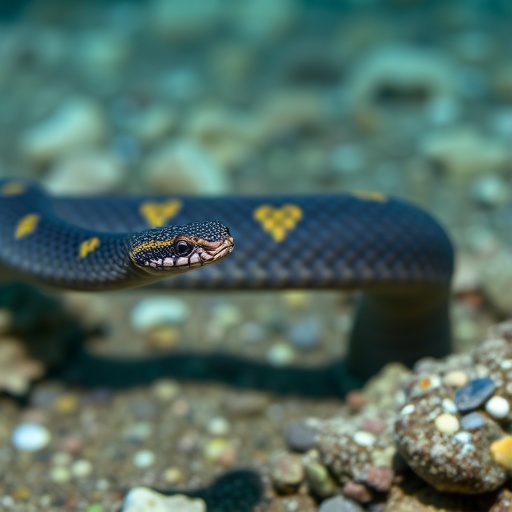
In a groundbreaking exploration into the enigmatic lives of sea snakes, researchers have provided the first detailed analysis of the fine-scale diving behavior of two coastal sea snake species, revealing previously unseen patterns and intriguing adaptive mechanisms. This study, led by University of Adelaide PhD candidate Shannon Coppersmith, sheds light on the sophisticated underwater navigation strategies that enable these reptiles to thrive in their challenging benthic habitats.
Sea snakes are remarkable marine reptiles that spend their entire lives submerged, yet, like all air-breathing vertebrates, they must regularly surface to breathe. This necessity imposes a unique challenge for benthic foragers such as Hydrophis stokesii and Hydrophis major, who hunt and feed along the seafloor. The research uncovers how these species negotiate the spatial separation between their food sources on the ocean floor and their need to breathe at the surface, providing profound insights into their survival strategies.
The study employed advanced acoustic telemetry to capture three-dimensional movement data from wild individuals in two distinct geographic locations: Exmouth Gulf, Western Australia, and Baie des Citrons, New Caledonia. This approach allowed the team to meticulously reconstruct dive profiles and track the underwater trajectories of these elusive snakes in unprecedented detail, revealing complex dive shapes that correspond to distinct behavioral states.
Analysis of the dive patterns indicates that the snakes execute two primary types of dives: U-shaped and S-shaped. U-shaped dives are characterized by the snake descending to the seafloor and remaining there for extended periods, presumably engaged in foraging or resting activities. Conversely, S-shaped dives encompass shorter seafloor intervals followed by a prolonged, gradual ascent marked by multiple stages, producing a characteristic undulating waveform when graphed as time versus depth.
Previously, S-shaped ascents had only been documented in the yellow-bellied sea snake (Hydrophis platurus), an offshore, pelagic species renowned for surface foraging. The discovery that coastal benthic species like H. stokesii and H. major also perform these dives challenges existing paradigms and suggests a broader functional significance of this behavior across sea snake lineages with disparate ecological niches.
The complex ascent phase observed in the S-shaped dives may reflect an adaptive response to environmental factors such as thermoclines or subsurface hydrodynamics. Coppersmith hypothesizes that traveling approximately six meters above the seabed during ascent confers several advantages: it potentially allows the snakes to exploit favorable thermal conditions, avoid physical obstacles posed by patchy benthic habitats or reef structures, and capitalize on neutral buoyancy to conserve energy through passive gliding.
One of the most fascinating findings is the detection of a distinctive “wiggle” performed by Hydrophis stokesii during underwater travel. This oscillatory movement, detected within dive profiles, may serve multiple physiological or ecological functions. The wiggle could be instrumental in fine-tuning buoyancy control, thereby facilitating energy-efficient locomotion. Alternatively, it may enhance prey detection or capture efficacy through subtle hydrodynamic variations, though further experimental investigation is required to elucidate these possibilities.
The methodology hinged on the deployment of acoustic telemetry arrays designed to triangulate precise spatial positions over time, enabling reconstruction of each snake’s trajectory in three dimensions. This method marks a significant advance over previous studies reliant on surface observations or indirect measures, opening new pathways for understanding the behavioral ecology of cryptic and venomous sea snakes.
Understanding these diving strategies is critically important for conservation biology. Sea snakes face myriad threats, including habitat degradation, climate change, and fisheries bycatch, but their elusive nature has limited ecological knowledge necessary for effective management. By elucidating species-specific movement patterns and habitat use, this work provides essential baseline data to inform conservation policies and mitigate anthropogenic impacts.
The discovery of U-shaped and S-shaped dives in coastal sea snakes, accompanied by oscillatory wiggles, not only deepens our understanding of sea snake physiology and behavior but also underscores the complexity of marine reptile adaptation. These findings prompt intriguing questions regarding the evolutionary drivers behind such dive strategies and whether similar patterns exist in other sea snake taxa or marine diving animals.
Coppersmith emphasizes the need for ongoing research to verify the functional hypotheses proposed, particularly concerning the role of wiggle movements and ascent behaviors in navigation, prey acquisition, or energy economy. The study sets a new frontier in sea snake ecology, bridging technological innovation with behavioral science to unravel the underwater lives of these enigmatic reptiles.
Through this pioneering research, the scientific community gains a more nuanced portrait of benthic foraging sea snakes, which may hold keys to understanding marine ecosystem dynamics and resilience. The interplay between diving behavior, environmental variables, and physiological constraints offers fertile ground for interdisciplinary investigation spanning marine biology, physiology, and conservation science.
As sea snake populations face increasing environmental pressures, detailed behavioral data like that provided by Coppersmith and colleagues are indispensable. These insights not only enhance biological knowledge but also provide essential tools for predicting species responses to changing oceanic conditions, ultimately supporting global biodiversity preservation efforts.
News Publication Date: Not explicitly provided.
Web References:
References:
- Original study published in Movement Ecology.
- Australian Institute of Marine Science
Cite Scienmag News
Gavin Prescott. (October 27, 2025). Sea snakes wiggle to forage along the seafloor, new study reveals. Scienmag. https://scienmag.com/sea-snakes-wiggle-to-forage-along-the-seafloor-new-study-reveals/
Gavin Prescott. "Sea snakes wiggle to forage along the seafloor, new study reveals." Scienmag, 27 October 2025, https://scienmag.com/sea-snakes-wiggle-to-forage-along-the-seafloor-new-study-reveals/. Accessed 4 September 2026.
Gavin Prescott. "Sea snakes wiggle to forage along the seafloor, new study reveals." Scienmag. October 27, 2025. https://scienmag.com/sea-snakes-wiggle-to-forage-along-the-seafloor-new-study-reveals/


