


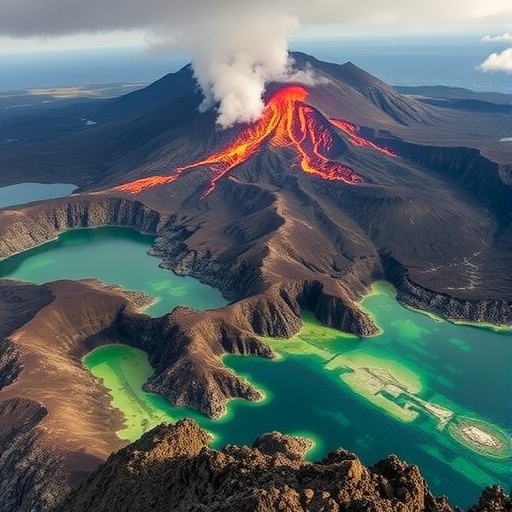
In recent findings published in Commun Earth Environ, a dynamic interplay between volcanic ash influx and redox conditions has been unveiled in ancient aquatic systems. The study, conducted by a team of researchers including Zhang, Stüeken, and Thomazo, provides insights that could reshape our understanding of biogeochemical processes during significant geological events. The influx of volcanic ash, historically considered merely a perturbation, is now seen as a catalyst for contrasting redox shifts, influencing both marine and lacustrine environments in profound ways.
The researchers focused on samples that spanned various geological epochs, analyzing sediment cores from ancient lakes and oceans. By employing advanced geochemical techniques, including isotope analysis and elemental ratios, they were able to reconstruct the environmental conditions of these ancient aquatic ecosystems. The results revealed a startling correlation: periods of increased volcanic activity corresponded with significant changes in the chemical composition of the water bodies, resulting in both reductive and oxidative states.
One of the key revelations was the dual nature of volcanic ash effects. In certain environments, the ash acted as a source of nutrients, fostering algal blooms that temporarily enriched the ecosystem’s productivity. Conversely, in more stagnant or isolated water bodies, the same ash composition seemed to drive anoxic conditions, leading to detrimental impacts on marine life. This dichotomy highlighted the importance of local environmental factors, such as water circulation and the geological context of the ash deposits.
Furthermore, the research team delved into the microbial responses to these shifting redox states. Microorganisms, particularly those involved in nitrogen and sulfur cycles, displayed remarkable adaptability. The findings suggest that ancient microbes may have employed diverse metabolic pathways in response to the varying chemical landscapes, which in turn influenced the sedimentological records we study today. The team’s work illustrates that life, even in its most primitive forms, has continually adapted to dramatic environmental changes.
The study also prompts questions about the potential long-term impacts of such drastic redox shifts on carbon cycling in these ancient ecosystems. As redox conditions oscillated, the storage and release of carbon in sedimentary contexts would likely have experienced fluctuations, influencing global carbon cycles. This could have had ramifications for climate regulation during those epochs, while also establishing feedback mechanisms that may still be relevant in our understanding of current climate dynamics.
Another important aspect was the role of volcanic ash in biogeochemical feedback loops. The release of nutrients from ash could initially enhance productivity, but over time could lead to a buildup of organic matter. As the organic material decomposed under different redox conditions, it might have contributed to shifts in sediment type and stratigraphy, thus forming a layered record of environmental change over millennia.
The implications of this study extend beyond geological curiosities; they invoke critical discussion regarding modern volcanic activity and its potential impacts on contemporary aquatic systems. As climate change continues to influence weather patterns, increased volcanic eruptions could become more common. Understanding historical responses becomes essential for predicting how future ecosystems may react under similar volcanic influences.
This work intertwines deep-time geological processes with contemporary ecological concerns, emphasizing the relevance of past events to current and future challenges. The researchers advocate for the integration of paleobiological insights into modern environmental policies, suggesting that lessons learned from the past can inform better stewardship of our natural resources in the face of rapid climate shifts.
Additionally, the study underpins the necessity for further research into how microbially induced redox shifts can help predict ecological responses to volcanic disturbances. With the advent of various biotechnologies and environmental monitoring techniques, scientists are increasingly capable of exploring these ancient interactions in new ways, providing an opportunity to refine our models of ecological resilience.
The methodologies employed in the study represent a significant advancement in paleoenvironments examination. The amalgamation of sedimentology, geochemistry, and paleobiology creates a comprehensive framework for understanding past environments. The researchers underscored their commitment to developing such interdisciplinary approaches to unlock further secrets of Earth’s intricate history.
In conclusion, the research, poised to attract future study and exploration, opens a new chapter in understanding ancient aquatic systems influenced by volcanic activity. It sets the stage for ongoing dialogue among scientists concerning the implications of these findings in relation to climate resilience and adaptive ecosystems. As we forge ahead into an uncertain future, the lessons derived from Earth’s history will serve as guideposts, highlighting the intertwined fates of geological forces and biological ecosystems.
The work of Zhang and his colleagues is expected to stimulate further interdisciplinary research initiatives, driving a deeper exploration into how past volcanic events shaped ecosystems and can provide a template for modern ecological dynamics. As scholars digest these findings, we may witness a resurgence in studies focused on the historical context of biogeochemical processes, ultimately enriching our understanding of both Earth’s past and its future.
This study not only pushes the boundaries of geological understanding but also intertwines our current ecological challenges with insights gained from ancient history, highlighting the need for ongoing vigilance in the face of climate and environmental change.
Zhang, K., Stüeken, E.E., Thomazo, C. et al. Volcanic ash drives contrasting redox shifts and biogeochemical feedbacks in ancient marine and lacustrine systems.
Commun Earth Environ 6, 850 (2025). https://doi.org/10.1038/s43247-025-02821-0
Cite Scienmag News
Violet Maxwell. (October 27, 2025). Volcanic Ash Alters Ancient Marine and Lake Ecosystems. Scienmag. https://scienmag.com/volcanic-ash-alters-ancient-marine-and-lake-ecosystems/
Violet Maxwell. "Volcanic Ash Alters Ancient Marine and Lake Ecosystems." Scienmag, 27 October 2025, https://scienmag.com/volcanic-ash-alters-ancient-marine-and-lake-ecosystems/. Accessed 3 September 2026.
Violet Maxwell. "Volcanic Ash Alters Ancient Marine and Lake Ecosystems." Scienmag. October 27, 2025. https://scienmag.com/volcanic-ash-alters-ancient-marine-and-lake-ecosystems/


