


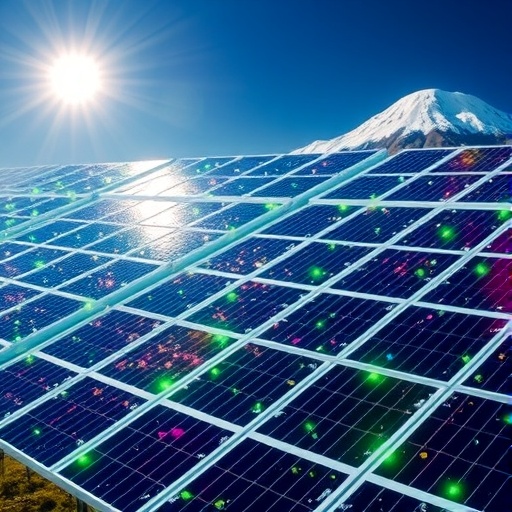
In the relentless quest for sustainable energy solutions, perovskite solar cells (PSCs) have emerged as a beacon of hope, combining impressive photovoltaic performance with relatively low production costs. However, as the global community increasingly prioritizes environmental responsibility, the synthesis and fabrication of these solar cells face scrutiny due to the solvents and processes traditionally employed. Recent advancements, highlighted in a groundbreaking study published in Nature Communications, reveal how the integration of green solvent engineering, artificial intelligence (AI) methodologies, and life cycle assessment (LCA) frameworks can drive PSC technology toward a genuinely sustainable future.
The environmental and occupational hazards associated with conventional solvents in PSC manufacturing have been a persistent challenge. These solvents, while effective in producing high-quality perovskite films, often involve toxicity and volatility issues that compromise worker safety and ecological wellbeing. As a countermeasure, green solvent alternatives have garnered intensified research interest owing to their potential to alleviate both health risks and environmental impacts without sacrificing device efficiency.
Yet, the transition to green solvents is riddled with technical hurdles that complicate widespread adoption. Central difficulties include achieving sufficient precursor solubility, controlling nucleation and crystallization pathways, managing solvent viscosity, and ensuring scalable process viability. Alcohol- and water-based formulations frequently suffer from limited solubility of lead salts and incomplete crystallization, leading to films that underperform or degrade rapidly. Ionic liquid-based systems, touted for their benign nature, introduce viscosity challenges that necessitate meticulous blending with co-solvents to sustain workable processing dynamics.
The nuanced evaporation behavior of many green anti-solvents further compounds processing complexity. These solvents tend to be highly sensitive to ambient conditions, requiring tightly controlled manufacturing environments to prevent variability in film morphology and performance. Overcoming this demands innovative approaches to improve coordination chemistry in eco-friendly media, thereby establishing more robust and reproducible crystallization pathways. Simultaneously, adopting solvent systems compatible with efficient recovery and reuse will be critical to reducing environmental footprints during scale-up and commercialization.
Advances in artificial intelligence present transformative opportunities to accelerate these developments. Machine learning algorithms have begun to screen a vast landscape of potential solvent candidates with unprecedented speed, predicting how various solvents influence film stability, crystallization kinetics, and ultimately device performance. This computational screening significantly reduces the reliance on labor-intensive trial-and-error experiments, hastening the discovery of optimum green solvent formulations tailored to perovskite chemistry.
Beyond formulation design, natural language processing (NLP) has shown promise in mapping solvent recovery and recycling strategies. These AI-driven protocols can forecast the feasibility of different end-of-life treatments, enhancing the circularity of PSC components and mitigating hazardous waste generation. However, contemporary AI models often grapple with limitations including small and narrow datasets, simplistic molecular descriptors, and constrained design spaces—a testament to the need for deeper integration of experimental results and more sophisticated chemical representations.
To comprehend the full environmental ramifications of PSC technologies, life cycle assessment serves as an indispensable analytical tool. LCA enables quantification of environmental impacts across the entire lifecycle—from raw material extraction and solvent synthesis to device fabrication, operation, and disposal. Studies to date have consistently identified solvent production and utilization, energy-intensive annealing processes, and waste management at end-of-life as disproportionate contributors to PSCs’ environmental burdens.
Nonetheless, the diversity of LCA studies has led to discrepancies that hamper cross-comparison, rooted in differing functional units, system boundaries, and inventory assumptions. Achieving standardization and transparency in LCA methodologies would foster more consistent, reliable evaluations. Moreover, AI-assisted surrogate modeling can fill critical data gaps within LCA inventories, offering predictive insights where experimental data are scarce. It remains essential, however, to handle uncertainties rigorously and align AI outputs with empirical evidence to maintain credibility.
The practical translation of greener solvent strategies requires a holistic appreciation of manufacturing realities. Substitution of hazardous solvents cannot be examined in isolation; instead, considerations must encompass solvent consumption intensity, energy expenditures throughout the process, system integration feasibility, and realistic logistics for solvent recovery. Similarly, recycling protocols should be appraised beyond mere recovery yields—operational simplicity and solvent management overheads are decisive factors for industrial adoption.
These integrative considerations underscore that genuine sustainability in PSC technology rests on coordinated progress across multiple domains. The triad of green solvent engineering, AI-driven design tools, and comprehensive LCA evaluation constitutes a powerful framework for confronting the multifaceted challenges impeding PSC commercialization. Green solvents fundamentally reduce chemical hazards, AI expedites the search for innovative, resilient formulations, and LCA ensures environmental claims withstand rigorous systemic scrutiny.
Looking forward, this convergence promises to shift PSC research paradigms beyond performance-centric optimization toward holistic metrics that balance ecological integrity with commercial viability. The pursuit of environmentally benign manufacturing routes coupled with intelligent design systems will underpin the responsible advancement of perovskite solar technology, resonating with global imperatives for sustainable energy transitions. By embracing these synergistic approaches, PSCs can become exemplars of next-generation photovoltaics that harmonize high efficiency with minimal environmental toll.
This comprehensive approach also highlights the critical role of interdisciplinary collaboration, bringing together chemists, materials scientists, AI experts, and sustainability analysts to forge a coherent vision for clean energy innovation. Enhancements in precursor solubility within green media, stabilization of crystallization under real-world processing conditions, and establishment of solvent recovery pathways compatible with industrial scaling remain priorities for future research. Each breakthrough not only transforms perovskite solar manufacturing but also sets precedents for sustainable materials development across broader sectors.
Innovations in AI modeling, informed by increasingly rich datasets and molecular descriptors that capture coordination chemistries, will unlock nuanced understanding of solvent–perovskite interactions. Coupled with in situ characterization techniques and real-time process monitoring, AI can optimize crystallization kinetics while adapting to ambient fluctuations, making green solvent processing more robust and reproducible. Such advances will be vital to moving beyond proof-of-concept studies towards commercial production lines capable of maintaining device uniformity and performance at scale.
Simultaneously, refined LCA frameworks incorporating localized energy mixes, solvent reuse efficiencies, and realistic end-of-life scenarios will guide lifecycle decisions that avoid unintended environmental consequences. This ensures that sustainability claims reflect actual reductions in hazards and impacts rather than theoretical benefits. Integrating feedback loops between LCA insights and AI-driven process optimization can create virtuous cycles of improvement that continuously push the boundaries of eco-friendly perovskite manufacturing.
In essence, the synergy of green solvent innovation, artificial intelligence, and life cycle assessment offers a transformative blueprint for sustainable perovskite solar technologies. The collaborative work of researchers such as Kim, Chen, and Lee underscores that tackling environmental challenges at the molecular, process, and systemic levels simultaneously is imperative. Their visionary research sets a new standard for how emergent energy technologies can harmonize technological prowess with environmental stewardship, exemplifying a pathway where high-performance photovoltaics go hand in hand with sustainability.
Cite Scienmag News
Denise Maddox. (May 20, 2026). AI-Powered Green Processing Advances Sustainable Perovskite Solar Cells. Scienmag. https://scienmag.com/ai-powered-green-processing-advances-sustainable-perovskite-solar-cells/
Denise Maddox. "AI-Powered Green Processing Advances Sustainable Perovskite Solar Cells." Scienmag, 20 May 2026, https://scienmag.com/ai-powered-green-processing-advances-sustainable-perovskite-solar-cells/. Accessed 3 September 2026.
Denise Maddox. "AI-Powered Green Processing Advances Sustainable Perovskite Solar Cells." Scienmag. May 20, 2026. https://scienmag.com/ai-powered-green-processing-advances-sustainable-perovskite-solar-cells/


