


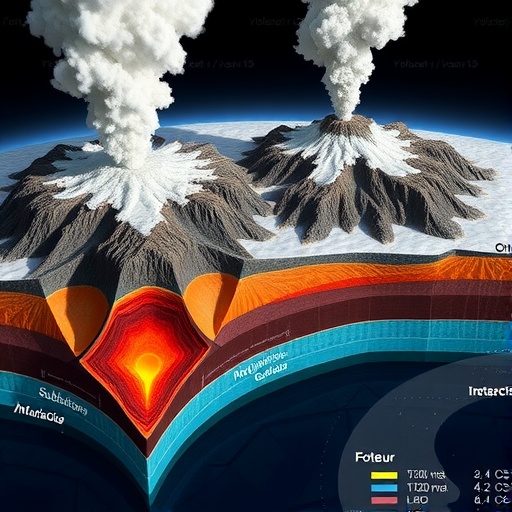
In a groundbreaking study published in Nature Communications, a team of geoscientists led by Yang, Faccenda, and Meyzen has offered unprecedented insights into the enigmatic processes beneath the Earth’s oceanic plates. Their research explores how subduction legacies embedded in the mantle transition zone significantly influence intraplate oceanic volcanism, a phenomenon that has long puzzled geologists worldwide. By unveiling the intricate relationship between ancient tectonic events and present-day volcanic activity far from plate boundaries, this work challenges traditional paradigms of mantle dynamics and volcanic genesis.
The mantle transition zone, a region extending roughly between 410 and 660 kilometers beneath Earth’s surface, acts as a dynamic conveyor between the upper and lower mantle layers. It is here that the subducted lithospheric slabs—the remnants of tectonic plates that have sunk deep into the mantle—interact with the surrounding mantle material. According to the study, these subducted slabs do not simply vanish; instead, they leave behind chemical and thermal footprints that persist for millions of years. Such “subduction legacies” are found to modulate melting processes, paving the way for intraplate volcanism to manifest in seemingly stable oceanic realms.
Traditionally, intraplate volcanism, particularly in oceanic settings distant from active plate boundaries, has been attributed to mantle plumes—columns of hot, buoyant rock rising from deeper sections of the mantle. However, the new findings suggest that the geophysical and geochemical signatures of intraplate volcanism cannot be fully explained by plume tectonics alone. Instead, the heterogeneity introduced by the subducted slab remnants within the mantle transition zone plays an equally crucial role, destabilizing parts of the mantle and inducing partial melting that fuels hotspot volcanism, such as that observed in prominent volcanic islands.
Yang and colleagues employed a sophisticated combination of seismic tomography, geochemical analyses, and numerical modeling to illustrate how subducted materials become stagnant within the mantle transition zone, creating complex flow patterns and thermal anomalies. These stagnant slabs influence the temperature and compositional gradients, which in turn control the degree and location of mantle melting beneath oceanic lithosphere. The integration of geophysical imaging and computational simulations allowed the team to reconstruct a comprehensive picture of mantle dynamics that bridges subduction history and volcanic activity in intraplate regions.
Their seismic data reveals striking contrasts in velocity anomalies within the mantle transition zone beneath oceanic hotspots. These anomalies are interpreted as the signature of chemically distinct subducted slab fragments that have resisted complete assimilation by their surrounding mantle. Such chemically buoyant heterogeneities raise the local solidus temperature but simultaneously generate localized zones where partial melting can occur due to dynamic perturbations. This discovery reconciles previously conflicting observations about mantle anomalies and intraplate volcanism, presenting a more nuanced understanding of the Earth’s interior.
The geochemical fingerprints of volcanic rocks sampled from oceanic islands were critical in this investigation. Trace element concentrations and isotopic ratios pointed towards source materials that were not purely primordial mantle but had been modified by recycled crustal components originating from ancient oceanic plates. These altered mantle domains harbor material that descends with subducted slabs and later influences melting beneath oceanic intraplate volcanic centers. This link bridges surface tectonic processes with deep mantle heterogeneities, highlighting the interconnectedness of Earth’s interior system.
One of the most compelling implications of this research is the temporal persistence of subduction legacies. The ancient slabs trapped within the mantle transition zone can influence volcanism tens to hundreds of millions of years after the cessation of active subduction in a region. This means that the tectonic history of an area imprints upon its present and future volcanic behavior, offering a predictive framework for understanding intraplate volcanism in ocean basins worldwide.
Furthermore, the study underlines that mantle convection and subduction are deeply entangled processes shaping the geochemical landscape beneath oceanic plates. The mantle transition zone serves not only as a physical barrier to slab descent but also as a chemical reservoir where recycled materials accumulate and interact. The heterogeneity arising from these processes modulates melting and magmatic activity, emphasizing the mantle transition zone’s role as a key player in Earth’s deep carbon and volatile cycles, which have broad climatic and ecological impacts.
This research also advances numerical modeling techniques by incorporating realistic slab morphologies and thermochemical properties into mantle convection simulations. By doing so, it sheds light on the dynamic stability of subducted slab fragments and their interaction with mantle flow patterns responsible for generating intraplate volcanism. These simulations help explain the spatial distribution and variability in volcanic activity observed in oceanic regions, previously attributed largely to ad hoc models.
Given the prominence of intraplate volcanism in contributing to ocean island formation and building ecological habitats, insights from this study have broader implications for understanding oceanic ecosystem evolution. Volcanic islands, formed through mantle melting processes modulated by subduction legacies, become hotspots for biodiversity and human settlement. Understanding the deep Earth processes behind their formation can enhance predictive models for volcanic hazards and geothermal resource potential in these often remote regions.
Moreover, these findings may influence interpretations of geochemical anomalies in mid-ocean ridge basalt (MORB) compositions and their deviation from global mantle homogeneity models. The mantle transition zone’s heterogeneity, derived from past subduction episodes, challenges the assumption of a uniformly convecting mantle source beneath ocean basins. This revelation compels geochemists to rethink mantle convection models and the cycling of crustal materials back into Earth’s interior.
The study primes the scientific community to revisit long-standing theories of plate tectonics and mantle dynamics by integrating the mantle transition zone’s complex role in lithosphere-mantle interactions. The persistence of subduction legacies could also refine our understanding of mantle plume initiation and impact, perhaps redefining how hotspots are classified and interpreted in mantle geodynamics frameworks.
Finally, this research opens new avenues for future multidisciplinary investigations combining deep Earth seismology, geochemistry, petrology, and numerical modeling. Each approach will be crucial to unraveling the mantle transition zone’s complexities, its chemical reservoirs, and how these influence intraplate volcanic activity on both regional and global scales. The Earth’s interior, it appears, holds a nuanced memory of its tectonic past with active consequences at the surface, making a compelling case for sustained scientific inquiry into these hidden depths.
Cite Scienmag News
Violet Maxwell. (May 20, 2026). Subduction Legacies Shape Intraplate Ocean Volcanoes. Scienmag. https://scienmag.com/subduction-legacies-shape-intraplate-ocean-volcanoes/
Violet Maxwell. "Subduction Legacies Shape Intraplate Ocean Volcanoes." Scienmag, 20 May 2026, https://scienmag.com/subduction-legacies-shape-intraplate-ocean-volcanoes/. Accessed 4 September 2026.
Violet Maxwell. "Subduction Legacies Shape Intraplate Ocean Volcanoes." Scienmag. May 20, 2026. https://scienmag.com/subduction-legacies-shape-intraplate-ocean-volcanoes/


