


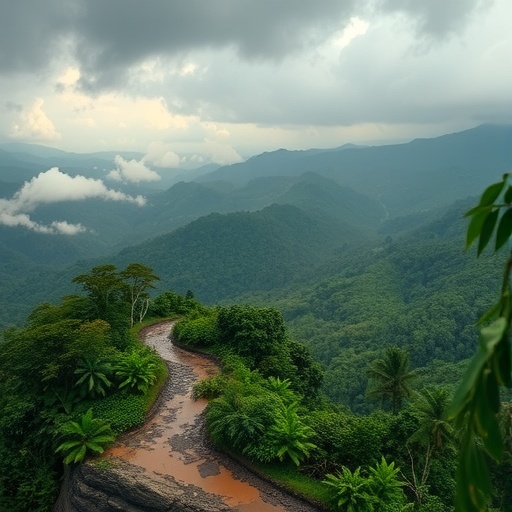
A groundbreaking study has unveiled a detailed climatic chronicle spanning two million years, uncovering a persistent and significant increase in precipitation across western Amazonia and the tropical Andes. This research, spearheaded by de Oliveira, Silva, Ferreira, and colleagues, leverages advanced paleoenvironmental techniques to reconstruct a long-term hydrological trend that has profound implications for understanding past climate dynamics and predicting future regional water availability in one of the world’s most vital ecological hotspots.
The research harnesses sediment cores and isotopic analyses from strategically located sites across western Amazonia and the tropical Andes, enabling scientists to piece together an unparalleled record of precipitation variability. Over the course of two million years, these proxies indicate not just episodic shifts but a consistent upward trajectory in rainfall patterns, suggesting that these regions have experienced progressive humidification rather than the instability often assumed for tropical climates over geological timescales. Such data disentangle complex interactions between atmospheric circulation, mountain orogeny, and tropical rainforest ecosystems.
One of the core revelations from this study centers on the interplay between Andean uplift and Amazonian precipitation. Geological evidence confirms that the rise of the Andes profoundly influences regional climate by acting as a barrier to moisture transport and modifying wind patterns. The sediment records reveal that as the Andes approached their current elevations, they facilitated enhanced orographic rainfall, intensifying wet conditions on the windward slopes and feeding the expansive rainforest basin. This insight deepens our understanding of how tectonic processes intersect with climate systems to shape biodiversity hotspots.
Central to the methodology are stable isotope ratios, particularly oxygen isotopes, preserved in lacustrine and fluvial sediments. These isotopic signatures carry distinct fingerprints of past moisture sources and precipitation amounts, allowing researchers to reconstruct rainfall intensities with remarkable precision. Through high-resolution sampling in continuous sediment sequences, the authors discern nuanced hydrological shifts that correlate with major climatic events such as the Mid-Pleistocene Transition and glacial-interglacial cycles, thereby anchoring local precipitation trends within a global climate framework.
The gradual intensification in precipitation not only impacts ecosystem structure and function but also provides critical insights into tropical carbon cycling through time. Increased humidity fosters greater biomass production, augmenting carbon sequestration capacities of rainforests. This two-million-year record thus links palaeoclimate to global biogeochemical cycles, illustrating how shifts in rainfall regimes contribute to long-term terrestrial carbon dynamics, which are essential for modelling contemporary climate change projections.
Importantly, the study sheds light on the resilience and adaptability of Amazonian and Andean ecosystems in the face of fluctuating moisture regimes. Despite increased precipitation, the data suggest episodic periods of drought and variability, highlighting that these landscapes have constantly navigated a complex hydrological balance. Such fluctuations likely drove evolutionary pressures, influencing species diversification and ecological interactions that underpin today’s exceptional biodiversity in these regions.
Furthermore, the authors underscore the critical role of atmospheric teleconnections in driving precipitation patterns. Changes in sea surface temperatures in the tropical Atlantic and Pacific Oceans, along with shifts in the Intertropical Convergence Zone, appear to modulate rainfall over western Amazonia and the Andes on millennial timescales. This expanded temporal perspective equips climate scientists with a more integrated view of the coupling between oceanic phenomena and continental hydroclimate variability.
The findings carry profound implications for future water resource management and conservation strategies in the Amazon and Andes. With current anthropogenic climate perturbations threatening delicate moisture cycles, understanding natural long-term trends is vital. This research provides a benchmark against which to measure the magnitude and rate of modern changes, aiding policymakers and environmental planners in preparing for scenarios involving altered precipitation regimes, floods, and drought periods.
The investigation also highlights the technological advancements that made this study possible. Cutting-edge radiometric dating methods, combined with machine learning algorithms for isotope data interpretation, enabled unprecedented temporal resolution and reduction of uncertainties. Such interdisciplinary approaches showcase the transformative power of integrating geology, climatology, and data science to resolve long-standing questions about Earth’s climate history.
Beyond academic research, the study resonates with indigenous perspectives and local knowledge systems that have long observed the rhythms of rainfall and ecological shifts in Amazonia and the Andes. By aligning paleoclimatic narratives with cultural histories, this work fosters a more inclusive understanding of environmental change, enhancing community engagement in climate resilience efforts.
Moreover, an intriguing aspect of the record is the identification of abrupt hydrological events punctuating the long-term trend. These sharp shifts may correspond to volcanic eruptions, solar variability, or abrupt sea surface temperature anomalies, offering a window into extreme climate phenomena and their cascading effects on terrestrial ecosystems. Such events underscore the nonlinearity and complexity of climate systems, cautioning against simplistic extrapolations into future weather patterns.
Collaboration across international research institutions and multidisciplinary expertise was pivotal in accomplishing this feat. Field campaigns traversed challenging terrains and employed innovative coring techniques, underscoring a commitment to unraveling the climatic past embedded beneath the Earth’s surface. The resultant dataset represents one of the most comprehensive archives of tropical hydrology ever assembled.
In synthesizing multiple lines of geological and climatological evidence, the study bridges a critical knowledge gap in tropical paleoclimate science and advances our grasp of how mountain building and atmospheric processes coalesce to drive rainfall variability over geological epochs. This new paradigm recalibrates assumptions about tropical climate stability and highlights the dynamic nature of Earth’s environmental systems.
Looking forward, the authors advocate for expanded sampling across broader spatial scales and incorporation of paleoecological records to complement hydroclimatic reconstructions. Enhanced resolution in both space and time would provide even richer context for phenomena such as biodiversity shifts and carbon flux changes tied to precipitation dynamics.
In summary, this monumental investigation into the last two million years of precipitation in western Amazonia and the tropical Andes not only redefines our understanding of long-term hydrological changes but also equips the scientific community, policymakers, and local stakeholders with indispensable insights for navigating future climate uncertainty. Unraveling these complex water histories is essential for conserving some of the Earth’s most vital ecological and cultural treasures amid accelerating global change.
Cite Scienmag News
Violet Maxwell. (May 20, 2026). Two Million Years of Rising Rain in Amazonia. Scienmag. https://scienmag.com/two-million-years-of-rising-rain-in-amazonia/
Violet Maxwell. "Two Million Years of Rising Rain in Amazonia." Scienmag, 20 May 2026, https://scienmag.com/two-million-years-of-rising-rain-in-amazonia/. Accessed 3 September 2026.
Violet Maxwell. "Two Million Years of Rising Rain in Amazonia." Scienmag. May 20, 2026. https://scienmag.com/two-million-years-of-rising-rain-in-amazonia/


