


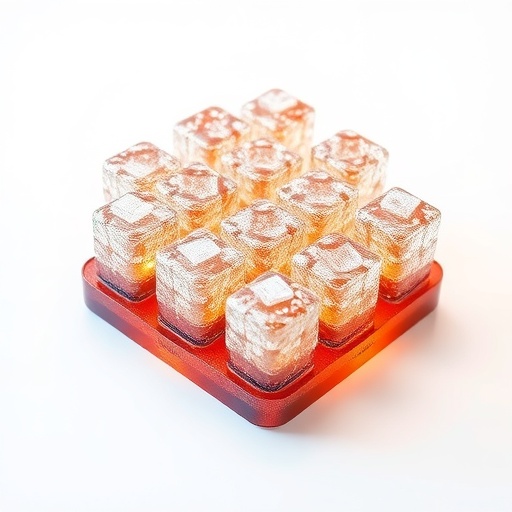
In a development that could reshape the landscape of clean energy technology, researchers at the University of Texas at San Antonio, working alongside collaborators at Jiangsu University and other partner institutions, have shattered one of the most deeply held assumptions in materials science. By deliberately introducing chaos into the atomic structure of a ceramic fuel cell material, the team has achieved oxygen-ion conductivity at temperatures once thought impossible, bringing solid oxide fuel cells a significant step closer to commercial reality. The findings, published in Science Advances with Shengli Pang, a Jiangsu University researcher and member of Chonglin Chen’s team, serving as lead author, describe a counterintuitive strategy borrowed from an unlikely source: steelmaking.
Solid oxide fuel cells have long tantalized the energy sector with their remarkable promise. Unlike conventional combustion-based power generation, these devices convert hydrogen or other renewable fuels directly into electricity and heat through an electrochemical process, producing virtually no pollution in the process. Their efficiency exceeds 60 percent, a figure that dwarfs many competing technologies. Yet for all their potential, solid oxide fuel cells have remained confined largely to laboratories and specialized industrial applications because of one stubborn problem: they demand extraordinarily high operating temperatures to function.
Conventional solid oxide fuel cells operate inadequately below 400 degrees Celsius, and in practice they typically require temperatures exceeding 700 degrees Celsius to perform at useful levels. That is hotter than the molten rock of many volcanic lavas, and the consequences are severe. Such extreme heat accelerates the breakdown of component materials, forces manufacturers to rely on expensive heat-resistant alloys and ceramics to contain the reaction, and imposes lengthy startup delays that render the technology impractical for everyday commercial use. For decades, engineers have searched for materials that could deliver comparable performance at more manageable temperatures, and for decades, the search has been constrained by what Chen describes as a golden rule.
“The golden rule has been that you need a perfect crystal lattice for fast ion movement,” said Chonglin Chen, PhD, a professor in the Department of Physics and Astronomy in the College of Sciences at UT San Antonio. “What we have done here challenges that assumption.” That assumption held that the best ionic conductors must possess flawlessly ordered crystal structures, with atoms arranged in neat, repeating rows that function like well-defined lanes on a highway, guiding charged particles smoothly from one electrode to the other. Any disorder, the thinking went, would create obstacles that impede the flow of ions and degrade performance.
The UT San Antonio team’s approach inverts this logic entirely. Rather than striving for atomic perfection, they embraced imperfection, using dramatic thermal shock to create disordered structures that conduct oxygen ions far better than their ordered counterparts. The process begins conventionally enough: the researchers baked a standard ceramic fuel cell material at a blistering 1,300 degrees Celsius. Then came the radical step. Using a technique called quenching, familiar to metallurgists for centuries, they plunged the superheated ceramic into liquid nitrogen at nearly minus 196 degrees Celsius. This violent temperature swing, dropping more than 1,400 degrees in an instant, shatters the material’s rigid, glass-like crystal structure into ultra-thin, microscopic clusters of atoms measuring just 0.63 nanometers thick. To appreciate the scale, thousands of these clusters could stack across the width of a single human hair.
The inspiration for the technique came from an unexpected place. Steelmakers have long used quenching to transform the mechanical properties of their products, rapidly cooling hot metal to lock in hardness or toughness. Chen and his colleagues wondered whether the same principle could be adapted to ceramics, and what they found exceeded expectations. When the quenched material was tested at 400 degrees Celsius, a temperature at which conventional ceramics perform inadequately, it achieved record oxygen-ion conductivity approximately 1,400 times higher than that of a conventional ceramic material. The result was not a marginal improvement but a transformation of the material’s fundamental behavior.
To understand why disordered atoms could outperform ordered ones, the team subjected their creation to intensive analysis using electron microscopy and X-ray techniques. What they observed was initially puzzling: the atoms inside the tiny fragments were genuinely disordered and chaotic, with none of the tidy periodicity that theory said should be necessary for fast ion transport. Yet the material was performing brilliantly. The explanation lies in the behavior of oxygen vacancies, the tiny gaps left in a crystal structure when oxygen atoms are absent. In traditional materials, these vacancies eventually become blocked as atoms clump together under thermal stress, creating atomic-scale bottlenecks that interrupt the flow of energy through the device.
Inside the new disordered nanoclusters, however, the oxygen vacancies remain isolated and active, and their interactions give rise to something remarkable: a dynamic, self-sustaining network through which ions can travel with unprecedented freedom. “With these vacancy-isolated clusters, we created a chaotic, highly dynamic network where the oxygen vacancies remain independent,” Chen explained. “Instead of fighting the disorder, we are using it to create a kind of superhighway for the ions.” In effect, the team discovered that controlled chaos can perform the same function that ordered crystal channels were supposed to provide, and perform it better, particularly at the lower temperatures where conventional materials falter.
The practical implications of the discovery were demonstrated in tests designed to gauge commercial viability. By blending a trace amount of the disordered clusters, just 0.5 percent by weight, with a conventional cobalt-based fuel cell cathode, the researchers tripled the fuel cell’s peak power output. The improvement required only a minuscule quantity of the new material, meaning manufacturers would not need to redesign their entire fuel cell systems to benefit from the innovation. This compatibility with existing technology could dramatically shorten the path from laboratory discovery to commercial deployment, a transition that has historically taken decades in the energy sector.
Perhaps even more striking than the power boost was the effect on durability, one of the most persistent weaknesses of fuel cell technology. Standard solid oxide fuel cells degrade rapidly under the intense thermal stress of high-temperature operation, losing more than 13 percent of their power output every 100 hours of use. Fuel cells enhanced with the disordered nanoclusters displayed the opposite behavior: they became 3.4 percent more stable and efficient with continued use. The material does not merely resist degradation; it actively improves with operation. “It acts as an atomic shield, boosting power while actively stopping the degradation that normally kills these devices,” Chen said.
The significance of the breakthrough extends beyond a single material or a single application. Solid oxide fuel cells are viewed as a cornerstone technology for a hydrogen-based economy, capable of generating electricity from renewable fuels without combustion and without the carbon emissions that drive climate change. By lowering the operating temperature threshold to around 400 degrees Celsius, the new approach addresses the core obstacles, cost, durability and startup time, that have kept these devices out of homes, vehicles and distributed power systems. Lower temperatures mean cheaper component materials, longer device lifetimes and faster response, all of which translate directly into economic viability.
Chen and his colleagues are now focused on scaling up production of the quench-derived nanoclusters, working to develop manufacturing processes that can supply the material at the volumes commercial fuel cell production would demand. Because the underlying technique relies on temperature manipulation rather than exotic chemistry, the researchers believe it should be straightforward for manufacturers to adopt. The quenching process itself is well understood in industrial settings, and the ceramic starting materials are standard. The transformation, in other words, requires no fundamentally new supply chain, only a new way of thinking about what happens when extreme heat meets extreme cold.
The broader lesson of the research may prove as influential as the material itself. For generations, materials scientists have pursued perfection, ever-larger single crystals and ever-cleaner lattices, in the quest for better electronic and ionic properties. This study suggests that in certain regimes, disorder deliberately engineered and atomically confined can outperform order, opening a new design space for ionic conductors, and perhaps for other functional materials as well. As Chen put it, the work brings the field “one step closer to practical, next-generation green energy.” If the technique scales as hoped, the frozen chaos inside these nanoclusters may one day hum quietly inside fuel cells powering homes, vehicles and industries, a reminder that sometimes the road to a cleaner future runs through the beautiful disorder of the atomic world.
Cite Scienmag News
Faith Mcneil. (September 7, 2026). Scientists unlock ice-like material for greener energy storage. Scienmag. https://scienmag.com/scientists-unlock-ice-like-material-for-greener-energy-storage/
Faith Mcneil. "Scientists unlock ice-like material for greener energy storage." Scienmag, 7 September 2026, https://scienmag.com/scientists-unlock-ice-like-material-for-greener-energy-storage/. Accessed 7 September 2026.
Faith Mcneil. "Scientists unlock ice-like material for greener energy storage." Scienmag. September 7, 2026. https://scienmag.com/scientists-unlock-ice-like-material-for-greener-energy-storage/


