


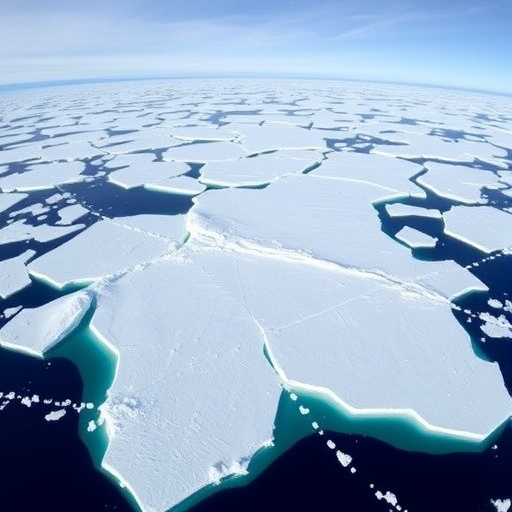
In a groundbreaking study published in Science Advances, researchers from the University of Southampton have uncovered the intricate and devastating mechanisms behind the precipitous decline of Antarctic sea ice, a phenomenon that has recently shifted from decades of resilience to alarming acceleration. This new research elucidates how a complex interplay of atmospheric and oceanic forces has conspired to unleash an unprecedented collapse in sea ice extent, with potentially profound consequences for global climate systems.
For many years, Antarctica’s sea ice exhibited a puzzling resilience, with ice coverage exhibiting a slight upward trend despite rising global temperatures. However, since the pivotal year of 2015, this trend reversed dramatically. The study identifies a trilogy of interwoven drivers—intensified winds, the upward intrusion of deep warm ocean water, and an ongoing feedback cycle sustaining unprecedented surface ocean conditions—as the key agents of this rapid ice loss.
Central to the study’s findings is the destabilization of the Southern Ocean’s finely balanced stratification. Typically, cold, fresh surface waters overlie denser, saltier deep waters, creating a barrier that protects the sea ice from warmer ocean layers below. But the team discovered that persistent strengthening of circum-Antarctic winds has progressively pulled Circumpolar Deep Water—a relatively warm, saline current located deep below the surface—upwards. This process has eroded the stratification, allowing heat to penetrate the surface layers and shatter the ice from below.
The year 2015 marked a critical threshold when enhanced wind mixing violently integrated this deep ocean heat into the upper ocean, accelerating the melting of sea ice in some of the most climatically sensitive regions of East Antarctica. This rapid injection of warmth initiated a self-reinforcing feedback: as ice recedes, the now saltier and warmer ocean surface discourages the reformation of new ice, establishing a vicious cycle that locks the Southern Ocean into a persistently low ice state.
Adding spatial complexity to the phenomenon, the study highlights a pronounced asymmetry in ice loss dynamics between East and West Antarctica. While the sea ice depletion in East Antarctica is largely driven by oceanographic mechanisms involving the intrusion of circumpolar deep waters, in West Antarctica, atmospheric processes play a dominant role. There, anomalously persistent cloud cover, guided by warm subtropical air masses transported poleward, traps heat within the ocean surface, which in turn melts ice during critical summer windows, as observed particularly in 2016 and 2019.
This differentiation signals that Antarctic ice loss is not a monolithic process but rather a multifaceted crisis influenced by distinct regional drivers. It also indicates that models predicting ice coverage need to integrate coupled ocean-atmosphere dynamics with regional specificity for accurate forecasting.
From a climatological perspective, the consequences of diminishing Antarctic sea ice extend far beyond the polar regions. Sea ice functions as Earth’s reflective shield, bouncing a significant portion of solar radiation back into space. The reduction in ice coverage decreases this albedo effect, exposing darker ocean surfaces that absorb heat and amplify global warming. Moreover, Antarctic sea ice is intimately connected to the ocean’s overturning circulation—a global conveyor belt that sequesters heat and carbon dioxide in the deep ocean. Disruption of this circulation could weaken this critical climate-regulating system, accelerating atmospheric warming.
More alarmingly, researchers caution that the loss of sea ice undermines the stability of ice shelves, the floating extensions of continental glaciers. Ice shelves act as buttresses preventing accelerated glacier flow into the ocean. Their destabilization could precipitate dramatic rises in global sea levels, threatening billions of people living in coastal areas worldwide.
The study’s authors emphasize the role of anthropogenic climate change as a potent amplifier of these processes. Increased greenhouse gas concentrations have intensified the Southern Hemisphere westerly winds, exposing larger areas of the Southern Ocean to upwelling warm waters. This wind-driven upwelling enhances heat transfer from the abyssal ocean, perpetuating the cycle of ice loss.
If current trends persist, the Southern Ocean may enter a new climatic regime characterized by a prolonged state of reduced sea ice cover. This would mark a paradigm shift whereby the ocean, previously a stabilizing component of Earth’s climate system, could become a driver of accelerating global warming with feedbacks that are challenging to reverse.
The Southampton-led team’s comprehensive analysis charted this transformation through an innovative combination of satellite observations and advanced oceanographic models. Their work illustrates how the seemingly slow and invisible processes deep beneath the ocean surface can exert outsized influence on planetary-scale climate features. It also underscores the urgency of sharply reducing greenhouse gas emissions to forestall further destabilization.
In the context of broader earth system science, these findings offer crucial insights into the vulnerability of polar regions, the intricacies of ocean-atmosphere interactions, and the cascading consequences that regional perturbations may have on global climate stability. They serve as a call to action for policymakers and the scientific community alike, highlighting the profound sensitivity of Earth’s cryosphere to both natural variability and human-induced changes.
As the planet continues to warm, understanding the fundamental mechanisms behind such phenomena is essential for refining climate models, informing mitigation efforts, and preparing societies worldwide for the inevitable shifts in environmental and socio-economic landscapes. The Antarctic’s sea ice is no longer the steadfast guardian it once seemed, but a fragile and dynamic frontier whose fate holds vital clues to the future trajectory of global climate change.
News Publication Date: 8 May 2026
Web References: http://dx.doi.org/10.31223/X51V0B
Cite Scienmag News
Russell Cooper. (May 8, 2026). Scientists Reveal Triple Threat of Climate Chaos Driving Collapse of Antarctic Sea Ice. Scienmag. https://scienmag.com/scientists-reveal-triple-threat-of-climate-chaos-driving-collapse-of-antarctic-sea-ice/
Russell Cooper. "Scientists Reveal Triple Threat of Climate Chaos Driving Collapse of Antarctic Sea Ice." Scienmag, 8 May 2026, https://scienmag.com/scientists-reveal-triple-threat-of-climate-chaos-driving-collapse-of-antarctic-sea-ice/. Accessed 3 September 2026.
Russell Cooper. "Scientists Reveal Triple Threat of Climate Chaos Driving Collapse of Antarctic Sea Ice." Scienmag. May 8, 2026. https://scienmag.com/scientists-reveal-triple-threat-of-climate-chaos-driving-collapse-of-antarctic-sea-ice/


