


Rock art explored by archaeologists in the Colombian Amazon has provided an insight into the complex relationship between the earliest settlers on the continent and the animals they encountered.

Credit: University of Exeter
Rock art explored by archaeologists in the Colombian Amazon has provided an insight into the complex relationship between the earliest settlers on the continent and the animals they encountered.
Spectacular ochre paintings of a wide variety of animal species, including depictions of animals and humans transforming into one another, indicate the rich mythology that guided generations of indigenous Amazonians.
And while the images found adorning the rocky outcrop of Cerro Azul in the Serranía de la Lindosa have yet to be accurately dated, associated evidence of human activity suggests they are likely to have served as galleries for thousands of years, as far back as 10,500BC.
The research, led by an international team from the University of Exeter, Universidad de Antioquia, Medellín and the Universidad Nacional de Colombia, and published in the Journal of Anthropological Archaeology, integrated zooarchaeological analysis of animal remains recovered from nearby excavations with analysis of the artistic depictions. The animal remains revealed a diverse diet, including fish, a range of small to large mammals, and reptiles, including turtle, snake, and crocodile. However, the proportions of animal bones do not match the proportional representation of animals, suggesting the artists did not just paint what they ate.
“These rock art sites include the earliest evidence of humans in western Amazonia, dating back 12,500 years ago,” says Dr Mark Robinson, Associate Professor of Archaeology in Exeter’s Department of Archaeology and History. “As such, the art is an amazing insight into how these first settlers understood their place in the world and how they formed relationships with animals. The context demonstrates the complexity of Amazonian relationships with animals, both as a food source but also as revered beings, which had supernatural connections and demanded complex negotiations from ritual specialists.”
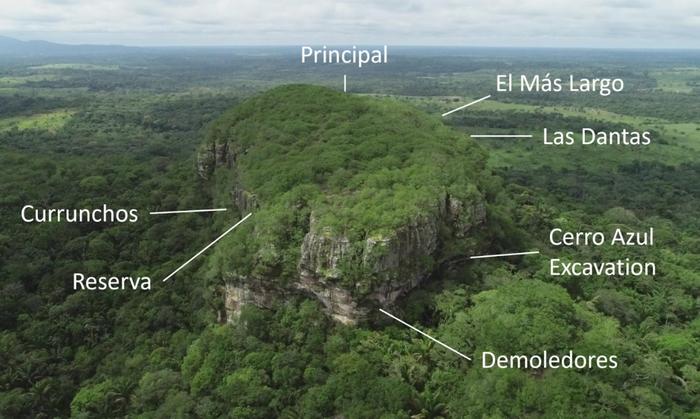
Archaeologists have documented several significant rock art sites in the region since a peace agreement between the Colombian government and FARC in 2016 paved the way for a safe resumption of scientific investigations. Cerro Azul, a free-standing table-top hill located close to the Guayabero River in the northwest of the Department of Guaviare, was among them. There, 16 ‘panels’ of ochre drawings were found, several of which could only be accessed via strenuous climbing and the use of ropes.
The research team, which included academics from the UK, Colombia, and Germany, chose to focus on six panels in detail. These ranged from the 40m-by-10m El Más Largo, which contained more than 1,000 images, to the much smaller, 10m-by-6m panel called Principal, many of whose 244 images are extremely well-preserved in vibrant red.
A total of 3,223 images were catalogued using drone photogrammetry and traditional photography. The images were categorised by their form, with figurative images being the most commonly occurring, contributing 58% of the total. More than half of these related to animals. At least 22 different animals were identified, including deer, birds, peccary, lizards, turtles, and tapir.
Although fish remains are abundant in the archaeological remains, their appearance in the art is limited to just two panels, in what appear to be fishing scenes. Notable by their absence were big cats, despite their position as apex predators and the evidence of artwork at other Colombian sites. The researchers speculate that the artists were potentially restricted from depicting powerful beasts, such as the jaguar. While images of figures combining human and animal characteristics reveal a complex mythology of transformation between animal and human states that is still present within modern Amazonian communities.
The diverse array of animals represented in the art and the archaeological remains demonstrates a broad understanding and exploitation of a multitude of environments in the region, including savannah, flooded forests and rivers.
“The Indigenous people of Cerro Azul and the surrounding lands hunted and depicted a diverse array of animals from different ecologies – from aquatic fish to arboreal monkeys; terrestrial deer to aerial birds, both nocturnal and diurnal,” says Dr Javier Aceituno, of Universidad de Antioquia, Medellín. “They had intimate knowledge of the various habitats in the region and possessed the relevant skills to track and hunt animals and harvest plants from each, as part of a broad subsistence strategy.”
“Our approach reveals differences between what indigenous communities exploited for food and what is conceptually important to represent – and not represent – in art,” concludes Professor Jose Iriarte, also of Exeter. “Though we cannot be certain what meaning these images have, they certainly do offer greater nuance to our understanding of the power of myths in indigenous communities. They are particularly revealing when it comes to more cosmological aspects of Amazonian life, such as what is considered taboo, where power resides, and how negotiations with the supernatural were conducted.”
Animals of the Serranía de la Lindosa: Exploring representation and categorisation in the rock art and zooarchaeological remains of the Colombian Amazon, has been published in the latest edition of the Journal of Anthropological Archaeology.
Journal
Journal of Anthropological Archaeology
Subject of Research
Animals
Article Title
Animals of the Serranía de la Lindosa: Exploring representation and categorisation in the rock art and zooarchaeological remains of the Colombian Amazon
Cite Scienmag News
Courtney Benton. (July 25, 2024). Rock art and archaeological record reveal man’s complex relationship with Amazonian animals. Scienmag. https://scienmag.com/rock-art-and-archaeological-record-reveal-mans-complex-relationship-with-amazonian-animals/
Courtney Benton. "Rock art and archaeological record reveal man’s complex relationship with Amazonian animals." Scienmag, 25 July 2024, https://scienmag.com/rock-art-and-archaeological-record-reveal-mans-complex-relationship-with-amazonian-animals/. Accessed 3 September 2026.
Courtney Benton. "Rock art and archaeological record reveal man’s complex relationship with Amazonian animals." Scienmag. July 25, 2024. https://scienmag.com/rock-art-and-archaeological-record-reveal-mans-complex-relationship-with-amazonian-animals/

