


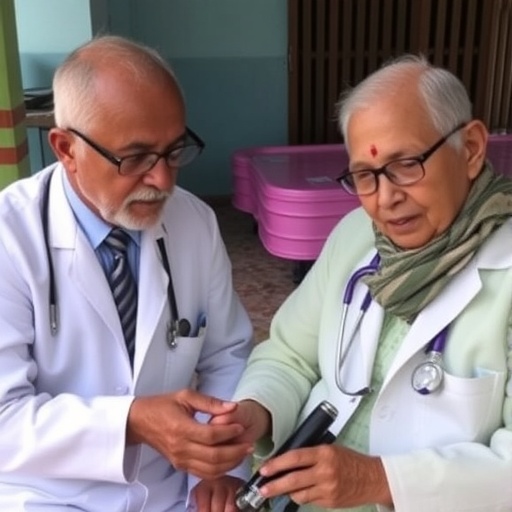
In the expansive rural landscapes of China, healthcare delivery faces persistent challenges, particularly for older adults grappling with chronic conditions such as diabetes. A recent groundbreaking study published in BMC Geriatrics explores an innovative approach to bridge healthcare gaps by leveraging the pivotal role of village doctors in integrated care provision. This cluster-randomized pilot trial sheds light on how empowering local healthcare workers can substantially enhance diabetes management among the elderly in rural settings, marking a crucial step toward equitable healthcare access and chronic disease control.
Diabetes, a global epidemic, disproportionately affects older populations in rural China, where access to specialized medical care remains limited. Traditional healthcare models often fail to address the complex needs of aging diabetic patients in these regions. The study led by Zhang, Q., Zhang, C., Zheng, J., and their colleagues investigates the efficacy of a village doctor-led integrated care model designed specifically for this vulnerable demographic. By embedding diabetes care within existing primary healthcare infrastructures, the intervention promises more personalized and continuous disease management.
This research adopts a cluster-randomized design, which strategically groups villages into intervention and control arms to evaluate the effect of the integrated care model. Village doctors in the intervention clusters received specialized training, equipping them with enhanced clinical skills and educational resources tailored for elderly diabetes patients. Their role extended beyond routine diagnosis, encompassing continuous monitoring, lifestyle counseling, medication management, and timely referrals to tertiary care when necessary. Such a comprehensive framework aims to address the multifactorial challenges posed by diabetes management among rural elderly populations.
A crucial aspect of the intervention was the integration of community-based resources and support systems. Village doctors collaborated closely with patients’ families and community leaders to foster an environment conducive to disease self-management and adherence to treatment protocols. This approach accounted for sociocultural factors unique to rural China, such as familial involvement in healthcare decisions and traditional health beliefs, which often influence patient behavior and treatment outcomes.
The pilot trial evaluated multiple outcome measures, including glycemic control, patient quality of life, and healthcare utilization. Early findings revealed significant improvements in blood glucose regulation among patients under the village doctor-led care model compared to those receiving standard care. This suggests that localized, continuous management not only facilitates better clinical outcomes but potentially reduces complications associated with uncontrolled diabetes, such as cardiovascular events and neuropathy.
Moreover, the intervention highlighted the potential of village doctors to act as agents of change within their communities. Their enhanced status and capabilities increased patient trust and engagement, critical factors in chronic disease management. The proximity and accessibility of village doctors contrasted starkly with the often distant and overburdened hospitals, reinforcing the feasibility of decentralizing specialized diabetes care to primary care settings without compromising quality.
The authors also underscore the training component as a cornerstone of the program’s success. Village doctors underwent rigorous, context-specific educational sessions focusing on the pathophysiology of diabetes, pharmacological treatments, behavioral modification strategies, and the interpretation of diagnostic biomarkers. This training enabled them to move from reactive to proactive care strategies, emphasizing prevention of complications and holistic management for older patients.
Technological integration played a subtle but essential role in the initiative. The use of digital health tools, including mobile health applications and electronic health records adapted for rural use, facilitated data collection, patient tracking, and remote consultations with specialized endocrinologists. This melding of traditional care with modern digital solutions represents a scalable model that could be replicated in similar low-resource settings worldwide, addressing the growing diabetes burden in aging populations.
An equally important finding relates to cost-effectiveness. By decentralizing diabetes management to village doctors, healthcare systems may alleviate pressure on tertiary hospitals and reduce overall expenditures associated with emergency care and hospital admissions. The study’s economic analysis, although preliminary, signals promising implications for sustainable healthcare financing in rural China, where budget constraints often hamper chronic disease management programs.
Community feedback was overwhelmingly positive, with patients reporting greater satisfaction due to improved communication, personalized care plans, and enhanced health literacy. The social dynamics fostered by village doctor-patient relationships contributed to better self-care behaviors, including adherence to diet, physical activity regimens, and medication schedules. These psychosocial factors are often overlooked but remain critical determinants of long-term diabetes control.
Despite the enthusiastic outcomes, the researchers acknowledge limitations intrinsic to pilot studies. The relatively small sample size and short follow-up period necessitate cautious interpretation of results and call for larger, multicenter trials to validate the findings. Additionally, variability in village doctor experience and resource availability across different regions could influence the generalizability of the intervention, highlighting the need for adaptable frameworks tailored to local contexts.
This study’s implications extend beyond diabetes care, offering a blueprint for integrated healthcare delivery in underserved rural regions facing multiple chronic disease burdens. By investing in human resource development at the community level and harnessing existing social frameworks, health systems can achieve substantial improvements in disease outcomes and patient well-being. The village doctor-led model exemplifies how blending traditional care paradigms with innovative strategies can transform rural healthcare landscapes globally.
Looking ahead, policy integration and systematic scaling of such programs require collaboration among government bodies, healthcare administrators, and local communities. Addressing infrastructural challenges, ensuring continuous professional development for village doctors, and embedding digital health technologies will be critical to sustaining and expanding integrated care initiatives. This could eventually form part of national health strategies aimed at universal health coverage and chronic disease prevention.
In summary, the pioneering work by Zhang and colleagues presents compelling evidence that village doctor-led integrated care models can significantly improve health outcomes for older adults with diabetes in rural China. By harnessing local healthcare providers’ proximity and cultural competence, coupled with targeted training and technological support, this approach offers a sustainable, patient-centered pathway to managing one of the most pressing public health challenges of our time. The study illuminates promising avenues for rural health innovation applicable across diverse global contexts.
Cite Scienmag News
Ophelia Keating. (May 26, 2026). Village Doctors Lead Diabetes Care for Rural Elders. Scienmag. https://scienmag.com/village-doctors-lead-diabetes-care-for-rural-elders/
Ophelia Keating. "Village Doctors Lead Diabetes Care for Rural Elders." Scienmag, 26 May 2026, https://scienmag.com/village-doctors-lead-diabetes-care-for-rural-elders/. Accessed 3 September 2026.
Ophelia Keating. "Village Doctors Lead Diabetes Care for Rural Elders." Scienmag. May 26, 2026. https://scienmag.com/village-doctors-lead-diabetes-care-for-rural-elders/


