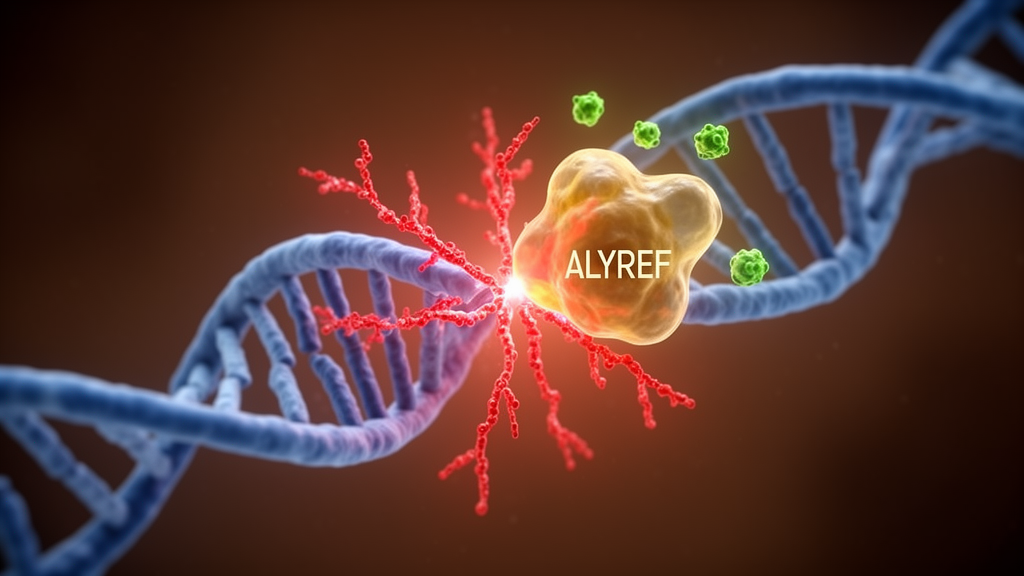
The protein, ALYREF, is rapidly recruited to double-strand breaks in the genome, where it latches onto chains of poly-ADP-ribose, a molecular scaffold that normally helps assemble the repair machinery. When ALYREF is present in excess, this binding appears to interfere with the orderly loading of early repair factors, delaying the repair of broken DNA strands. The findings, published in EMBO Reports, also reveal that ALYREF is highly expressed in many tumor types, raising the possibility that its overexpression contributes to genome instability in cancer cells.
DNA–RNA hybrids, structures in which an RNA transcript is paired with its DNA template, are a well-established source of genome instability because they can obstruct the machinery that copies DNA during cell division. These hybrids accumulate at sites of DNA damage, particularly double-strand breaks, where they are known as break-induced RNA-DNA hybrids. Previous work in yeast and human cells has shown that such hybrids can interfere with repair and must be removed before the damage can be faithfully mended.
To investigate, the researchers used laser microirradiation to generate localized DNA damage in human U2OS cells and tracked protein movement by live-cell imaging. ALYREF tagged with a fluorescent marker rapidly accumulated along the damaged stripes, reaching peak levels within about two minutes and disappearing by seven minutes. In contrast, UAP56/DDX39B was not recruited at all and appeared to be excluded from the damaged region. The team confirmed the recruitment of endogenous ALYREF by immunofluorescence and showed that overexpressed ALYREF was enriched at the laser stripe roughly twofold. They then used two additional systems to rule out artifacts of the laser approach: a U2OS-derived cell line expressing the AsiSI restriction enzyme, which can be activated to cut the genome at roughly 150 defined sites, and a CRISPR-Cas9 system that induces breaks in repetitive LINE1 sequences. Both approaches supported the conclusion that ALYREF, but not UAP56/DDX39B, accumulates at double-strand breaks regardless of how the damage is produced.
Because ALYREF is an RNA-binding factor that links transcription to RNA export, the researchers next asked whether its recruitment to breaks depends on ongoing transcription or on the DNA–RNA hybrids that form at damaged sites. Pretreating cells with transcription inhibitors such as DRB or cordycepin partially reduced ALYREF localization to the damaged stripes, and forcing cells to overexpress RNase H1, an enzyme that degrades DNA–RNA hybrids, also lowered ALYREF enrichment. These results indicate that transcription and hybrids contribute to, but are not strictly required for, ALYREF recruitment. The team also tested whether the RNA modification m5C, which ALYREF is known to read, might guide the protein to breaks; depleting the methyltransferase TRDMT1 had no effect, ruling out that mechanism.
The decisive factor turned out to be poly-ADP-ribose, or PAR. Early in the DNA damage response, the enzyme PARP-1 is activated and decorates damaged DNA ends with PAR polymers, which serve as docking sites for repair proteins. When the researchers inhibited PARP-1 with the drug olaparib before laser microirradiation, ALYREF recruitment to the damage sites was completely abolished. Conversely, blocking PARG, the enzyme that degrades PAR, caused ALYREF to accumulate more strongly and persist longer at the breaks. A similar reduction in ALYREF accumulation was seen when olaparib was applied to cells undergoing CRISPR-Cas9-induced breaks, confirming that the dependency on PARylation holds across different damage models.
To determine whether ALYREF binds PAR directly, the team purified recombinant ALYREF protein and performed in vitro binding assays. Wild-type ALYREF showed strong affinity for PAR polymers, whereas UAP56/DDX39B did not bind at all. Mutational analysis pinpointed the interaction to ALYREF’s RNA-binding motifs: a mutant called ALYREF-10E, in which the RGG/RG RNA-binding domain is disrupted, lost the ability to bind PAR. Another mutant, ALYREF-ΔNC, which cannot interact with UAP56/DDX39B, still bound PAR efficiently, showing that the interaction is independent of the helicase partner. When the PAR-binding-deficient ALYREF-10E mutant was expressed in cells, it failed to accumulate at laser-induced damage sites, supporting the conclusion that ALYREF’s intrinsic PAR-binding capacity mediates its recruitment to DNA breaks.
Having established how ALYREF reaches breaks, the researchers asked whether the protein influences repair itself. Using three established GFP-based reporter systems in U2OS cells that separately measure homologous recombination, non-homologous end joining, and single-strand annealing, they found that depleting ALYREF with small interfering RNAs reduced the efficiency of all three repair pathways. The effect was reproducible with two independent siRNAs and was also observed in hTERT-RPE1 cells depleted of ALYREF by CRISPR-Cas9, which showed increased DNA damage markers, particularly after olaparib treatment. In contrast, depleting UAP56/DDX39B reduced homologous recombination but had no effect on end joining, and the authors attribute this difference to the strong pleiotropic effects of UAP56/DDX39B loss on cell viability rather than a direct role at breaks.
Analysis of repair-factor dynamics provided clues about how ALYREF acts. In ALYREF-depleted cells, the exonuclease MRE11 tended to remain bound at damage sites for longer than in control cells, and the single-strand DNA-binding protein RPA70 showed a tendency to accumulate over time, suggesting increased DNA end resection. Conversely, when ALYREF was overexpressed, the researchers observed a delay in the disappearance of the γH2AX damage marker after laser microirradiation, indicating slower repair. Overexpression also altered the loading dynamics of KU70, which accumulated faster and continued to increase over time, and modestly delayed MRE11 recruitment. Critically, overexpressing the PAR-binding-deficient ALYREF-10E mutant did not perturb KU70 loading, demonstrating that the effect depends on ALYREF’s ability to bind PAR rather than on the mere presence of extra protein. Consistent with a direct interference mechanism, ALYREF overexpression significantly increased PAR signal at damage sites, as if the excess protein were retaining PAR polymers that would otherwise be turned over.
The clinical relevance of these findings emerged from database analyses. Mining TCGA tumor RNA-sequencing data, the team found that ALYREF is highly expressed in a large number of cancer types, including breast invasive carcinoma, ovarian carcinoma, pancreatic adenocarcinoma, lung adenocarcinoma, lung squamous cell carcinoma, colon and rectal adenocarcinomas, and bladder urothelial carcinoma. Data from cBioPortal indicated that the ALYREF gene is frequently amplified across cancers, with particularly high prevalence in BRCA2-deficient tumors from breast, ovarian, and pancreatic origins. Within breast invasive carcinoma, ALYREF expression was significantly elevated in HER2-positive and triple-negative subtypes, both among the most aggressive forms of the disease. The overexpression levels observed in tumors, as estimated from The Human Protein Atlas, fell in a range comparable to the experimental overexpression achieved in the U2OS cell system, although the authors note that no data are available to establish a reliable correlation between the transient overexpression used experimentally and endogenous tumor levels.
Linking ALYREF expression to treatment response, the researchers analyzed the Genomics of Drug Sensitivity in Cancer database and found that cancer cell lines with high ALYREF expression showed significantly increased sensitivity to the PARP inhibitor olaparib, reflected in lower IC50 values. Using the OncoPredict computational tool to extend the analysis to patient-derived breast tumor transcriptomic data, they found that the association was more pronounced in tumors predicted to be sensitive to olaparib. High ALYREF expression was generally associated with poorer patient survival, and the effect was stronger in olaparib-sensitive tumors. The team also observed differential survival outcomes with other chemotherapeutic agents: high ALYREF expression correlated with poorer survival under temozolomide treatment but better survival under etoposide treatment, a pattern the authors interpret as consistent with a specific impact of ALYREF overexpression on double-strand break repair rather than a general stress response. Together, the results suggest that ALYREF imbalance, whether through depletion or overexpression, disrupts the timely repair of DNA breaks, and that tumors with elevated ALYREF may represent a distinct subgroup with heightened sensitivity to PARP inhibition. The work points to ALYREF as a potential biomarker of tumorigenicity and suggests that disrupting the ALYREF–PAR interaction could open new therapeutic avenues for cancers with defective DNA repair.
Subject of Research: Role of the RNA-binding protein ALYREF in poly-ADP-ribose-dependent recruitment to DNA double-strand breaks and its impact on DNA repair and tumor biology
Article Title: ALYREF binds to poly-ADP-ribose at double strand breaks impairing repair in tumoral cells
Article References: Guillén-Mendoza, C., Silva, S., Bustamante-Sequeiros, M., Priego Moreno, S., Trujillo-Sierra, S., Núñez-Martín, I., Eliaz, L. M., Barroso, S., Gil-Lanza, N., Asua, L., Gómez-González, B., Bayona-Feliu, A., Xue, X., Luna, R., & Aguilera, A. (2026). ALYREF binds to poly-ADP-ribose at double strand breaks impairing repair in tumoral cells. EMBO Reports. https://doi.org/10.1038/s44319-026-00963-6
Image Credits: AI Generated
DOI: 10.1038/s44319-026-00963-6
Keywords: ALYREF, poly-ADP-ribose, DNA double-strand breaks, DNA repair, PARP inhibitors, R-loops, tumor overexpression, homologous recombination, non-homologous end joining, UAP56/DDX39B, genome instability, cancer biomarker
Cite Scienmag News
Nathaniel Bowman. (October 28, 2026). RNA Chaperone ALYREF Hijacks Poly-ADP-Ribose at DNA Breaks and Slows Repair in Tumor Cells. Scienmag. https://scienmag.com/rna-chaperone-alyref-hijacks-poly-adp-ribose-at-dna-breaks-and-slows-repair-in-tumor-cells/
Nathaniel Bowman. "RNA Chaperone ALYREF Hijacks Poly-ADP-Ribose at DNA Breaks and Slows Repair in Tumor Cells." Scienmag, 28 October 2026, https://scienmag.com/rna-chaperone-alyref-hijacks-poly-adp-ribose-at-dna-breaks-and-slows-repair-in-tumor-cells/. Accessed 29 October 2026.
Nathaniel Bowman. "RNA Chaperone ALYREF Hijacks Poly-ADP-Ribose at DNA Breaks and Slows Repair in Tumor Cells." Scienmag. October 28, 2026. https://scienmag.com/rna-chaperone-alyref-hijacks-poly-adp-ribose-at-dna-breaks-and-slows-repair-in-tumor-cells/