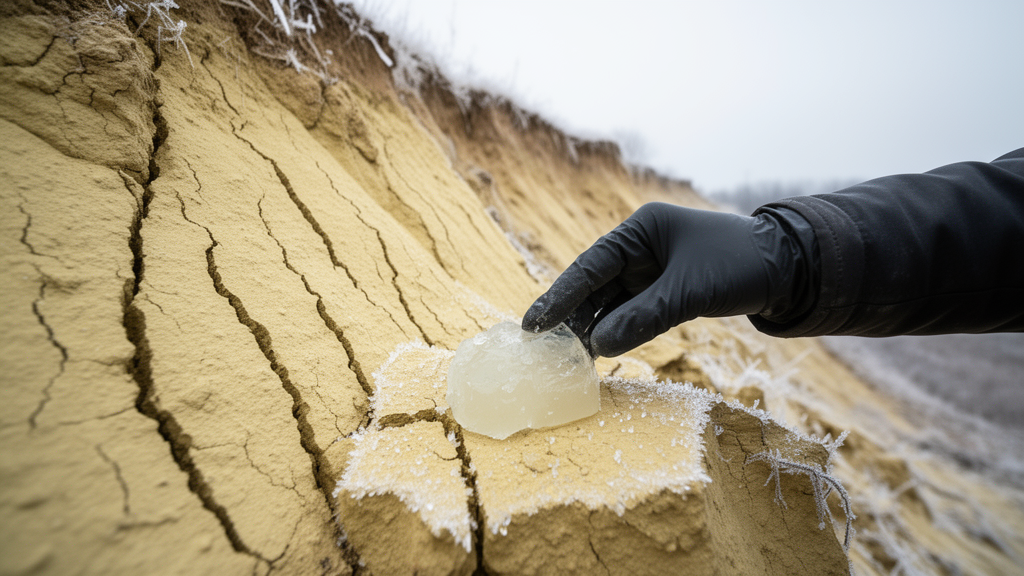
Loess slopes in China’s Yili River Valley spend up to five months a year frozen, and each winter-to-spring swing leaves the ground weaker. A laboratory study now reports that mixing a polymer hydrogel into this soil does something unusual: instead of merely slowing the damage caused by repeated freezing and thawing, it made the soil measurably stronger after the cycles were over. After 20 freeze–thaw cycles, the shear strength of hydrogel-treated loess rose from 269 to 491 kilopascals under 100 kilopascal confining pressure, an increase of 82.5 percent, while untreated loess lost 26.9 percent of its strength under the same conditions.
The work, published in the journal Geoenvironmental Disasters, was carried out by researchers at Chengdu University of Technology working with undisturbed loess sampled from the slope of the Songhu Iron Mine in Nilka County, Xinjiang. Loess is a wind-deposited silt that dominates much of arid northern China, and the Yili variant is particularly vulnerable: it is poorly graded silty clay, rich in water-sensitive montmorillonite, and it endures intense seasonal freeze–thaw cycling. When pore water freezes, ice crystals push apart the soil skeleton and break the delicate cementation bonds between particles; when it thaws, moisture redistributes and the soil softens. Repeated cycles progressively degrade mechanical properties, undermining slope stability and aggravating erosion.
Conventional fixes have drawbacks the authors lay out plainly. Inorganic binders such as cement and lime harden soil into a brittle structure that cracks under frost heave stress; excessive doses can also harm the soil habitat that plants depend on. Fiber reinforcement improves shear strength but faces decomposition or cost problems in long service. Most existing approaches, the team argues, focus on resisting strength loss rather than exploiting the freeze–thaw process itself. The hydrogel they tested, a composite of polyvinyl alcohol and sodium alginate, offers a different logic: a flexible three-dimensional network that absorbs hundreds of times its weight in water and can deform elastically to cushion the expansion of freezing pore water.
The experimental design was extensive. The researchers prepared cylindrical specimens 39.1 millimeters in diameter and 80 millimeters tall, mixing the loess with a fixed hydrogel dosage of 3 percent by dry soil mass at three initial water contents: 14.2 percent, matching the in-situ moisture of the excavated loess; 18.2 percent, its optimum moisture content; and 22.2 percent. An unmodified control group was prepared alongside. The specimens endured 0, 2, 5, 10, 15, and 20 freeze–thaw cycles, each lasting 24 hours with a temperature swing from minus 30 degrees Celsius to 36 degrees, rates drawn from 2020–2025 meteorological records for Nilke County. The cycles ran with no lateral or vertical load, mimicking the low-confinement state of shallow natural slopes. Every combination of water content, confining pressure, and cycle count was tested three times, yielding 216 standard triaxial tests in total.
The triaxial results, conducted under unconsolidated–undrained conditions at confining pressures of 25, 50, and 100 kilopascals, showed a fundamental shift in how the soil deforms. Untreated loess at 18.2 percent water content and 25 kilopascal confinement failed in a classic brittle manner: a sharp peak deviatoric stress of roughly 184 kilopascals at 4.2 percent axial strain, followed by a drop to 158 kilopascals by 15 percent strain. After 20 freeze–thaw cycles, the same control soil carried only about 98 kilopascals at 15 percent strain, a 46.7 percent loss relative to its initial peak. The hydrogel-treated specimens, by contrast, showed strain-hardening across the board. In the wettest group at 100 kilopascal confinement, deviatoric stress climbed continuously from 311 to 535 kilopascals as axial strain rose from 5 to 20 percent, an increase of 72 percent within a single test. The authors attribute this ductility to the polymer network dissipating energy through stretching and rearrangement of chains rather than through brittle breakage of cementation bonds.
Elastic modulus told the same story from the stiffness side. Measured from the initial linear portion of the stress–strain curve, the modulus of untreated loess at 100 kilopascal confinement fell from 15.0 megapascals before cycling to 10.2 after five cycles and 7.68 after twenty, a cumulative decline of 48.9 percent. The treated soil started far softer, at 5.8 megapascals, but its modulus rose to 8.0 megapascals after 20 cycles, a gain of 37.9 percent. The researchers note that the treated soil’s initial stiffness was lower because the flexible gel partially replaces rigid particle interlocking, yet the gel-softened soil grew stiffer with cycling while the untreated soil collapsed. Moisture mattered: at 14.2 percent water content the hydrogel was not fully hydrated, and its strengthening rate fell between the control and the fully hydrated group, indicating that adequate moisture is needed to form an effective flexible skeleton.
The strength gain was traced to apparent cohesion rather than friction angle. The internal friction angle of the treated soil fluctuated modestly with cycling, while apparent cohesion grew sharply, with the wettest group showing the largest increase. Fitting the data, the team derived a Mohr–Coulomb strength criterion in which cohesion depends quadratically on cycle number and water content, with a coefficient of determination of 0.717. They also established a linear relationship between shear strength and elastic modulus for the treated soil, with R² of 0.752, and argue that because modulus can be measured rapidly and non-destructively in the field with tools such as ground-penetrating radar or surface wave methods, slope strength could be estimated without destructive drilling and sampling.
Microstructural evidence backed the macroscopic numbers. Scanning electron microscopy showed that after five freeze–thaw cycles the hydrogel formed a flexible coating layer around particles, promoting rearrangement into denser aggregates and shifting particle contacts from point-surface to surface-surface configurations. Nuclear magnetic resonance measurements quantified the pore structure: after 20 cycles, the mean pore diameter of the control group grew from 1.45 to 2.25 micrometers, an increase of 0.80 micrometers, while the treated group grew only from 1.34 to 1.86 micrometers, an increase of 0.52 micrometers. The macropore proportion rose by 4.06 percent in the control but only 2.49 percent in the treated soil, and the pore fractal dimension of the control shifted by 0.0078 while the treated group varied by just 0.003. In the control soil, macropore proportion correlated strongly and negatively with every mechanical index, and a linear fit linked cumulative pore coarsening to strength loss with R² of 0.94, identifying pore coarsening as the mechanism behind freeze–thaw degradation.
Fourier-transform infrared spectroscopy added a molecular-level clue. In the hydroxyl stretching region between 3016 and 3696 wavenumbers, the treated soil showed significant changes in peak intensity and spectral broadening after five freeze–thaw cycles, which the authors interpret as hydrogel molecular chains unfolding and rearranging on particle surfaces so that more hydroxyl sites form hydrogen bonds with the clay mineral matrix. They identify this enhanced hydrogen-bonding network, which shifts the gel–soil interaction from simple physical filling toward stronger interfacial bonding, as the primary reason strength increases after cycling. The team also checked that the gain was not an artifact of changing soil state variables: matric suction in the treated soil actually fell from 120 to 85 kilopascals over 20 cycles, and saturation rose, both of which conventional unsaturated soil theory associates with weaker soil, making the structural reorganization by the gel network the remaining explanation.
The authors frame the result as a shift from damage resistance to strength enhancement, with the hydrogel acting as a stress-mitigating cushion during freezing and a water-retaining agent during thawing that enables particle densification under gravity and capillary action. They are careful about limits, however. The study used a single hydrogel dosage and only 20 cycles, laboratory conditions differ from the heterogeneous multi-field environment of real slopes, the microstructural analysis relied on post-cycling observations rather than in-situ monitoring, and the long-term effects on slope vegetation and soil ecology remain unassessed. Field-scale validation, longer durability testing across dosage gradients, and real-time imaging of pore evolution during cycling are all flagged as necessary next steps before the approach can move from the bench to slope stabilization and ecological restoration in seasonally frozen terrain.
Subject of Research: Hydrogel modification of Yili loess to enhance strength under seasonal freeze–thaw cycles
Article Title: Macroscopic mechanical response and microscopic action mechanism of hydrogel–modified Yili loess in seasonal frozen region
Article References: Zhang, X., Pei, X., Li, M., Wang, Z., Chang, M., Jiang, J., & Liao, R. (2026). Macroscopic mechanical response and microscopic action mechanism of hydrogel–modified Yili loess in seasonal frozen region. Geoenvironmental Disasters, 13(1), Article 62. https://doi.org/10.1186/s40677-026-00399-z
Image Credits: AI Generated
DOI: 10.1186/s40677-026-00399-z
Keywords: hydrogel, loess, freeze–thaw cycles, shear strength, triaxial testing, pore structure, NMR, SEM, FTIR, slope stability, Yili River Valley, soil improvement
Cite Scienmag News
Violet Maxwell. (October 28, 2026). Hydrogel turns freeze–thaw damage into strength gains for loess slopes. Scienmag. https://scienmag.com/hydrogel-turns-freeze-thaw-damage-into-strength-gains-for-loess-slopes/
Violet Maxwell. "Hydrogel turns freeze–thaw damage into strength gains for loess slopes." Scienmag, 28 October 2026, https://scienmag.com/hydrogel-turns-freeze-thaw-damage-into-strength-gains-for-loess-slopes/. Accessed 4 November 2026.
Violet Maxwell. "Hydrogel turns freeze–thaw damage into strength gains for loess slopes." Scienmag. October 28, 2026. https://scienmag.com/hydrogel-turns-freeze-thaw-damage-into-strength-gains-for-loess-slopes/