


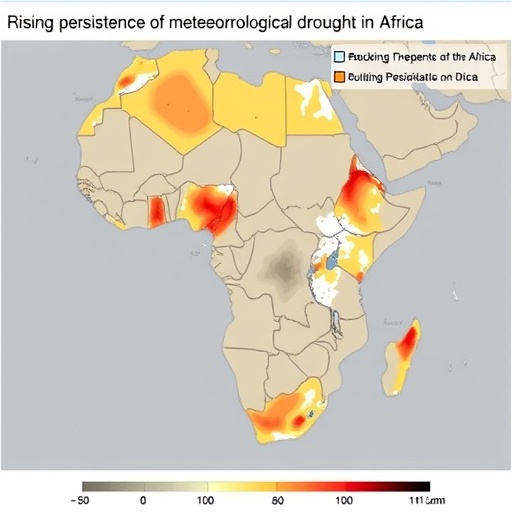
Meteorological droughts, defined as extended periods of deficient rainfall, have long posed significant challenges to the African continent. Yet, a groundbreaking new study published in Communications Earth & Environment reveals a startling evolution in the behavior of these droughts, with far-reaching consequences for environmental stability, human livelihoods, and regional economies. The research, led by Ogunrinde, Adigun, Diaraku, and their team, documents a dramatic reorganization in the spatial and temporal patterns of meteorological drought across Africa, accompanied by a worrisome increase in their persistence. This emergent phenomenon underscores a pressing need to rethink how drought risk is understood, forecasted, and managed on the continent.
At the heart of this study lies a sophisticated analysis of multiple decades of meteorological data, deploying advanced statistical techniques and climate modeling to identify subtle but critical changes in drought dynamics. Unlike previous studies that often treated meteorological drought as a relatively random or stationary phenomenon, Ogunrinde and colleagues uncover evidence of a growing structural shift. This shift manifests not only in the frequency and intensity of drought events but also in the way these dry spells organize themselves spatially across the continent, revealing novel clusters and extended dry zones that persist for longer durations.
Meteorological drought, primarily driven by deficits in precipitation, differs from agricultural and hydrological droughts, which refer to soil moisture deficits and decreased water supply in rivers and reservoirs, respectively. The study meticulously isolates meteorological drought conditions by analyzing precipitation anomalies relative to long-term baselines across various African regions. This granular approach allows the researchers to pinpoint emergent patterns that might have previously remained obscured by overarching climatic variability and noise.
One of the most alarming findings pertains to the increasing persistence of drought events. Persistent droughts—those lasting several consecutive months or even years—exert outsized impacts by draining soil moisture, reducing crop yields, and diminishing water availability for both urban and rural communities. The analysis reveals a significant uptick in these prolonged dry spells, particularly in the Sahel, Horn of Africa, and southern African regions. This extended duration complicates recovery efforts and exacerbates vulnerability among already stressed populations.
Moreover, the emergent reorganization of meteorological droughts implies that regions traditionally considered less prone to drought are beginning to experience more frequent and persistent dry conditions. This spatial reconfiguration challenges long-standing assumptions in disaster preparedness and agricultural planning. Areas once deemed relatively safe now face an elevated risk of drought-induced disruptions, necessitating a recalibration of resource allocation and early warning systems.
The researchers employed comprehensive drought indices, including the Standardized Precipitation Index (SPI), calculated over multiple accumulation periods to capture both short-term and medium-term moisture deficits. They then applied advanced clustering algorithms over spatial grids to detect contiguous dry regions, thereby unveiling a shifting mosaic of drought-affected zones. This methodological innovation allowed the team to move beyond simple frequency counts towards understanding the spatial coherence and temporal continuity of drought events.
Climate change is implicated as a major driver of these emergent patterns. Rising global temperatures influence atmospheric circulation and moisture transport, altering rainfall regimes across Africa’s diverse climatic zones. The study’s findings align with broader projections that suggest increasing climatic variability and extremes under ongoing anthropogenic warming scenarios. However, the observed reorganization and persistence exceed many climate model forecasts, signaling potentially underestimated drought risks.
The ecological ramifications of more persistent and spatially organized droughts are profound. Extended dry periods not only stress vegetation and wildlife but also disrupt ecosystem services such as carbon sequestration and soil stabilization. Recurrent drought episodes weaken the resilience of natural landscapes, leading to degradation, desertification, and loss of biodiversity. Such environmental degradation further undermines agricultural productivity, compounding socio-economic challenges.
From a socio-economic perspective, the human cost of drought intensification and reorganization is immense. Communities reliant on rain-fed agriculture are particularly vulnerable, with food security and livelihoods directly threatened by erratic precipitation patterns. Water scarcity, already a critical issue in many parts of Africa, is exacerbated by prolonged drought events, affecting domestic use, livestock, and industrial activities. The study thus underscores the urgency of integrating these drought dynamics into policy frameworks for disaster risk reduction and climate adaptation.
Importantly, the study’s insights carry practical implications for drought monitoring and early warning systems. Conventional monitoring tools may need to incorporate spatial clustering metrics and persistence indicators to better capture evolving drought threats. Enhanced forecasting models harnessing machine learning and high-resolution climate data could provide more timely and localized alerts, empowering governments and communities to take proactive measures.
Adaptation strategies must recognize the changing nature of drought. Investment in drought-resilient infrastructure, such as water harvesting and storage systems, alongside diversification of livelihoods, could buffer populations against the long-lasting dry episodes identified by this research. Additionally, reinforcing regional cooperation and knowledge exchange will be vital, given the transboundary nature of drought-related impacts and the spatial continuity of dry spells uncovered.
The multidisciplinary approach adopted by Ogunrinde and colleagues—combining climatology, statistics, and socio-environmental perspectives—sets a benchmark for future research. It opens avenues to explore links between meteorological drought and other climate extremes, such as heatwaves, wildfires, and floods, which increasingly interact in complex ways in a warming world. Understanding these synergies will be critical for comprehensive risk assessment and management.
In conclusion, this pivotal study redefines our understanding of meteorological drought across Africa, revealing a continent in the throes of a fundamental hydrometeorological shift. The emergent reorganization and enhanced persistence of drought represent a formidable challenge that transcends scientific interest, touching on the very fabric of human and ecological well-being. Addressing these challenges requires concerted efforts in research, policy innovation, and community engagement to build resilience in the face of a changing climate.
As droughts rewrite their own rules, the imperative to anticipate and adapt becomes ever more urgent. By illuminating these evolving drought dynamics with unprecedented clarity, the study by Ogunrinde, Adigun, Diaraku, and team provides a critical knowledge foundation to guide Africa’s path through an increasingly arid future.
Cite Scienmag News
Violet Maxwell. (April 25, 2026). Rising Persistence of Meteorological Drought in Africa. Scienmag. https://scienmag.com/rising-persistence-of-meteorological-drought-in-africa/
Violet Maxwell. "Rising Persistence of Meteorological Drought in Africa." Scienmag, 25 April 2026, https://scienmag.com/rising-persistence-of-meteorological-drought-in-africa/. Accessed 3 September 2026.
Violet Maxwell. "Rising Persistence of Meteorological Drought in Africa." Scienmag. April 25, 2026. https://scienmag.com/rising-persistence-of-meteorological-drought-in-africa/


