


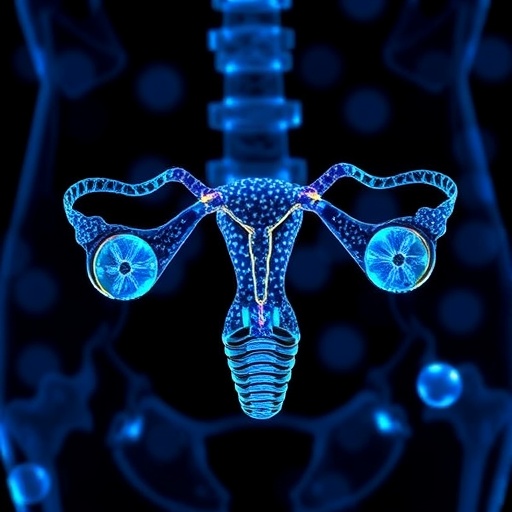
In a groundbreaking study published in Cell Death Discovery, researchers illuminate the sophisticated role of dynamic ion channel regulation in ovarian cancer, revealing how the delicate interplay between calcium and potassium currents orchestrated by KCNMA1 underpins cellular plasticity and therapeutic responsiveness. This discovery unravels a new layer of complexity in cancer biology where ion flux becomes a decisive factor in maintaining the epithelial/mesenchymal hybrid state that cancer cells exploit to thrive and evade treatment.
Ovarian cancer continues to be one of the deadliest gynecological malignancies, notoriously difficult to treat due to its adaptive capacity and heterogeneous cellular states. Central to this adaptability is the phenomenon known as the epithelial-to-mesenchymal transition (EMT), a process by which epithelial tumor cells gain mesenchymal traits, enhancing their invasive and metastatic potential. Notably, a hybrid epithelial/mesenchymal (E/M) state has emerged as critical for cancer progression and therapy resistance, yet the molecular mechanisms sustaining this precarious balance have remained elusive.
The study by Buchtova, Bartkova, Yamamoto, and colleagues shifts focus onto the ion channel KCNMA1, well recognized for its role in modulating potassium conductance across cellular membranes. By meticulously dissecting how KCNMA1 dynamically balances calcium and potassium ion fluxes, the research team illustrates that this delicate ionic equilibrium sustains the E/M hybrid phenotype within ovarian cancer cells. This phenotype endows cells with the agility to toggle between epithelial characteristics, favoring adhesion, and mesenchymal traits, promoting motility and invasiveness—essential facets of metastatic competence.
Ion channels have long been implicated in cancer physiology, but the intricate coupling between specific calcium and potassium fluxes and their direct impact on phenotypic states in ovarian cancer hitherto remained undefined. KCNMA1’s dual regulatory function pours new insight into how cellular bioelectric states dictate the transcriptional programs underlying cellular plasticity. The researchers employed a combination of electrophysiological measurements, live-cell imaging, and molecular interventions to decode the signaling pathways calibrated by KCNMA1 activity.
Integral to this discovery is the finding that modulation of KCNMA1 alters intracellular calcium dynamics, which in turn orchestrate downstream signaling cascades critical for maintaining a hybrid E/M transcriptional signature. This directly challenges traditional views that emphasized genetic alterations and soluble signaling molecules as dominant drivers of EMT and mesenchymal stability. Here, ion homeostasis emerges as a potent, yet previously underappreciated, regulator of phenotypic state transitions.
The implications extend beyond mechanistic biochemistry to practical therapeutic avenues. The study demonstrates that tweaking KCNMA1 channel activity influences how ovarian cancer cells respond to chemotherapy and targeted treatments. Specifically, disruption of the calcium-potassium balance mediated by KCNMA1 sensitizes cancer cells, breaking their evasive capacity and potentially overcoming resistance — a major obstacle in contemporary oncological practice.
By preserving the E/M hybrid state, KCNMA1 inadvertently supports cellular heterogeneity within tumors, a recognized driver of treatment failure. This protective effect underscores the channel’s double-edged role: while maintaining tumor plasticity that fuels metastasis, it simultaneously undermines therapeutic efficacy. Illuminating this axis presents an unprecedented target where ion channel modulation could synergize with existing therapies to curb tumor progression and resistance development.
The research also posits intriguing questions about the broader applicability of this ionic regulatory mechanism. Given that ion channels are ubiquitously expressed, could similar dynamic calcium-potassium interplay influence cellular plasticity in other tumors? Early evidence suggests that the bioelectric microenvironment may be a conserved modality by which cancers orchestrate complex phenotypic adaptations, potentially revolutionizing how ion channels are viewed in oncology—beyond passive conduits to active phenotypic modulators.
Furthermore, understanding the structural biology of KCNMA1 offers promising insights for drug development. The researchers highlight how specific conformational changes in the channel triggered by voltage and calcium binding underlie its precise gating function. Tailoring small molecules to modulate this gating with high specificity could enable fine-tuned interference, minimizing off-target effects—a perennial challenge in ion channel pharmacology.
One of the most compelling aspects of the study is its multidisciplinary approach, combining cellular electrophysiology with transcriptomic profiling to build a comprehensive picture of how fluctuating ion gradients translate into gene expression landscapes. This integrative methodology sets a new standard for studying tumor biology, advocating for a convergence of biophysics, molecular biology, and clinical oncology in addressing the complexity of cancer resilience.
The team’s findings also enrich the conceptual framework surrounding EMT and tumor heterogeneity. Instead of viewing the epithelial and mesenchymal states as static endpoints, the notion of an ion channel-governed slider between cellular states adds a dynamic dimension, emphasizing plasticity as a continuous spectrum rather than discrete categories. This paradigm shift could explain why targeting single molecular effectors has often failed, advocating for therapeutic strategies that destabilize plasticity maintenance mechanisms like KCNMA1.
Moreover, the research hints at potential biomarkers for predicting treatment responses. Measuring KCNMA1 expression or its electrophysiological activity could stratify patients according to their tumors’ plasticity state and therapy susceptibility. Such predictive markers would be invaluable in personalizing treatment regimens, moving toward precision medicine where ion channel dynamics inform clinical decisions.
The broader implications of this study extend beyond ovarian cancer. Similar principles could reshape our understanding of developmental biology and tissue regeneration, where epithelial/mesenchymal plasticity plays crucial physiological roles. Insights gleaned here might illuminate new strategies for regenerative medicine, controlling cellular states through ion channel manipulation to guide tissue repair and fibrosis.
In conclusion, the revelation that KCNMA1-mediated dynamic balancing of calcium and potassium ions preserves the coveted epithelial/mesenchymal hybrid state marks a pivotal advance in cancer biology. This discovery not only deepens our molecular understanding of ovarian cancer progression but also unveils a novel therapeutic target poised to disrupt cancer plasticity and treatment resistance. As ion channels step into the spotlight as master regulators of cellular identity, the promise of bioelectric modulation heralds an exciting frontier in precision oncology.
Buchtova and her colleagues’ work propels a paradigm shift wherein the electrical properties of cancer cells are harnessed as intrinsic regulators of malignancy, fundamentally altering how we perceive and tackle tumor biology. Their study eloquently exemplifies how integrating ion channel physiology into cancer research unveils uncharted avenues for therapy, offering hope against one of the most relentless forms of cancer.
Cite Scienmag News
Nathaniel Bowman. (June 6, 2026). KCNMA1 Balances Calcium–Potassium to Impact Ovarian Cancer. Scienmag. https://scienmag.com/kcnma1-balances-calcium-potassium-to-impact-ovarian-cancer/
Nathaniel Bowman. "KCNMA1 Balances Calcium–Potassium to Impact Ovarian Cancer." Scienmag, 6 June 2026, https://scienmag.com/kcnma1-balances-calcium-potassium-to-impact-ovarian-cancer/. Accessed 4 September 2026.
Nathaniel Bowman. "KCNMA1 Balances Calcium–Potassium to Impact Ovarian Cancer." Scienmag. June 6, 2026. https://scienmag.com/kcnma1-balances-calcium-potassium-to-impact-ovarian-cancer/


