


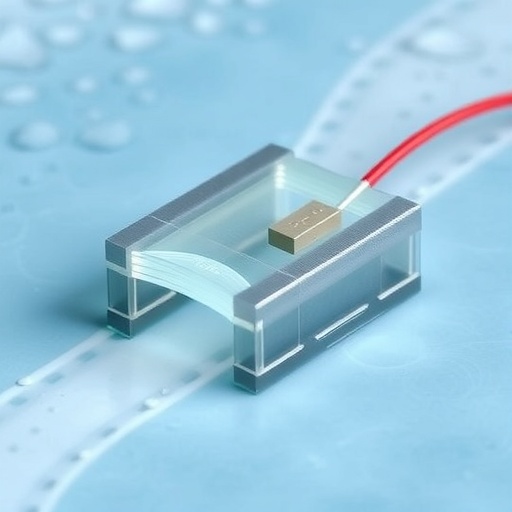
In the relentless pursuit of sustainable energy storage solutions, researchers have made a groundbreaking discovery that could revolutionize the field of supercapacitors. A team led by Artemov, Babiy, Teng, and colleagues has unveiled a novel all-water supercapacitor, distinguished by its utilization of ultra-narrow 1-nanometer clay channels. This innovation, recently published in Nature Communications, promises a new horizon in energy storage technology by leveraging the unique properties of naturally occurring materials combined with cutting-edge nanotechnology.
Supercapacitors are essential for the rapid charging and discharging of energy in various applications, from electric vehicles to renewable energy systems. However, conventional supercapacitors face limitations related to their electrolyte stability, environmental impact, and scalability. The newly developed device stands apart by incorporating a water-based electrolyte, buffered within the confines of sub-nanometer clay channels, which not only enhances performance but also introduces a level of environmental friendliness previously unattainable in this field.
At the heart of this innovation is the use of synthetic clay materials engineered to possess precisely 1-nanometer-wide channels. These channels provide highly confined pathways for electrolyte ions, significantly impacting ion transport dynamics and electrochemical stability. The constrained nanochannels effectively attenuate the deleterious effects that typically plague aqueous electrolytes, such as evaporation, leakage, and limited voltage windows, without compromising the ionic conductivity crucial for high performance.
The research team meticulously characterized the physicochemical properties of these clay channels, demonstrating their ability to hold and direct water molecules and ions with unprecedented precision. This molecular confinement alters the structure and dynamics of the aqueous environment, showcasing distinct behaviors compared to bulk water. The result is a supercapacitor electrolyte where ion mobility is optimized, and unwanted side reactions are suppressed, culminating in enhanced device longevity and efficiency.
One of the most striking features of the all-water supercapacitor is its voltage window, which surpasses conventional aqueous systems. Typically, water-based electrolytes struggle to exceed voltages of about 1.23 volts due to water splitting. However, the 1-nm clay channels create a unique microenvironment that elevates the voltage threshold without triggering deleterious electrochemical reactions. This breakthrough could open avenues for aqueous supercapacitors to manage energy with higher densities, rivaling those of organic solvent-based counterparts, while maintaining safety and eco-friendliness.
Furthermore, the fabrication process used to integrate the 1-nm clay channels into the supercapacitors emphasizes scalability and environmental consciousness. The researchers utilized abundant and inexpensive clay minerals as templates, which can be synthesized and processed through water-based chemical methods. This approach not only reduces the cost barrier traditionally associated with nanoscale engineering but also aligns with sustainable manufacturing paradigms vital for scaling next-generation energy storage devices to real-world applications.
Electrochemical performance tests revealed remarkable capacitance retention over thousands of charge-discharge cycles, showcasing the device’s potential for practical use where durability is paramount. The suppression of electrolyte degradation and mechanical stability under repeated cycling attest to the mechanical robustness of the clay-based channel structures. The water-based electrolyte also imparts safety benefits by mitigating risks associated with flammability and toxicity prevalent in organic electrolyte systems.
Beyond energy storage, the 1-nm clay channel framework exhibits promising implications for ion sieving and selective ion transport technologies. The profound control over ionic pathways demonstrated in this work could influence the design of other functional devices in sensing, filtration, and catalysis. This study exemplifies how the marriage of naturally occurring materials with nanoscale engineering can unlock multifunctional platforms with transformative technological potential.
The interdisciplinary approach employed in the study combines mineralogy, electrochemistry, materials science, and nanofluidics. By harnessing the natural affinity of water molecules to confined spaces, the team created an entirely new electrolyte paradigm. These insights deepen scientific understanding of how confined water behaves differently from bulk water, influencing charge storage and transfer processes at the molecular level.
Looking forward, the prospects for integrating this technology into commercial devices appear highly promising. The compatibility of the all-water supercapacitor with existing manufacturing protocols, combined with its enhanced sustainability and performance metrics, makes it an attractive candidate for next-generation energy storage. The researchers envision applications extending from portable electronics to grid-scale renewable energy stabilization, where safety, cost, and environmental impact are critical considerations.
As demand for rapid, safe, and sustainable energy storage solutions surges worldwide, breakthroughs like the all-water supercapacitor enabled by 1-nanometer clay channels reinforce the importance of exploring unconventional materials and nanoscale phenomena. This work not only advances supercapacitor technology but offers an inspiring example of how nature-inspired nanotechnology can forge new paths toward a clean energy future.
The study also highlights the importance of fundamental research into the interplay between materials structure and electrochemical behavior. Uncovering how the nano-confined water environment alters ion hydration and electrochemical stability provides a foundation for further innovations. The strategic use of layered clay minerals introduces a versatile platform to tailor electrolyte properties precisely, potentially enabling customized energy storage solutions optimized for specific applications.
While challenges remain, such as optimizing device integration and upscaling manufacturing techniques, the implications of this discovery extend far beyond the laboratory. The 1-nm clay channel supercapacitor could herald a new era of high-performance, environmentally benign energy storage devices that address both the technological and ecological demands of modern society.
Ultimately, the work by Artemov and colleagues embodies the cutting edge of energy materials research, merging detailed nanostructural engineering with the pragmatic requirements of real-world application. Their pioneering results demonstrate that harnessing the governing principles of nanoscale confinement and water chemistry can yield unprecedented performance breakthroughs, with profound societal implications for sustainable technological advancement.
Cite Scienmag News
Faith Mcneil. (June 5, 2026). 1-Nm Clay Channels Power All-Water Supercapacitor. Scienmag. https://scienmag.com/1-nm-clay-channels-power-all-water-supercapacitor/
Faith Mcneil. "1-Nm Clay Channels Power All-Water Supercapacitor." Scienmag, 5 June 2026, https://scienmag.com/1-nm-clay-channels-power-all-water-supercapacitor/. Accessed 3 September 2026.
Faith Mcneil. "1-Nm Clay Channels Power All-Water Supercapacitor." Scienmag. June 5, 2026. https://scienmag.com/1-nm-clay-channels-power-all-water-supercapacitor/


