


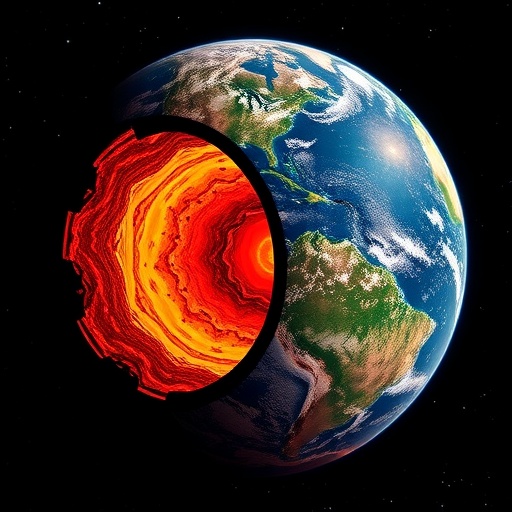
Earth’s deepest boundary may be hiding a chemical fingerprint left over from the planet’s earliest history. A new study by C. Lv, W. Wang, T. Wang and colleagues reports evidence for an enrichment of heavy iron isotopes at the core–mantle boundary, the immense region where Earth’s rocky mantle meets its metallic core nearly 2,900 kilometres beneath the surface. The finding offers scientists a new way to investigate how Earth’s interior evolved, how material moves through the deep mantle and how the planet’s core and mantle have exchanged chemical signals over geological time.
Iron is not a single uniform substance at the atomic level. It occurs naturally as several stable isotopes, atoms that contain the same number of protons but different numbers of neutrons. The most common iron isotope is iron-56, while heavier forms such as iron-57 and iron-58 contain additional neutrons. These isotopes behave almost identically in ordinary chemical reactions, but their small mass differences can cause them to separate under extreme conditions. Such isotope fractionation can preserve information about temperature, pressure, chemical reactions and the movement of matter deep inside a planet.
The core–mantle boundary is one of Earth’s most dramatic geological environments. Above it lies the solid silicate mantle, which slowly circulates over millions of years through convection. Below it is the liquid outer core, composed mainly of iron and nickel, surrounding the solid inner core. Temperatures and pressures at this boundary are immense, and the region is far beyond the reach of direct sampling. Scientists therefore rely on indirect evidence, including seismic waves, laboratory experiments, high-pressure mineral physics, geochemical modelling and isotopic measurements from rocks that may have originated in the deep mantle.
The reported heavy iron isotopic enrichment is significant because it suggests that iron-bearing materials near the boundary do not have exactly the same isotopic composition as iron found elsewhere in Earth’s interior or at the surface. “Heavy” in this context does not mean that the region contains more iron overall. It means that the relative proportion of heavier iron isotopes is elevated. That distinction is crucial: isotope ratios act more like a chemical signature than a simple measure of abundance, allowing researchers to trace processes that may otherwise leave little visible evidence.
One possible implication is that the core and mantle have exchanged material or chemical information more actively than traditionally assumed. Earth’s core formed early in the planet’s history as dense molten metal separated from silicate rock and sank toward the centre. During that process, iron and other elements were redistributed under extreme heat and pressure. If isotope fractionation occurred during core formation, crystallisation or later reactions at the boundary, the resulting signature could have remained locked in parts of the deep mantle for billions of years.
The finding may also help illuminate the behaviour of the lowermost mantle, a region known for unusual structures and complex chemistry. Seismic studies have identified large, dense provinces near the core–mantle boundary, as well as thin, ultra-low-velocity zones that may represent partially molten or compositionally distinct material. Heavy iron isotopes could provide an additional clue to the origins of these features. They might reflect ancient remnants of differentiated planetary material, chemical exchange between core and mantle, or processes associated with melting and crystallisation in the boundary layer.
Iron isotope fractionation is controlled by both physics and chemistry. At high temperatures, isotope differences are generally small, but they can become more pronounced when iron changes its chemical environment, oxidation state or mineral host. Iron can exist in different valence states, particularly iron-2 and iron-3, and these forms partition differently among minerals and melts. Pressure can further alter the structure and electronic behaviour of iron-bearing materials. As a result, an isotopic anomaly at the core–mantle boundary could encode a combination of thermal, chemical and mineralogical processes rather than a single event.
The result is especially intriguing for understanding the long-term evolution of Earth’s core. The outer core’s movement generates the planet’s magnetic field, while heat escaping from the core drives important aspects of mantle dynamics. Any chemical exchange across the boundary could affect the density and buoyancy of material, influence convection and modify how heat flows between the core and mantle. These processes are connected to the stability of the magnetic field, the development of mantle plumes and the formation of volcanic systems that eventually transport deep material toward the surface.
Scientists will now need to determine how widespread the heavy iron isotope signature is and precisely what process produced it. The answer may come from comparing deep-mantle rocks, volcanic materials thought to originate from ancient reservoirs and high-pressure experiments that recreate conditions at the boundary. Numerical models will also be essential, because they can test whether proposed isotope differences could survive over geological time despite the intense mixing expected inside Earth. The study’s evidence does not mean that the entire core–mantle boundary has a uniform composition; instead, it points to a measurable signal that may reveal previously hidden complexity.
Because the boundary cannot be drilled or sampled directly, every new chemical clue has unusual value. Heavy iron isotopes could become a powerful tracer of Earth’s internal history, linking the planet’s earliest differentiation to present-day geological activity. The discovery transforms an otherwise inaccessible interface into a potential archive of planetary evolution. Far below earthquakes, volcanoes and continental drift, the core–mantle boundary may be preserving the isotopic memory of how Earth became the layered, dynamic world it is today.
Cite Scienmag News
Violet Maxwell. (August 7, 2026). Study Finds Heavy Iron Isotopes Enriched at Earth’s Core-Mantle Boundary. Scienmag. https://scienmag.com/study-finds-heavy-iron-isotopes-enriched-at-earths-core-mantle-boundary/
Violet Maxwell. "Study Finds Heavy Iron Isotopes Enriched at Earth’s Core-Mantle Boundary." Scienmag, 7 August 2026, https://scienmag.com/study-finds-heavy-iron-isotopes-enriched-at-earths-core-mantle-boundary/. Accessed 4 September 2026.
Violet Maxwell. "Study Finds Heavy Iron Isotopes Enriched at Earth’s Core-Mantle Boundary." Scienmag. August 7, 2026. https://scienmag.com/study-finds-heavy-iron-isotopes-enriched-at-earths-core-mantle-boundary/


