


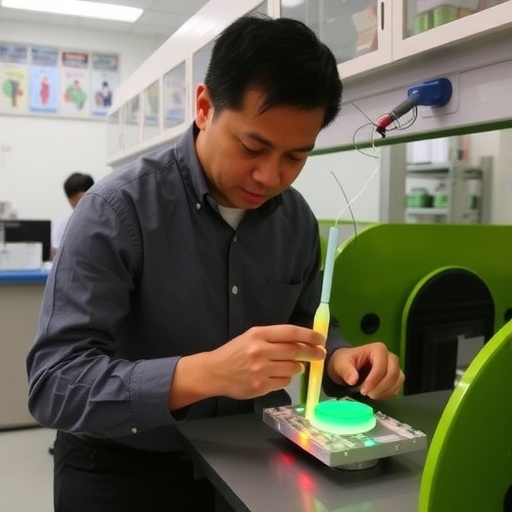
Rice University engineers have developed a charge-based method for controlling how therapeutic peptides are released from gelatin microparticles, potentially addressing one of the most persistent challenges in regenerative medicine: keeping small, biologically active molecules at a treatment site long enough to support healing. In experiments, the approach allowed a bone-promoting peptide to remain associated with its carrier and release gradually for as long as two to three weeks.
Peptides are attractive candidates for tissue engineering because they can be designed to activate highly specific biological processes, including bone formation, blood vessel growth and tissue repair. They are generally smaller, easier to manufacture and often more stable than full-sized proteins. Their compact structure also creates a delivery problem. When placed inside hydrogels or other water-rich biomaterials, peptides can rapidly diffuse into the surrounding fluid, producing a large initial burst followed by little therapeutic activity at the target site.
The new study, published in Cell Biomaterials, shows that electrostatic interactions can be used to slow this escape. The research team, led by Antonios Mikos, the Louis Calder Professor of Bioengineering and Chemical and Biomolecular Engineering at Rice, modified the electrical charge of a model peptide and examined how it interacted with gelatin microparticles. By creating attraction between the peptide and the carrier, the engineers were able to regulate how quickly the molecule moved out of the material.
The team focused on osteogenic growth peptide, or OGP, a short molecule associated with the formation of bone. Researchers added brief sequences of charged amino acids to OGP, producing positively charged, negatively charged and electrically balanced versions. These modified peptides were then loaded into gelatin microparticles. The particles were selected as carriers because gelatin is biocompatible, widely studied in regenerative medicine and capable of carrying different electrical charges depending on the way it is processed.
At the molecular level, the system relies on noncovalent electrostatic attraction rather than a permanent chemical bond. Oppositely charged regions on the peptide and gelatin interact, making it more difficult for the peptide to diffuse through the water-filled spaces within the particle. The strength and duration of that interaction can be influenced by the number and distribution of charged groups, as well as by the surrounding environment. Because the peptide is not permanently attached, it can ultimately leave the carrier in a soluble form.
The researchers compared how the different peptide variants behaved after being incorporated into the microparticles. They measured loading efficiency, release rates and the extent of the early burst release that commonly occurs when drug-loaded biomaterials are immersed in liquid. They also evaluated whether modifying the charge of the carrier altered swelling or degradation, two properties that can affect how a gelatin-based delivery system behaves in tissue.
The electrical charge of the peptide itself had the strongest influence on its release profile. Positively charged modifications generally produced greater retention inside the gelatin particles and reduced the rapid initial loss of peptide. The charge of the gelatin carrier also affected release, but adding additional charged peptide sequences directly to the gelatin produced a more limited change. Those carrier modifications did not significantly alter the particles’ swelling or overall degradation, suggesting that release could be adjusted without dramatically changing the material’s physical breakdown.
One positively charged version of OGP was released gradually for 14 to 21 days in enzyme-containing conditions designed to reproduce aspects of a healing tissue environment. That timeframe is important because many small peptides delivered through conventional hydrogel systems remain at the site for only a few days unless they are chemically linked to the material. Extending release into the two- or three-week range could help provide a more sustained biological signal during the early stages of tissue regeneration.
The Rice team says the strategy could be adapted beyond bone repair. A charge-modified peptide might be selected to encourage blood vessel formation, stimulate connective-tissue repair or support other regenerative processes, with the carrier and peptide engineered to produce a desired release curve. The researchers emphasize that the method provides several variables for tuning delivery, including the peptide’s charge, the gelatin’s electrical properties and the density of charged interaction sites. Further studies will be needed to determine how the system performs in living tissue, but the results point to a relatively simple way to turn peptide delivery from a rapid burst into a controlled, sustained treatment.
Web References: https://www.sciencedirect.com/science/article/pii/S3050562326002096?via%3Dihub; https://profiles.rice.edu/faculty/antonios-mikos; https://mikoslab.rice.edu/emily-jiang/
References: Cell Biomaterials; DOI: 10.1016/j.celbio.2026.100553
Keywords
Therapeutic peptides, gelatin microparticles, controlled release, electrostatic interactions, osteogenic growth peptide, bone regeneration, tissue engineering, regenerative medicine, drug delivery, Rice University
Cite Scienmag News
Alan Morgan. (August 7, 2026). Rice Scientists Harness Electrical Charges for More Precise Peptide Delivery. Scienmag. https://scienmag.com/rice-scientists-harness-electrical-charges-for-more-precise-peptide-delivery/
Alan Morgan. "Rice Scientists Harness Electrical Charges for More Precise Peptide Delivery." Scienmag, 7 August 2026, https://scienmag.com/rice-scientists-harness-electrical-charges-for-more-precise-peptide-delivery/. Accessed 5 September 2026.
Alan Morgan. "Rice Scientists Harness Electrical Charges for More Precise Peptide Delivery." Scienmag. August 7, 2026. https://scienmag.com/rice-scientists-harness-electrical-charges-for-more-precise-peptide-delivery/


