


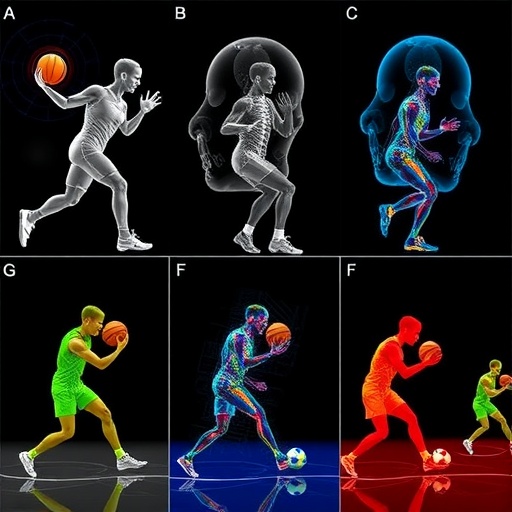
In a development that could reshape how schools, coaches, and clinicians keep track of adolescent physical health, researchers have unveiled an artificial intelligence system that fuses depth-camera video and wearable inertial sensor data to recognize sports movements and flag abnormal health behaviors with an accuracy exceeding 90 percent. The study, published in the journal Discover Artificial Intelligence, tackles a problem that has long frustrated public health researchers: adolescents are moving less, getting fatter, and becoming more nearsighted, yet the tools used to monitor their physical activity remain crude, subjective, and fragmented.
The urgency behind the work is stark. Over the past decade, moderate-to-vigorous physical activity among adolescents has dropped by roughly 40 percent, according to figures cited in the study. In developing countries, about a third of urban teenagers are now overweight or obese by World Health Organization standards, and in regions with intense academic workloads, nearly two-thirds of children suffer from myopia. Traditional monitoring approaches—questionnaires and manual observation by teachers or coaches—are ill-suited to the scale of the problem. Self-reported activity levels diverge from accelerometer-measured reality by 25 to 38 percent in meta-analyses, a gap the authors attribute to cognitive and memory biases. Manual observation, meanwhile, cannot possibly cover the full breadth of a teenager’s daily activities, and both methods yield fragmented snapshots rather than the continuous behavioral profiles needed to design personalized interventions.
The new system, developed by Di Dai and Yuanyuan Fan, attacks these limitations at both the hardware and algorithmic levels. On the hardware side, the architecture envisions a ZigBee-networked array of wearable devices—oxygen sensors, carbon dioxide sensors, and piezoelectric thin-film sensors—combined with inertial measurement units and depth-video cameras. From the physiological streams, the system can derive peak oxygen uptake from the discrepancy between oxygen and carbon dioxide readings during exertion, respiratory entropy from the ratio of carbon dioxide production to oxygen consumption, and heart rate from photoplethysmography waveforms generated by the piezoelectric film as hemodynamic changes induce predictable optical scattering. Heart rate then serves as a baseline biometric to stabilize the other physiological readings. An XML and web middleware layer handles information interaction and command transmission, treating continuous, long-horizon monitoring as a first-class design constraint rather than an afterthought.
The algorithmic heart of the system lies in a novel multimodal fusion strategy built around two image-like representations. The first is the depth motion image, or DMI. Depth video sequences—captured as a set of depth image frames—contain rich spatiotemporal information about a moving body, including the cumulative effect of an action across time. The researchers map these depth sequences onto three orthogonal Cartesian planes (frontal, lateral, and horizontal) and compute, for each plane, the accumulated sum of absolute pixel-level differences between successive frames. Because different adolescent actions span different durations, the resulting DMIs vary in size, so all are uniformly rescaled to identical dimensions via bicubic interpolation. The second representation is the signal image: the six raw signal streams from a wearable inertial unit—triaxial angular velocity and triaxial acceleration—are stacked row by row in a carefully chosen interleaved ordering (1-2-3-4-5-6-1-3-5-2-4-6-1-4-1-5-2-5-3-6-4-3-2-6), so that every sequence sits adjacent to every other sequence and each appears four times, yielding a 24-column image in which a residual convolutional network can exploit hidden temporal dependencies between channels.
To sharpen feature representation further, both the DMIs and the signal images are processed with the local ternary pattern (LTP) operator, a texture descriptor that encodes each pixel neighborhood into three discrete levels: values exceeding a threshold n relative to the center pixel are labeled +1, values below it by more than n are labeled −1, and everything within the tolerance band is labeled 0. The resulting ternary codes are summed as powers of three into a compact pattern value. With the threshold n set to 5 in these experiments, LTP captures subtle motion patterns that raw intensity representations tend to wash out, and the LTP-processed images are treated as supplementary modalities alongside the originals.
Feature extraction then proceeds through a ResNet101 residual network, initialized from ImageNet-pretrained weights and fine-tuned separately on each modality stream—raw and LTP-processed DMIs on the depth side, raw and LTP-processed signal images on the inertial side. The features from each pair are concatenated into per-modality descriptors, and here the study makes its most consequential design choice: rather than simply concatenating the two 2048-dimensional feature vectors or relying on canonical correlation analysis (CCA), the authors apply discriminant correlation analysis (DCA), a class-aware fusion technique that solves a generalized eigenvalue problem to find projection directions maximizing between-class scatter while suppressing within-class scatter.
The distinction matters because adolescent sports actions exhibit both large within-class variation—different subjects, viewpoints, speeds, and equipment—and substantial between-class similarity in short segments. The take-off phase of a sprint, for instance, produces visual and inertial descriptors nearly indistinguishable from the take-off of a standing long jump. CCA, which maximizes only the overall correlation between two modality sets, tends to preserve directions along which both within-class variation and between-class similarity are large, leaving the fused representation weakly discriminative. DCA instead whitens the inter-class scatter matrix of each modality, reduces it to a low-dimensional space via singular value decomposition of the inter-set correlation matrix, and aligns the two modalities so that non-zero correlations exist only between counterpart features of the same class. The transformed features are then combined by summation—chosen for its reduced dimensionality and computational efficiency—and fed into a multi-class support vector machine with a radial basis function kernel, penalty parameter C set to 1, solved through one-versus-one decomposition.
Experimental validation was carried out on the publicly available UTD-MHAD multimodal benchmark, which provides synchronized Kinect depth video and six-axis inertial signals. From the full 27-action set, the authors selected five sports-relevant classes representative of adolescent physical activity: basketball shoot, bowling, tennis serve, baseball swing, and tennis swing. Following the standard cross-subject protocol, samples from odd-indexed subjects trained the model while even-indexed subjects were held out for testing, with 10 percent of the training data reserved for hyperparameter selection. To guard against the luck of a single random draw, training was repeated across ten random seeds, and a four-fold subject-wise cross-validation provided an additional stability check. All experiments ran in MATLAB R2019b on an Intel Xeon Gold 5115 CPU with an NVIDIA Quadro P4000 GPU, using stochastic gradient descent with momentum at an initial learning rate of 0.001 and a batch size of 32 over 50 epochs per stream. DCA retained the top four discriminant directions from each modality, compressing the two 2048-dimensional streams into a shared four-dimensional discriminant space.
The results were decisive. Training accuracy stabilized between 0.94 and 0.96, and on the held-out test set the system surpassed 90 percent recognition accuracy across the five action categories, with most classes reaching upper-90 percent accuracy. F1 scores hovered close to 1 across all categories, indicating balanced precision and recall. Confusions that did remain concentrated in action pairs sharing similar take-off or upper-body signatures—precisely the class-similarity problem the DCA fusion was designed to address. An ablation study isolating the fusion operator, with backbones and classifier held fixed, showed that DCA-based fusion consistently beat both direct concatenation and CCA-based fusion across the ten repeated runs, with the paired t-test confirming the advantage over concatenation was statistically significant. The authors attribute the weakness of direct concatenation to its doubled 4096-dimensional feature space, which, under limited training samples, dilutes the discriminative signal—a problem DCA sidesteps by learning separate class-aware projections for each modality.
The study positions itself carefully against the 2025 state of the art. Multimodal frameworks such as MAF-Net, which combines skeleton and inertial streams through weighted late fusion, report 92.0 percent on the full UTD-MHAD cross-subject protocol, while XTinyHAR, a distillation-based transformer compressing a multimodal teacher into an inertial-only student, reaches 98.71 percent. The authors note these reference numbers are not strictly protocol-matched to their five-class experiment, but they argue their pipeline offers a lighter, single-pass alternative that requires neither a large distillation teacher nor heavy attention stacks while retaining an explicit inter-class separability objective at the fusion stage—a meaningful trade-off for systems that must run continuously on modest edge hardware in schools and clinics.
Beyond the leaderboard numbers, the work signals something larger: the maturing of image-encoded sensor representations as a practical paradigm. By converting raw time-series data into images, processing them with classical texture descriptors, and fusing them through a statistically principled, class-aware operator, the system demonstrates that robust adolescent health monitoring does not demand exotic architectures—only the right marriage of representation and fusion. As the authors conclude, the framework provides technical support for the sustainable design of dynamic monitoring systems, offering a meaningful step toward addressing the growing toll of physical inactivity on the next generation. With the physiological sensing branch of the architecture awaiting controlled data collection under ethics clearance, the stage is set for full multimodal deployment—depth cameras, inertial units, and metabolic sensors working in concert to watch over the health of adolescents around the clock.
Cite Scienmag News
Blake Davidson. (September 5, 2026). Multimodal fusion boosts recognition of teen sports and abnormal health behaviors. Scienmag. https://scienmag.com/multimodal-fusion-boosts-recognition-of-teen-sports-and-abnormal-health-behaviors/
Blake Davidson. "Multimodal fusion boosts recognition of teen sports and abnormal health behaviors." Scienmag, 5 September 2026, https://scienmag.com/multimodal-fusion-boosts-recognition-of-teen-sports-and-abnormal-health-behaviors/. Accessed 5 September 2026.
Blake Davidson. "Multimodal fusion boosts recognition of teen sports and abnormal health behaviors." Scienmag. September 5, 2026. https://scienmag.com/multimodal-fusion-boosts-recognition-of-teen-sports-and-abnormal-health-behaviors/


