


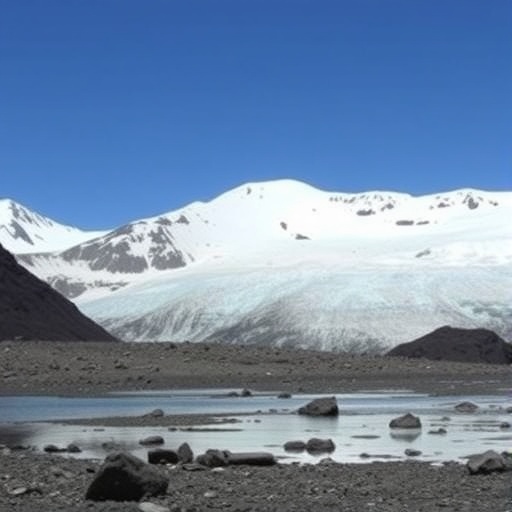
Beneath the sprawling ice sheets of Antarctica lies a secret world far more complex and dynamic than previously imagined. In a groundbreaking study recently published in Communications Earth & Environment, researchers have embarked on an unprecedented exploration beneath the Thwaites Glacier, one of the most critical glaciers in the Antarctic system. Their findings have unveiled the existence of extensive hard rock formations intertwined with vast deep wetlands underlying this icy behemoth, revolutionizing our understanding of the subglacial environment and its implications for global climate systems.
Thwaites Glacier, often dubbed the “Doomsday Glacier,” has become a focal point for climate scientists because of its rapid retreat and potential to significantly contribute to global sea-level rise. Despite considerable attention, much of the glacier’s bed has remained a mystery due to the technical challenges of penetrating the thick ice that cloaks it. However, through the integration of advanced geophysical techniques, including radar sounding and seismic imaging, the research team led by Zeising, Eisen, and Hofstede has illuminated the complex geological and hydrological fabric beneath the glacier.
Their comprehensive survey reveals that the glacier rests atop a foundation not just of sediment or soft debris, as previously assumed, but of solid, hard rock formations that shape how the glacier interacts with its base. These bedrock properties influence the movement and stability of the ice sheet, governing how the glacier flows and fractures over time. The presence of durable rock substrates beneath the glacier also suggests a previously underappreciated interaction that may either hinder or facilitate the glacier’s retreat depending on localized conditions.
Equally compelling is the discovery of extensive wetlands far beneath the ice surface. These subglacial wetlands originate from meltwater produced at the ice-bed interface due to geothermal heat and frictional forces as the glacier slides. This water accumulates in depressions and forms large, saturated wetlands, creating a lubricating layer that can dramatically impact the glacier’s dynamics. The wetlands may enable the ice to slide more rapidly toward the ocean, potentially accelerating the discharge of ice and further destabilizing the glacier’s structure.
This research presents a paradigm shift in how scientists conceptualize subglacial environments. Until now, wetlands of this magnitude were thought uncommon or ephemeral under Antarctic ice sheets. The sheer extent and depth of these wetlands beneath Thwaites indicate a more widespread and persistent feature that may exist beneath other ice masses across the continent, challenging prior sedimentology and hydrology models. Subglacial water systems like these are now recognized as pivotal components in ice flow regulation, energy dissipation, and even biogeochemical cycling in Antarctica.
The implications of these findings stretch beyond pure scientific curiosity. Thwaites Glacier’s stability is intimately connected to global sea levels, and understanding the physical conditions beneath it is paramount for improving predictive models. Hard rock outcrops interspersed with wetlands create a heterogeneous basal environment that complicates models of ice sheet response to climatic warming. The interactions between these geological and hydrological elements can either dampen or amplify ice discharge rates, making long-term projections more uncertain but equally critical.
From a technical standpoint, the research employed innovative combinations of radar and seismic methods to peer through 2 kilometers of ice. Radar soundings probed the internal structure of the ice and reflected signals from its bottom, providing clues about the nature of the bed. Seismic techniques, which analyze how artificial or natural vibrations travel through subsurface materials, allowed researchers to distinguish between solid rock and sediment or wet media. This interdisciplinary strategy represents a leap forward in Antarctic cryospheric exploration, opening new avenues for studying inaccessible environments.
Moreover, detailed mapping revealed subtle variations in bedrock topography that influence meltwater accumulation. Areas of depression trap water, forming these vast wetlands, while adjacent ridges composed of harder rock act as barriers, guiding hydrological pathways. Understanding these micro-scale interactions deepens our appreciation of the complexity beneath ice sheets, challenging linear models that treat subglacial beds as uniform or simplistic.
Intriguingly, these wetlands beneath Thwaites may also harbor unique microbial ecosystems. While it currently remains speculative, the interaction between rock, water, and ice creates habitats that could support extremophiles adapted to perpetual darkness and low temperatures. Such environments might provide analogs for astrobiological studies, revealing how life might persist in icy environments beyond Earth.
Future exploration of these findings will necessitate in situ sampling for confirmation of wetland extents, rock composition, and potential biological presence. This will require drilling through kilometers of ice, a formidable engineering challenge but one worth pursuing given the critical data to be gained. By integrating satellite remote sensing with continued geophysical surveys, scientists aim to build refined models that better predict the glacier’s evolution under warming scenarios.
Importantly, the revelation of hard rock and deep wetlands coexisting beneath Thwaites also reshapes policies concerning Antarctic conservation and climate response strategies. Recognizing the glacier as a dynamic system influenced by complex subglacial conditions underscores the urgency of monitoring these hidden environments. Alterations in geothermal heat flux or ice flow could rapidly shift wetland configurations, with cascading effects on glacier stability.
This research emerges at a time when accurate climate modeling is crucial for global preparedness. Rising sea levels threaten coastal cities worldwide, and Thwaites Glacier is among the largest potential contributors to this hazard. By elucidating the nuanced geology and hydrology existing beneath this glacier, the study provides invaluable data that can refine multidisciplinary models spanning glaciology, geology, oceanography, and climate science.
The collaborative international effort exemplifies the spirit of polar science, combining expertise from geophysicists, glaciologists, hydrologists, and biologists. Their integrated approach exemplifies how solving Earth’s most complex questions demands crossing traditional disciplinary boundaries. As technology advances, we can expect more revelations emerging from beneath the polar ice caps, transforming our understanding of Earth’s cryosphere and its role in global systems.
In summary, the discovery of both hard rocks and extensive deep wetlands beneath the Thwaites Glacier represents a transformative leap in Antarctic science. These findings unearth new questions about how ice sheets interact with their substrates, how subglacial water modulates ice flow, and how these mechanisms drive ice mass loss and contribute to sea-level rise. As research progresses in this newly illuminated domain, the delicate interactions at the ice-bed interface will become pivotal for accurately forecasting Earth’s climatic future.
Cite Scienmag News
Violet Maxwell. (April 25, 2026). Hard Rocks, Deep Wetlands Found Under Thwaites Glacier. Scienmag. https://scienmag.com/hard-rocks-deep-wetlands-found-under-thwaites-glacier/
Violet Maxwell. "Hard Rocks, Deep Wetlands Found Under Thwaites Glacier." Scienmag, 25 April 2026, https://scienmag.com/hard-rocks-deep-wetlands-found-under-thwaites-glacier/. Accessed 8 September 2026.
Violet Maxwell. "Hard Rocks, Deep Wetlands Found Under Thwaites Glacier." Scienmag. April 25, 2026. https://scienmag.com/hard-rocks-deep-wetlands-found-under-thwaites-glacier/


