


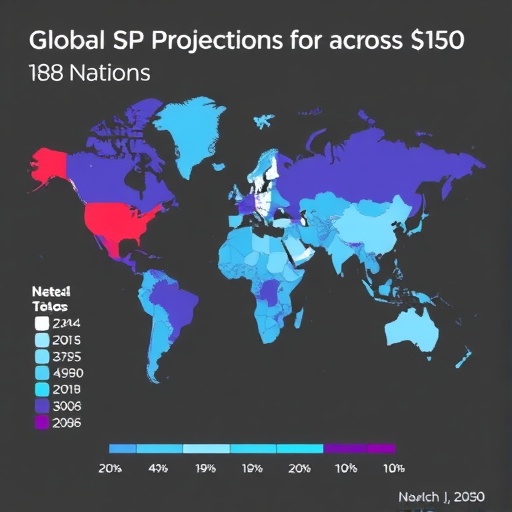
In a groundbreaking advancement poised to reshape how we understand and project global socio-economic trajectories, a team of researchers led by J.D. Moyer, B.B. Hughes, and M. Irfan have unveiled an unprecedented dataset quantifying Shared Socioeconomic Pathways (SSP) elements for 188 countries extending all the way to the year 2150. Published in the prestigious journal Nature Communications, this study leverages the International Futures (IFs) integrated assessment platform to generate the broadest and most nuanced global projections to date, offering invaluable insights for climate policy, development planning, and sustainable futures research.
At the core of this monumental effort lies the concept of Shared Socioeconomic Pathways, which are frameworks designed to encapsulate diverse global development trajectories under different assumptions about factors such as population growth, economic development, technological progress, and governance. While previous SSPs provided invaluable scenarios for climate modeling and policy analysis up to 2100, the Moyer et al. study extends these projections by 150 years, thus significantly enhancing our long-term perspective on human development and environmental interactions.
The methodology employed by the researchers integrates empirical data streams with sophisticated modeling techniques within International Futures, a versatile global forecasting system. This platform weaves together demographic, economic, energy, agricultural, and environmental data to simulate plausible futures based on varying assumptions of policy and social change. What sets this research apart is its country-level granularity, covering 188 nations with diverse socio-political and economic landscapes, thereby avoiding one-size-fits-all extrapolations and acknowledging unique national pathways alongside global trends.
One of the critical technical innovations in this work is the harmonization and calibration of SSP elements with country-specific data sources, historical trends, and expert judgment to ensure internally consistent and plausible futures that respect each country’s socio-economic context. This detailed integration pushes beyond aggregate global or regional scenarios and offers nuanced insights into the drivers of change at national scales. This is instrumental for policymaking, as it highlights differential vulnerabilities and potential intervention points specific to local realities.
Extending the SSP framework to 2150 required balancing complexity and uncertainty. The researchers implemented iterative scenario analysis, which involved running multiple simulations to capture the spectrum of possible outcomes under diverse global development paradigms. This long-term horizon exposes the accumulation of incremental social and economic shifts, technological innovations, and policy measures, reflecting how early actions or inactions may profoundly influence future generations and planetary health.
This study also provides an analytical foundation to link socio-economic dynamics directly with climate outcomes more robustly than before. By offering granular socio-economic trajectories compatible with Representative Concentration Pathways (RCPs) and other climate forcing scenarios, the researchers enable integrated assessment models to predict potential environmental impacts with greater precision. This level of detail is crucial for adapting climate mitigation and adaptation strategies, as it contextualizes environmental challenges within realistic development pathways.
The dataset and projections also underscore the significant heterogeneity among countries in their trajectories. For example, low-income countries are projected to experience different demographic and economic patterns compared to high-income nations, influencing their capacity to address climate change and sustainable development goals. By capturing these variations explicitly, the work highlights equity considerations essential for global cooperation and resource allocation in international climate finance and development aid.
From a technical standpoint, the incorporation of novel data assimilation methods and scenario synthesis techniques improves the transparency and reproducibility of SSP-based assessments. The researchers provided open access to their data and modeling code, fostering collaborative validation and adaptation within the scientific community. This openness promotes iterative refinement of socio-economic pathways as new information and methodologies emerge over the coming decades.
Importantly, the implications of this research extend beyond academic interest and modeling sophistication. It equips policymakers, environmental planners, and even private sector stakeholders with a detailed roadmap of possible futures, informing decisions that can steer societies towards sustainable and inclusive growth. By understanding the socio-economic underpinnings of environmental change, interventions can be better targeted to leverage synergies between development and climate objectives.
Moreover, the study articulates how long-term planning horizons influence adaptive capacities and resilience. As climate and social systems become increasingly interconnected and sensitive to shocks, having multi-century projections allows for the anticipation of systemic risks and the design of policies that are resilient across various temporal scales. This is particularly timely given growing concerns about tipping points and irreversible climate impacts.
The authors also discuss the interplay between technological innovation and socio-economic development pathways. Their model allows exploration of how breakthrough technologies could alter trajectories by enhancing productivity, reducing emissions, or improving social equity. Conversely, the projections serve as cautionary tales, illustrating scenarios where stalled innovation or inequitable growth exacerbate vulnerabilities and environmental degradation.
By embedding these extended SSP quantifications within International Futures, Moyer and colleagues create a versatile decision-support framework that can be continuously updated and tailored to specific contexts. This dynamic adaptability positions the study not just as a landmark publication but as a living tool for anticipating and shaping the intertwined futures of humanity and the planet.
In essence, this research represents a significant leap in global sustainability modeling by bridging long-term socio-economic forecasting with actionable insights for climate and development policy. The depth and breadth of the work provide a vital compass as humanity charts a course through an era of unprecedented environmental change and socio-political complexity.
As nations pursue the ambitious goals embodied in the Paris Agreement and the Sustainable Development Goals, having access to detailed, country-specific SSP data up to 2150 equips decision-makers with the knowledge needed to align immediate actions with long-term aspirations. This alignment is critical to navigating trade-offs and maximizing co-benefits across sectors.
In conclusion, the study by Moyer et al. crystallizes a pivotal synergy between data science, social science, and environmental modeling, crafting a comprehensive vista of possible human futures on Earth. It challenges the research community and policymakers alike to embrace extended planning horizons and nuanced, differentiated approaches to foster resilient and equitable societies in the face of a changing climate.
Moyer, J.D., Hughes, B.B., Irfan, M. et al. Broadly quantifying SSP elements for 188 countries to 2150 in International Futures. Nat Commun (2026). https://doi.org/10.1038/s41467-026-73836-0
Cite Scienmag News
Violet Maxwell. (June 5, 2026). Global SSP Projections for 2150 Across 188 Nations. Scienmag. https://scienmag.com/global-ssp-projections-for-2150-across-188-nations/
Violet Maxwell. "Global SSP Projections for 2150 Across 188 Nations." Scienmag, 5 June 2026, https://scienmag.com/global-ssp-projections-for-2150-across-188-nations/. Accessed 3 September 2026.
Violet Maxwell. "Global SSP Projections for 2150 Across 188 Nations." Scienmag. June 5, 2026. https://scienmag.com/global-ssp-projections-for-2150-across-188-nations/


