


HOUSTON – (Aug. 12, 2024) – Ammonia plays a critical role in sustaining food production for the world’s growing population, but making it accounts for about 2% of global energy consumption and 1.4% of carbon dioxide emissions. Rice University engineers have developed a revolutionary reactor design that could decarbonize ammonia production while also mitigating water pollution.

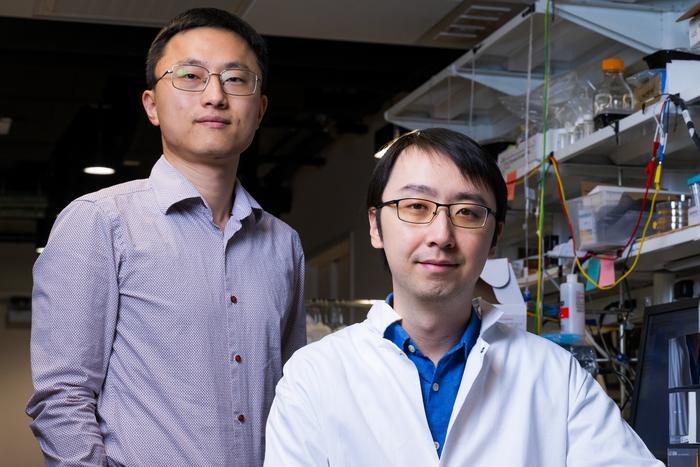
Credit: (Photo by Jeff Fitlow/Rice University)
HOUSTON – (Aug. 12, 2024) – Ammonia plays a critical role in sustaining food production for the world’s growing population, but making it accounts for about 2% of global energy consumption and 1.4% of carbon dioxide emissions. Rice University engineers have developed a revolutionary reactor design that could decarbonize ammonia production while also mitigating water pollution.
In a study published in Nature Catalysis, a team of Rice engineers led by Haotian Wang described the development of a new reactor system that converts nitrates — common pollutants found in industrial wastewater and agricultural runoff — into ammonia, a vital chemical used not only in fertilizers, but also in a wide range of industrial and commercial products, from household cleaners to plastics, explosives and even fuel.
Currently, ammonia is one of the most widely produced chemicals in the world, with global demand surpassing 180 million tons annually. The main way to make ammonia is the Haber-Bosh process, which entails a reaction between hydrogen and nitrogen that occurs under high temperature and pressure conditions and is dependent on large-scale centralized infrastructure. One alternative to this process is electrochemical synthesis, which involves the use of electricity to drive chemical reactions.
“Electrochemistry can occur at room temperature, is more amenable to scalable formats for different infrastructure systems, and has the capacity to be powered by decentralized renewable energy,” said Feng-Yang Chen, a Rice graduate student who is the lead author on the study. “However, the current challenge for this technology is that large quantities of additive chemicals are required during the electrochemical conversion process. The reactor we developed uses recyclable ions and a three-chamber system to improve the reaction’s efficiency.”
One of the key innovations lies in the use of a porous solid electrolyte, which eliminates the need for high concentrations of supporting electrolytes — an issue that has hampered previous attempts to convert nitrates to ammonia sustainably. Moreover, powering the conversion process with renewable energy would essentially render ammonia production carbon neutral.
“We conducted experiments where we flowed nitrate-contaminated water through this reactor and measured the amount of ammonia produced and the purity of the treated water,” said Chen, who is pursuing a doctoral degree in chemical and biomolecular engineering under Wang’s supervision. “We discovered that our novel reactor system could turn nitrate-contaminated water into pure ammonia and clean water very efficiently, without the need for extra chemicals. In simple terms, you put wastewater in, and you get pure ammonia and purified water out.”
The new reactor system makes possible an electrochemical nitrate-to-ammonia conversion pathway that would eliminate the need for denitrification ⎯ the process by which wastewater treatment plants remove nitrates from contaminated water, generating nitrogen that gets fed into the Haber-Bosch process. In addition to bypassing both the traditional denitrification and Haber-Bosch routes, this approach provides an effective water decontamination method.
“Nitrate is one of the priority pollutants that most frequently violates drinking water standards, and it is a is a significant concern in growing cities as farmland with nitrate-contaminated groundwater supplies is converted to urban development,” said Pedro Alvarez, the George R. Brown Professor of Civil and Environmental Engineering, director of the Nanosystems Engineering Research Center for Nanotechnology-Enabled Water Treatment (NEWT) and the Water Technologies Entrepreneurship and Research (WaTER) Institute at Rice.
According to Alvarez, “conventional nitrate removal in drinking water treatment involves ion exchange or membrane filtration by reverse osmosis, which generates brines and transfers the nitrate problem from one phase to another.”
“Professor Wang’s innovation is very timely and important, as it offers a solution that eliminates nitrate toxicity and associated liability without the need to add treatment chemicals,” Alvarez said.
The implications of this work extend beyond ammonia production. The design of the reactor and the study’s accompanying techno-economic assessment can help inform further research into other eco-friendly chemical processes, potentially transforming how industries address environmental challenges.
“Our findings suggest a new, greener method of addressing both water pollution and ammonia production, which could influence how industries and communities handle these challenges,” said Wang, associate professor of chemical and biomolecular engineering, materials science and nanoengineering, and chemistry at Rice. “If we want to decarbonize the grid and reach net-zero goals by 2050, there is an urgent need to develop alternative ways to produce ammonia sustainably.”
The research was supported by Rice University and the National Science Foundation through NEWT (1449500). The content in this press release is solely the responsibility of the authors and does not necessarily represent the official views of the supporting entities.
-30-
This news release can be found online at news.rice.edu.
Follow Rice News and Media Relations via Twitter @RiceUNews.
Click here to read the online press release.
Download associated media files.
Peer-reviewed paper:
“Electrochemical nitrate reduction to ammonia with cation shuttling in a solid electrolyte reactor” | Nature Catalysis | DOI: 10.1038/s41929-024-01200-w
Authors: Feng-Yang Chen, Ahmad Elgazzar, Stephanie Pecaut, Chang Qiu, Yuge Feng, Sushanth Ashokkumar, Zhou Yu, Chase Sellers, Shaoyun Hao, Peng Zhu and Haotian Wang
About Rice:
Located on a 300-acre forested campus in Houston, Rice University is consistently ranked among the nation’s top 20 universities by U.S. News & World Report. Rice has highly respected schools of architecture, business, continuing studies, engineering, humanities, music, natural sciences and social sciences and is home to the Baker Institute for Public Policy. With 4,574 undergraduates and 3,982 graduate students, Rice’s undergraduate student-to-faculty ratio is just under 6-to-1. Its residential college system builds close-knit communities and lifelong friendships, just one reason why Rice is ranked No. 1 for lots of race/class interaction, No. 2 for best-run colleges and No. 12 for quality of life by the Princeton Review. Rice is also rated as a best value among private universities by Kiplinger’s Personal Finance.
Journal
Nature Catalysis
Article Title
“Electrochemical nitrate reduction to ammonia with cation shuttling in a solid electrolyte reactor”
Article Publication Date
12-Aug-2024
COI Statement
The authors declare no competing interests.
Cite Scienmag News
Alan Morgan. (August 12, 2024). Rice-built reactor yields green ammonia and purified water. Scienmag. https://scienmag.com/rice-built-reactor-yields-green-ammonia-and-purified-water/
Alan Morgan. "Rice-built reactor yields green ammonia and purified water." Scienmag, 12 August 2024, https://scienmag.com/rice-built-reactor-yields-green-ammonia-and-purified-water/. Accessed 3 September 2026.
Alan Morgan. "Rice-built reactor yields green ammonia and purified water." Scienmag. August 12, 2024. https://scienmag.com/rice-built-reactor-yields-green-ammonia-and-purified-water/

