


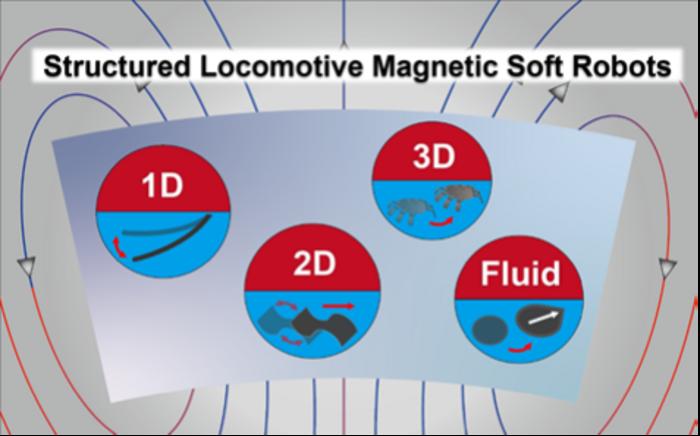
Magnetic soft robots have emerged as a groundbreaking area within robotics, merging advanced materials science with biomechanics to create devices that exhibit unmatched versatility and adaptability. Recently, significant contributions to this field were made by Dr. Renheng Bo and a team of researchers at Tsinghua University, who have published a comprehensive review articulating the intricate relationships between the structural designs of magnetic soft robots and their resultant locomotion capabilities. This pioneering work, titled “Structured Locomotive Magnetic Soft Robots,” published in the journal FlexTech, illuminates the potential these robots have to revolutionize various applications, especially in medical settings.
The backbone of Dr. Bo’s research emphasizes not only the innovative designs that define magnetic soft robots but also how these designs dictate the modes of movement these robots can perform. Their review meticulously categorizes these robots based on their structural complexities into four main classes: one-dimensional, two-dimensional, three-dimensional, and fluid-based robots. This classification not only streamlines the vast diversity found within the realm of magnetic soft robotics but also serves as a foundational framework to better understand their capabilities in real-world applications.
One-dimensional magnetic soft robots represent the most basic yet crucial configurations, typically allowing for linear motion and manipulation. As structural engineering advances, innovators have demonstrated that these seemingly simple designs can yield complex behaviors that enhance their operational effectiveness. Their capabilities could potentially disrupt conventional methods in drug delivery systems where precision and controlled movement are critical. The encapsulation of drugs in a soft robotic structure, guided by magnetic fields, could lead to new delivery methods that reduce side effects and increase treatment efficacy.
As the complexity rises, two-dimensional and three-dimensional magnetic soft robots introduce additional layers of functionality and versatility. Two-dimensional designs can navigate more complex terrains and perform surface-level tasks, which could be vital in environments where traditional robots might struggle. The intricacies of three-dimensional magnetic soft robotics open the door for tasks that demand multidimensional movements, including potential applications in minimally invasive surgical procedures. This dimensional advantage enables surgical robots to reach targeted areas within the human body with greater precision, minimizing damage to surrounding tissues.
Fluidic magnetic soft robots represent the cutting edge of this technology, employing fluid mechanics to enable movement under various conditions. These advanced designs are often inspired by biological models, mimicking the locomotion found in nature. For instance, the ability to swim or transform shape allows fluidic robots to navigate complex environments, potentially leading to significant advancements in environmental monitoring and search-and-rescue operations. The shift toward bio-inspired designs is an exciting frontier, where engineers are equipped with the knowledge gleaned from nature to create solutions that are not only highly functional but also adaptable to changing circumstances.
Through their extensive review, Dr. Bo and his colleagues delve into the material compositions that underpin these diverse robots, showcasing the interplay between material selection and performance outcomes. New metamaterials and composites have emerged as candidates for crafting soft robotic structures that do not merely resemble biological entities but actively engage with their environments. The choice of materials directly affects the magnetic properties, flexibility, and durability of these robots, thereby influencing their operational range and functional integration.
Advancements in micro and nanofabrication technologies have also facilitated the development of more intricate designs, enabling researchers to create soft robots with finer movements and higher reliability. These precision fabrication techniques are essential for developing more robust robots capable of executing complex tasks with unparalleled accuracy. Furthermore, as the field progresses, the integration of sensors and feedback loops within these robots allows for real-time adjustments in response to environmental stimuli, enhancing their overall efficiency.
Despite the advances in magnetic soft robotics, several challenges persist that researchers must address to fully realize the potential of these devices. One significant challenge is the integration of components that allow for seamless task execution across varied environments. As robotic designs become more sophisticated, the need for synergy between configuration, locomotion modes, and functionalities will become paramount. Addressing this challenge requires a multidisciplinary approach, one that harmonizes the expertise of material scientists, robotic engineers, and biomechanists.
Understanding the limitations of current designs is crucial for future research. Dr. Bo and his team highlighted the importance of creating more structure-induced locomotion modes. This involves arriving at design iterations that can not only expand the operational capabilities of these robots but also anticipate the needs of various applications. As researchers innovate in the structural designs, it will be essential to work toward the creation of robots that can adapt their locomotion modes in accordance with task requirements, particularly when operating in dynamically changing environments.
The scientific community has the opportunity to propel magnetic soft robotics forward, driven by collaborative research initiatives and open dialogues among researchers. Such partnerships could lead to the sharing of critical insights that inform design principles and operational parameters. The exploration of new materials, alongside rigorous testing in real-world scenarios, is also pivotal in determining the broader applicability of magnetic soft robots. By creating established pathways for knowledge exchange and innovation, researchers can better prepare these devices for practical use in various fields.
As Dr. Bo’s review suggests, the future of magnetic soft robotics lies heavily in integrated systems that enhance a robot’s situational awareness and responsiveness. By focusing on synergetic design patterns, researchers can develop robots that not only look promising on paper but also triumph in practical applications. This calls for a concerted effort to fuse structural design with functionality, ensuring that these machines fulfill their intended purposes effectively.
In summary, the work presented by Dr. Bo and his colleagues marks a significant step forward in the understanding and application of magnetic soft robots. By categorizing these robots and elucidating the relationship between structure and motion, the authors provide a framework that not only shines a light on the current state of research but also offers avenues for future exploration. By addressing the challenges that lie ahead, researchers will continue to refine these fascinating devices, ultimately unlocking their full potential across medical, environmental, and technological landscapes.
Cite Scienmag News
Denise Maddox. (April 2, 2025). Revolutionizing Robotics: How Structural Engineering is Advancing Structured Magnetic Soft Robot Locomotion. Scienmag. https://scienmag.com/revolutionizing-robotics-how-structural-engineering-is-advancing-structured-magnetic-soft-robot-locomotion/
Denise Maddox. "Revolutionizing Robotics: How Structural Engineering is Advancing Structured Magnetic Soft Robot Locomotion." Scienmag, 2 April 2025, https://scienmag.com/revolutionizing-robotics-how-structural-engineering-is-advancing-structured-magnetic-soft-robot-locomotion/. Accessed 4 September 2026.
Denise Maddox. "Revolutionizing Robotics: How Structural Engineering is Advancing Structured Magnetic Soft Robot Locomotion." Scienmag. April 2, 2025. https://scienmag.com/revolutionizing-robotics-how-structural-engineering-is-advancing-structured-magnetic-soft-robot-locomotion/


