


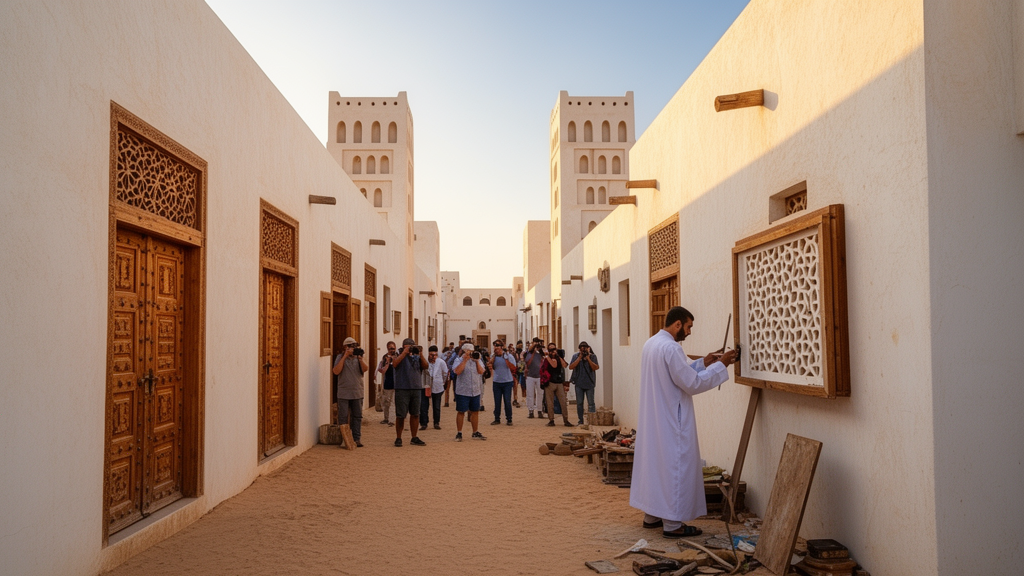
Historic districts in the Gulf are no longer simply being preserved; they are being re-engineered as tourism products. A new comparative study published in City, Territory and Architecture examines how the process of patrimonialisation, the staged transformation of places into recognized heritage, has become the operating logic behind three of the region’s most prominent urban heritage projects: Al Balad in Jeddah, Al Shindagha in Dubai, and Souq Waqif in Doha. The research argues that this process, far from being a neutral act of conservation, functions as a catalyst that converts neglected pre-oil urban fabric into curated destinations for cultural tourism consumption.
The study, led by Saad Hanif with Mohammad S. Arar, Djamel Boussaa and Jihad Awad, adopts a qualitative, multiple case study design grounded in methodological triangulation. The authors drew on three data sources: an extensive literature review of peer-reviewed articles, book chapters, conference proceedings and postgraduate theses; document analysis of UNESCO nomination dossiers, master plan proposals linked to national visions, and redevelopment strategies issued by state-led authorities; and an examination of stakeholder-driven promotional material published on official district websites and through LinkedIn announcements. No primary data collection, such as resident surveys, stakeholder interviews or time-framed site visits, was undertaken, a limitation the authors acknowledge explicitly.
The analytical spine of the research is a five-dimensional patrimonialisation framework drawn from Faure and elaborated by later scholars. The dimensions are selection, justification, conservation, exposition and valorisation. Selection identifies specific sites, practices or objects as potential heritage based on cultural, historical, social or political relevance. Justification constructs the narratives that legitimize why those elements deserve heritage status. Conservation preserves, reconstructs and reintegrates heritage into the evolving urban fabric. Exposition presents and interprets heritage to the public through museums, exhibitions and cultural programming. Valorisation, the final stage, links heritage to tourism development strategies and its economic and social mobilization. The framework treats heritage not as a fixed attribute but as something co-produced over time within specific territorial and institutional contexts.
The three cases were purposively selected to capture variation in preservation initiatives, scales of intervention and stages of international recognition. Al Balad, the roughly 2.5 square kilometer historic core of Jeddah, a city of approximately 4.8 million people, has been inscribed on the UNESCO World Heritage List since 2014 under criteria (ii), (iv) and (vi), with a designated property of 17.92 hectares and a buffer zone of 113.58 hectares. Khor Dubai, including Al Shindagha, was submitted to UNESCO’s Tentative List in 2012 under criteria (ii), (iii) and (v). Souq Waqif in Doha, by contrast, holds no UNESCO inscription or formal nomination; it is a locally significant heritage site within the broader Historic Doha redevelopment initiative aligned with the Environmental Development pillar of the Qatar National Vision 2030.
Al Balad’s trajectory illustrates a conservation-led model. Established in the 7th century CE as a maritime hub and gateway for pilgrims arriving by sea to Makkah, the district is defined by vernacular Hijazi coral-stone architecture and wooden roshan and mashrabiya windows. Conservation began in the early 1970s with the district’s inclusion in the 1973 master plan by Robert Mathew and John Marshall Consultants, which identified around 537 historical sites, but the authors describe this early phase as selective and piecemeal, focused on facade restoration and retro-aesthetics rather than holistic regeneration. The current phase is far more institutionalized: the Jeddah Historic District Program was established in 2018 under the Ministry of Culture and formalized by royal decree in 2020, and the Al Balad Regeneration and Development Plan by the Al Balad Development Company, backed by Saudi Arabia’s Public Investment Fund, extends beyond the inscribed property into the broader environmental setting. Adaptive reuse of heritage buildings as hotels, museums, retail spaces and cultural venues, alongside events such as the Balad Beast Festival blending music, light and culinary experiences, marks the district’s valorisation stage.
Al Shindagha demonstrates a reconstruction-oriented variant. Once the seat of the ruling Al Maktoum family at the mouth of Dubai Creek, anchored by Sheikh Saeed Al Maktoum House built in 1896, the district declined after the ruling residence moved to Zabeel in 1958, and by 1991 redevelopment plans envisaged replacing its fabric with high-rise schemes. Systematic preservation instead began with the restoration of Beit Sheikh Saeed between 1984 and 1986, and accelerated in March 1996 with the creation of a tourist heritage village along the creek. Since the late 1990s, the authors note, the district has been meticulously reconstructed, with several heritage structures rebuilt as replicas of buildings that existed roughly a century ago. The result is one of the world’s largest open-air museum environments, integrating specialized museums with advanced interpretive technologies. The study cites a post-occupancy evaluation by Awad and colleagues across heritage districts in the UAE in which Al Shindagha recorded a 77.2 percent positive tourism valuation, the highest walking-based mobility at 15.6 percent, a mean overall experiential score of 52.1 percent, and historic and traditional character ratings of 3.92 and 3.83 above a 3.5 threshold. Visitor composition was primarily group-based at 37.8 percent, followed by family visits at 33.1 percent.
Souq Waqif represents a third, more modest pathway. Originating as a weekly marketplace whose name derives from the Arabic term for standing, reflecting merchants selling goods on foot in a constrained layout, the souq evolved from 18th-century courtyard dwellings into a permanent commercial center trading with merchants from Persia, Asia and neighboring Gulf countries. After the oil boom drew residents to suburban villa developments and a destructive fire in 2003 underscored the urgency of intervention, a comprehensive restoration and reconstruction initiative launched in 2004 and ran through 2010 under the direction of Sheikh Hamad bin Khalifa Al Thani, championed by Sheikha Moza bint Nasser. The intervention preserved the oldest structures, removed post-1950 additions, and required new buildings to follow or reimagine traditional Qatari forms using vernacular materials and climate-responsive techniques such as thick masonry walls, mangrove roofing and natural insulation. The souq was shortlisted for the Aga Khan Award for Architecture in the 2008 to 2010 cycle, and the study reports it was the most frequented heritage site during the 2022 FIFA World Cup.
The comparative analysis reveals distinct dominant dimensions in each case. In Al Balad, conservation emerges as the most prominent and ongoing endeavor, regulated by state-led bodies including the Ministry of Culture, the Heritage Commission, the Al Balad Development Company and the Historic Jeddah Team. In Al Shindagha, exposition dominates, as the transformation into an open-air museum reinterprets the district’s significance, though the reliance on reconstructed fabric raises questions about authenticity and transparency. In Souq Waqif, selection and justification take precedence, anchored in the district’s historical continuity of function and socio-cultural relevance rather than UNESCO-driven criteria. A recent study cited in the paper, by Furlan and colleagues, found that although the core souq covers only about 1.68 square kilometers, its functional catchment extends to nearly 22 square kilometers, roughly 17 percent of Doha’s municipal urban area, a 1:13 ratio radiating several kilometers in different directions.
The authors frame the process as double-edged. On the opportunity side, patrimonialisation has repositioned deteriorating districts from blight to blessing, rejuvenated intangible heritage, supported identity reconstruction and introduced a renewed sense of belonging among local communities, while the drive for UNESCO designation has motivated new preservation initiatives embedded in urban transformation and cultural tourism frameworks. On the challenge side, reconstruction and replication, most visible in Al Shindagha, risk diluting authenticity, and the process can align with capital accumulation and gentrification, undermining residents’ ability to resist change. The study also notes that heritage mobilization is tied to escalating property values and rental costs through the rent gap dynamic, and that selective preservation driven by tourism demand poses threats to authentic urban heritage.
The authors are careful about the limits of their claims. Because the analysis rests entirely on secondary sources, they state that causal claims about the patrimonialisation dimensions should be treated as plausible hypotheses rather than demonstrated effects. The study is also confined to the transformation of places, leaving aside impacts on people and practices. Future research, they suggest, could expand the comparison to additional Gulf cities, integrate empirical user-based analyses, and separately compare inscribed UNESCO sites with tentative list sites to build a more contextualized understanding of how heritage is being made, staged and sold across the region.
Subject of Research: How the patrimonialisation process transforms three Gulf urban heritage districts into cultural tourism destinations
Article Title: Patrimonialisation as a catalyst for cultural tourism: a comparative analysis of three urban heritage districts in the Gulf
Article References: Hanif, S., Arar, M. S., Boussaa, D., & Awad, J. (2026). Patrimonialisation as a catalyst for cultural tourism: a comparative analysis of three urban heritage districts in the Gulf. City, Territory and Architecture, 13(1), Article 20. https://doi.org/10.1186/s40410-026-00318-7
Image Credits: AI Generated
DOI: 10.1186/s40410-026-00318-7
Keywords: patrimonialisation, cultural tourism, urban heritage, Al Balad, Al Shindagha, Souq Waqif, Jeddah, Dubai, Doha, UNESCO World Heritage, heritage conservation, Gulf region
Cite Scienmag News
Denise Maddox. (October 30, 2026). Heritage remade: how three Gulf districts turn patrimonialisation into cultural tourism. Scienmag. https://scienmag.com/heritage-remade-how-three-gulf-districts-turn-patrimonialisation-into-cultural-tourism/
Denise Maddox. "Heritage remade: how three Gulf districts turn patrimonialisation into cultural tourism." Scienmag, 30 October 2026, https://scienmag.com/heritage-remade-how-three-gulf-districts-turn-patrimonialisation-into-cultural-tourism/. Accessed 4 November 2026.
Denise Maddox. "Heritage remade: how three Gulf districts turn patrimonialisation into cultural tourism." Scienmag. October 30, 2026. https://scienmag.com/heritage-remade-how-three-gulf-districts-turn-patrimonialisation-into-cultural-tourism/




