


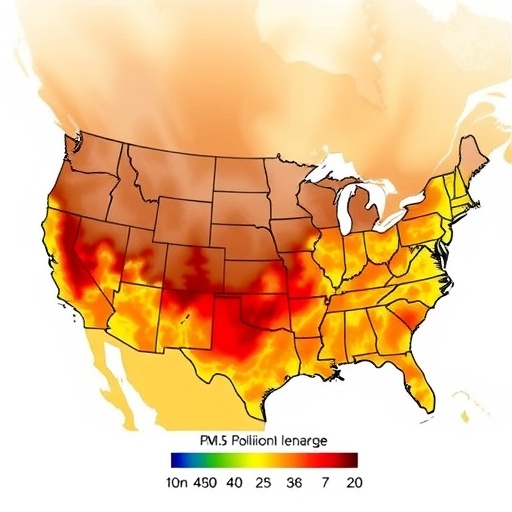
An unprecedented inquiry into the intricate relationship between drought, wildfires, and air pollution has emerged from the laboratories of Pohang University of Science and Technology (POSTECH). Spearheaded by Professor Hyung Joo Lee and his dedicated research team, this study delves into fifteen years of empirical data to unravel how these environmental phenomena coalesce to affect fine particulate matter—PM2.5—in California. Published in the respected international journal Environment International, the study casts new light on the synergistic impacts of drought and wildfire on atmospheric composition, revealing pressing challenges for air quality management in the context of climate change.
Fine particulate matter, especially PM2.5, comprises airborne particles with diameters less than 2.5 micrometers. Due to their diminutive size, these particles can evade the body’s natural defenses within the respiratory system, penetrating deep into lung tissue and even entering the bloodstream. The public health implications of PM2.5 exposure are staggering, with epidemiological research linking it to heightened risks of cardiovascular disease, respiratory ailments such as asthma, and premature mortality. Consequently, PM2.5 concentrations are strictly regulated globally, yet understanding the environmental drivers behind their fluctuations remains a scientific imperative.
California serves as a natural laboratory for investigating the confluence of drought and wildfire effects due to its Mediterranean climate, characterized by periodic yet intense dry spells punctuated by frequent, expansive wildfires. However, prior to this investigation, most studies focused on either drought or wildfire impacts on air quality independently, neglecting the intertwined dynamics that undergird these phenomena. The POSTECH team addressed this gap by integrating extensive air quality monitoring records with sophisticated computational modeling spanning from 2006 to 2020.
A cornerstone of the study was employing the Standardized Precipitation Evapotranspiration Index (SPEI) to quantify drought severity. With each unit decrease in SPEI—indicating growing aridity—a consistent escalation of 1.5 µg/m³ in mean PM2.5 concentration was observed. This correlation underscores the influence of meteorological extremes on particulate levels but invites a deeper examination of the underlying mechanisms driving these changes. Notably, the team found that drought intensification exponentially increased wildfire occurrence probability, with nearly a 90% surge in wildfire incidents correlating with each SPEI unit drop.
Wildfires emerged as the primary catalysts driving the elevated PM2.5 levels amid drought scenarios. This revelation is critical because it nuances the narrative that drought alone exacerbates air pollution; instead, it is the wildfire activity amplified by drought conditions that predominantly contributes to airborne particulate matter. The data demonstrated that in the absence of wildfire events, even severe drought conditions did not precipitate notable shifts in PM2.5 concentrations, effectively decoupling drought from direct particulate augmentation.
Under extreme synergistic conditions—where drought severity met large-scale wildfire outbreaks—the study reported atmospheric PM2.5 concentrations soaring to an average of 9.5 µg/m³, starkly contrasted with baseline levels recorded during normal meteorological periods. This amplification highlights the compounded risks posed by climate-induced extremes, not only degrading air quality but exacerbating public health threats across spatially extensive regions.
These findings resonate profoundly in the era of anthropogenic climate change, where projections indicate an escalation of drought frequency, severity, and consequent wildfire activity, not only in California but globally. The translational relevance extends to South Korea, where continuing urbanization and evolving climate patterns have introduced comparable environmental challenges. Professor Lee emphasized that this study’s quantitative insights into the drought-wildfire-PM2.5 nexus could inform adaptive strategies crucial for air pollution mitigation and public health protection worldwide.
Mitigation efforts must extend beyond conventional controls targeting anthropogenic emissions. This investigation underscores the urgency of adopting holistic environmental policies that integrate wildfire prevention, forest management, and drought resilience as pivotal components of air quality governance. Only through such integrated strategies can policymakers hope to curtail the cascading effects that climate-induced natural disasters impose on atmospheric pollution and human health.
From a technical perspective, this study employed longitudinal analysis combining remote sensing data, ground-based monitors, and atmospheric diffusion modeling, ensuring robustness in capturing spatially and temporally heterogeneous pollution patterns. The utilization of SPEI as a drought index enabled a nuanced quantification of water stress by accounting for both precipitation deficits and temperature-driven evapotranspiration demand, enhancing the precision of the drought-wildfire interaction analysis.
Furthermore, the research highlighted potential feedback mechanisms wherein prolonged drought desiccates forest biomass, creating tinderbox conditions, while wildfire emissions inject vast quantities of particulate matter and trace gases into the lower atmosphere, influencing regional climate and air quality dynamics. This complex interplay necessitates advancing predictive modeling capabilities to anticipate and mitigate contaminant surges under future climate scenarios.
The societal implications of these findings are far-reaching. Vulnerable populations, particularly those with pre-existing respiratory and cardiovascular conditions, stand to suffer disproportionate burdens from heightened PM2.5 exposures during drought-wildfire episodes. Public health frameworks must therefore incorporate environmental surveillance data and climate forecasts to enhance community preparedness and healthcare response during high-risk periods.
In summary, the research conducted by Professor Hyung Joo Lee and his team at POSTECH provides a landmark analysis elucidating the compounded effects of drought and wildfires on fine particulate matter pollution in California. By establishing wildfire activity as the critical intermediary between drought conditions and air quality degradation, the study delivers actionable intelligence vital for global environmental health efforts in an era increasingly defined by climatic extremes.
News Publication Date: 17-Jul-2025
Web References: http://dx.doi.org/10.1016/j.envint.2025.109678
Cite Scienmag News
Russell Cooper. (October 15, 2025). Revealing How Compound Drought and Wildfires Intensify PM2.5 Air Pollution Amid Climate Change. Scienmag. https://scienmag.com/revealing-how-compound-drought-and-wildfires-intensify-pm2-5-air-pollution-amid-climate-change/
Russell Cooper. "Revealing How Compound Drought and Wildfires Intensify PM2.5 Air Pollution Amid Climate Change." Scienmag, 15 October 2025, https://scienmag.com/revealing-how-compound-drought-and-wildfires-intensify-pm2-5-air-pollution-amid-climate-change/. Accessed 5 September 2026.
Russell Cooper. "Revealing How Compound Drought and Wildfires Intensify PM2.5 Air Pollution Amid Climate Change." Scienmag. October 15, 2025. https://scienmag.com/revealing-how-compound-drought-and-wildfires-intensify-pm2-5-air-pollution-amid-climate-change/


