


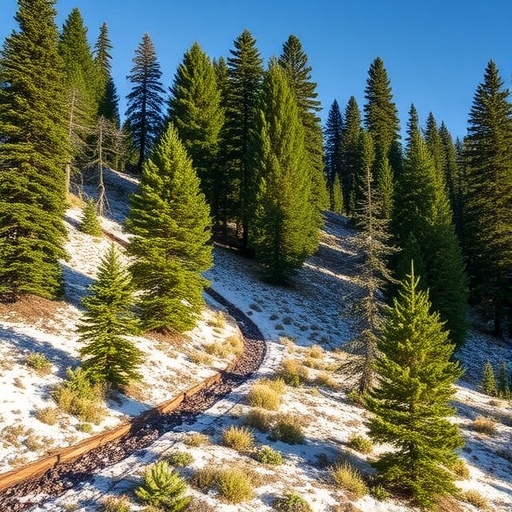
For decades, the simplest prediction about climate change in mountain forests was that trees would climb. As temperatures rise, the thinking went, species would follow cooler conditions upslope until they reached the summit. A new global study suggests that this familiar story is incomplete. Some montane tree species are indeed moving toward higher elevations, but others are expanding downhill. The difference, researchers report, is largely explained by the way each species transports and conserves water.
Published in Nature Climate Change, the study is one of the broadest investigations yet into how mountain trees are responding to a warming planet. An international research team combined tree-ring records from more than 121,000 trees representing 45 species with climate and growth data collected from 3,057 forest sites worldwide. The researchers also analyzed hydraulic traits—physiological characteristics that govern water movement through a tree—and compared them with global observations of elevational range shifts involving 102 mountain tree species.
Hydraulic traits determine how efficiently a tree moves water from its roots to its leaves. This process is essential for photosynthesis, but it also creates a vulnerability: during drought, water transported through a tree’s xylem can come under intense tension and form air bubbles, a potentially fatal failure known as embolism. Species that move water rapidly may grow efficiently when conditions are favorable, yet they can be more exposed to heat and water stress. Other species transport water more cautiously and rely on anatomical or physiological safeguards that allow them to survive prolonged drought.
The study found that trees with highly efficient water-transport systems tend to be more sensitive to warming and are more likely to shift upslope. Moving higher can place them in cooler environments where evaporation rates are lower and moisture stress is reduced. By contrast, species with stronger drought-resistant traits often tolerate warmer and drier conditions more successfully. These trees may persist at their existing elevations or expand into lower areas as competition and climate conditions change, producing a downhill shift that contradicts the traditional expectation that all species should move toward mountain summits.
Tim Rademacher, director of the University of Vermont’s Proctor Maple Research Center and a co-author of the study, said the findings clarify why trees exposed to the same regional warming can respond in dramatically different ways. A species’ hydraulic strategy influences its ability to balance rapid growth against the risk of drought damage. That balance, the researchers argue, is a more powerful predictor of future distribution than temperature change alone.
The results challenge the idea that the rate of local warming can independently explain how quickly a species changes its range. Even where warming is similar, trees with different hydraulic systems may follow entirely different trajectories. Some may retreat toward cooler elevations, while others remain in place or spread downward. This means that climate projections based only on temperature and precipitation could miss the biological mechanisms that determine which species will survive, compete, or disappear from particular mountain zones.
The consequences may be especially serious for species that respond to warming by moving uphill. Mountain landscapes become narrower as elevation increases, with less land available near the summit than at lower elevations. As upslope-moving trees are squeezed into shrinking areas, their populations may become concentrated in isolated high-elevation refuges. Crowding, habitat fragmentation, reduced genetic exchange, and competition with resident species could increase their vulnerability. In the most extreme cases, trees may run out of suitable habitat before they can adapt or disperse farther.
Hongyan Liu of Peking University, the study’s corresponding author, said hydraulic strategies help explain whether a species tracks warming to higher elevations or persists and expands into drier lowlands. The researchers caution that climate refuges are not a universal solution. Drought-sensitive species may be protected temporarily by cool mountain environments, but those refuges can contract over time. Meanwhile, drought-tolerant species may gain territory lower on the mountain, potentially reorganizing forest communities and changing the balance of carbon storage, water regulation, and habitat for wildlife.
The findings provide a practical framework for conservation and forest management. Instead of assuming that every threatened tree should be protected at higher elevations, managers could use hydraulic traits to identify which species are most likely to benefit from assisted migration, where new habitat may remain suitable, and which forests are likely to change first. Mountain regions cover about one-quarter of Earth’s land surface and support extraordinary biodiversity, so understanding these physiological differences could be essential for anticipating the next generation of forests. The study’s central message is both simple and consequential: as mountains warm, trees will not all climb in the same direction.
News Publication Date: 6-Aug-2026
Web References: https://www.nature.com/articles/s41558-026-02726-6; https://doi.org/10.1038/s41558-026-02726-6
References: Zhang, X. et al. “Hydraulic Traits Govern Opposing Range Shifts of Montane Trees Under Warming.” Nature Climate Change.
Cite Scienmag News
Sloane Callahan. (August 7, 2026). Global study finds climate change isn’t pushing all mountain trees uphill. Scienmag. https://scienmag.com/global-study-finds-climate-change-isnt-pushing-all-mountain-trees-uphill/
Sloane Callahan. "Global study finds climate change isn’t pushing all mountain trees uphill." Scienmag, 7 August 2026, https://scienmag.com/global-study-finds-climate-change-isnt-pushing-all-mountain-trees-uphill/. Accessed 3 September 2026.
Sloane Callahan. "Global study finds climate change isn’t pushing all mountain trees uphill." Scienmag. August 7, 2026. https://scienmag.com/global-study-finds-climate-change-isnt-pushing-all-mountain-trees-uphill/


