


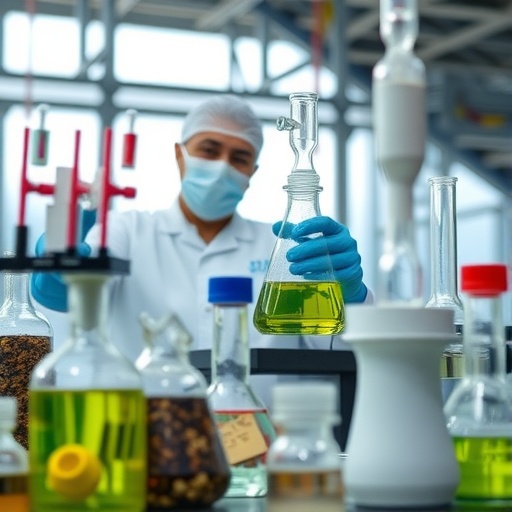
COLUMBUS, Ohio—A new electrochemical process developed by researchers at The Ohio State University could turn two major industrial waste streams—steel slag and coal ash—into green hydrogen and a valuable mineral, while permanently locking captured carbon dioxide into solid form. The technology, described in a study published in ACS Energy Letters, combines carbon dioxide mineralization with hydrogen production, creating a system designed to reduce emissions while generating commercially useful products.
Green hydrogen is generally produced by electrolysis, in which electricity splits water molecules into hydrogen and oxygen. When the electricity comes from renewable sources such as wind or solar power, the process can generate hydrogen without the direct carbon emissions associated with fossil-fuel-based production. However, conventional electrolysis requires substantial amounts of electricity, and the cost and availability of low-carbon power remain significant barriers to large-scale deployment.
The Ohio State team’s approach is designed to lower that energy burden by using chemical reactions that occur during carbon capture and mineralization. Instead of treating carbon dioxide as a waste gas that must simply be compressed or stored, the process uses it as a reactive feedstock. When carbon dioxide encounters alkaline components in steel slag or coal ash, it can react to form calcium carbonate, commonly known as calcite. This reaction permanently converts the gas into a stable mineral while releasing chemical energy that can assist the electrochemical production of hydrogen.
In their first demonstration, the researchers exposed industrial by-products to carbon dioxide and showed that the gas could be incorporated into high-purity calcite. Steel slag, a residue generated during steelmaking, contains calcium-rich compounds capable of reacting with carbon dioxide. Coal ash, produced by coal combustion, can also contain alkaline minerals and reactive metal oxides. These materials are often difficult or costly to manage, but the new process treats them as chemical resources rather than unwanted residues.
Calcite is one of the most abundant minerals on Earth and has broad industrial applications. It can be used in construction materials, agricultural products, paper, plastics, paints and pharmaceuticals. By producing calcite alongside hydrogen, the researchers aim to create an economic incentive for carbon capture that does not depend entirely on carbon credits, government subsidies or environmental mandates. The mineral product could potentially offset part of the cost of operating the system.
The key technical feature of the process is its electrochemical integration. During mineralization, carbon dioxide reacts with calcium-containing compounds in the waste, producing carbonate ions that ultimately precipitate as calcite. At the same time, water electrolysis generates hydrogen at an electrode. Because the mineralization reactions alter the chemical environment and contribute energy to the overall system, less external electrical energy may be required than in conventional hydrogen production. The researchers report that this interaction allowed them to produce hydrogen using widely available grid electricity while achieving a negative-emissions outcome under their accounting framework.
A negative-emissions claim means that the process removes and permanently stores more carbon dioxide than is released throughout the relevant production pathway. In this case, the carbon is fixed into calcite rather than being released back into the atmosphere. The environmental performance of the technology would still depend on factors including the source of the electricity, the energy required to transport and process the industrial waste, and the durability and end use of the mineral product. Even so, the ability to combine waste treatment, carbon storage and fuel production in one process could provide an important advantage over systems that perform these functions separately.
The researchers estimate that the value of the calcite co-product could reduce the effective cost of hydrogen production to less than $1 per kilogram. That projected figure would place the process within the range needed to compete with hydrogen produced from fossil fuels, although commercial performance would need to be confirmed at a much larger scale. Laboratory demonstrations do not always capture the challenges of continuous operation, waste-material variability, electrode durability, gas purification, mineral separation and industrial permitting.
If deployed across interconnected steel, coal and energy sectors, the technology could prevent an estimated 500 million metric tons of carbon dioxide pollution each year, according to the study. Its potential reach extends beyond hydrogen: carbon dioxide converted into mineral form could serve as a feedstock for sustainable manufacturing of other chemicals and advanced materials. The researchers emphasize that their system does not require specialized carbon-capture materials, relying instead on abundant industrial residues that are already generated in large quantities.
The study, led by postdoctoral researcher Tomaz Neves-Garcia with senior author Robert Baker, presents the process as an example of a broader shift in climate technology: designing systems that create economic value while reducing emissions. By transforming carbon dioxide, steel slag and coal ash into hydrogen and calcite, the researchers say their approach could simplify carbon management and make clean-fuel production more attractive. The work was supported by the Camille and Henry Dreyfus Foundation, with undergraduate research fellow Corrado Masciocchi also contributing as a co-author.
News Publication Date: 8 July 2026
Web References: https://climate.mit.edu/ask-mit/how-clean-green-hydrogen; https://research.cbc.osu.edu/baker.2364/employees/tomaz-neves-garcia/; https://chemistry.osu.edu/
References: ACS Energy Letters, DOI: 10.1021/acsenergylett.6c01395
Cite Scienmag News
Russell Cooper. (August 6, 2026). Chemists seek to transform industrial waste into renewable resources. Scienmag. https://scienmag.com/chemists-seek-to-transform-industrial-waste-into-renewable-resources/
Russell Cooper. "Chemists seek to transform industrial waste into renewable resources." Scienmag, 6 August 2026, https://scienmag.com/chemists-seek-to-transform-industrial-waste-into-renewable-resources/. Accessed 3 September 2026.
Russell Cooper. "Chemists seek to transform industrial waste into renewable resources." Scienmag. August 6, 2026. https://scienmag.com/chemists-seek-to-transform-industrial-waste-into-renewable-resources/


