


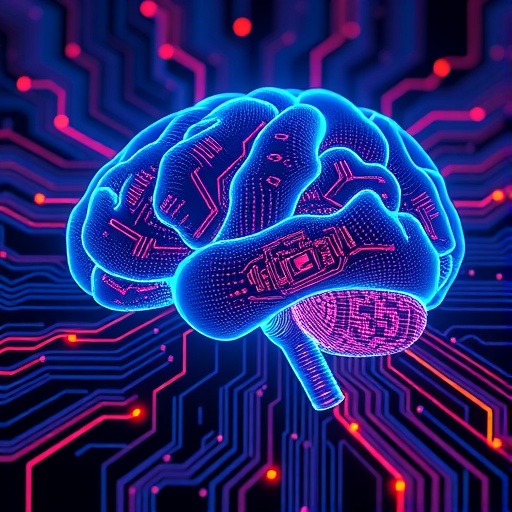
As the relentless march of traditional computing chips confronts the immutable laws of physics, a profound paradigm shift is underway. Researchers at the University of Missouri are pioneering a revolutionary approach to computing, inspired by the unparalleled efficiency and adaptive intelligence of the human brain. This work emerges at a pivotal moment when the soaring energy consumption of artificial intelligence (AI) data centers threatens to escalate unsustainably, with projections suggesting their energy demands could double by the decade’s close. Addressing this challenge demands a rethinking of how computers fundamentally operate.
Conventional computer architecture separates the functions of memory and processing, a design legacy that has persisted despite the exponential increase in computing power. This dichotomy introduces inefficiencies, as data must traverse between distinct units during operation, creating bottlenecks and significantly elevating power consumption. In stark contrast, the human brain embodies an integrated architecture where synaptic connections not only transmit signals but concurrently manage information storage and processing. Such synergistic functionality enables the brain to achieve remarkable cognitive feats while operating on as little as 20 watts—comparable to the power of an antiquated incandescent light bulb.
At the forefront of this transformative research, Professor Suchi Guha and her multidisciplinary team are engineering neuromorphic hardware that mimics the brain’s architecture at the molecular level. Central to their approach is the development of organic synaptic transistors, devices crafted from innovative organic polymer materials designed to replicate the dual roles of biological synapses. Unlike traditional transistors, which act as discrete, binary switches, these organic devices can modulate their conductivity in a graded manner, allowing them to “learn” and adapt through changes in their electrical characteristics, thus facilitating brain-like plasticity.
A critical breakthrough in Guha’s research lies in understanding how subtle molecular interactions at the interface between the semiconducting layer and the insulating substrate affect synaptic transistor performance. Experiments with pyridyl triazole copolymers—a class of organic compounds notable for their tunable electronic properties—revealed that materials seemingly identical in bulk properties exhibited vastly different synaptic behavior. This divergence underscores that device efficacy is intricately tied not solely to material composition but to the structural and chemical nuances of interfaces within the transistor architecture.
This revelation challenges longstanding assumptions in semiconductor physics, where the focus has predominantly been on intrinsic material properties. The findings insist on a holistic view, encouraging materials scientists and electrical engineers to consider the atomically thin boundary layers as arenas where critical functional traits of neuromorphic devices emerge. Consequently, tailoring interface chemistry can engender devices with enhanced energy efficiency and improved fidelity in emulating synaptic plasticity, the biological process underpinning learning and memory.
The implications of integrating such synaptic transistors into computing systems are profound. Neuromorphic hardware promises to bridge the cognitive divide between artificial and biological systems, enabling machines to process complex information in real time while consuming mere fractions of the energy currently required. Applications span from pattern recognition and autonomous decision-making to realms of AI that demand continuous learning capabilities without incurring prohibitive power costs. This marks a fundamental departure from the deterministic algorithms entrenched in today’s silicon-based processors.
Moreover, the shift towards organic, brain-like transistors signifies a broader trend toward leveraging the principles of biological computation in electronic design. Unlike conventional silicon transistors, organic materials offer flexibility, tunability, and the prospect of low-cost, scalable manufacturing processes. The incorporation of neuromorphic elements into embedded systems could revolutionize the Internet of Things (IoT), augment wearable technology, and spawn adaptive robotics that learn from their environments with unprecedented energy economy.
While the marriage of neuroscience and materials science remains nascent, this interdisciplinary effort pushes the envelope, narrowing the gap between machine intelligence and the human brain’s elegant computational paradigm. Guha emphasizes that achieving truly intelligent machines necessitates hardware architectures capable of not just raw speed but of adaptive, energy-efficient learning—a concept that can no longer be an afterthought in an era dominated by AI.
This study, titled “Structure–Function Coupling in Pyridyl Triazole Copolymers for Neuromorphic Synaptic Transistors,” detailed in ACS Applied Electronic Materials, presents a roadmap for researchers worldwide seeking to harness molecular architecture for neuromorphic applications. Co-authored by scientists from the University of Missouri and Hamad Bin Khalifa University, it constitutes a foundational step toward scalable, practical neuromorphic computing solutions which might soon redefine how data is processed across numerous technological domains.
At its core, the research reflects a profound philosophical shift: moving from energy-hungry, rigid computing systems toward architectures that are inherently adaptive, efficient, and integrated. This shift is vital as the limits of Moore’s Law become apparent and as AI’s energy footprint burgeons. By looking inward, to the machinery evolved within our own brains, scientists at the University of Missouri illuminate a path toward sustainable, intelligent computational futures.
The necessity for such innovation is not merely academic but urgent amidst escalating global demands for energy sustainability. Neuromorphic computing offers the tantalizing prospect of devices that function harmoniously with their environment, analogous to neural tissue, fundamentally reshaping the technological landscape and addressing climate concerns linked to data processing infrastructure.
In sum, this pioneering work at the intersection of organic electronics and computational neuroscience heralds a new chapter in computer architecture. It calls for collaborative efforts spanning disciplines to realize machines that are not only faster and more powerful but capable of learning with an economy and elegance mirrored only by the human brain itself.
News Publication Date: 12-Feb-2026
Web References:
10.1021/acsaelm.5c02633
References:
Guha, S., Ghobadi, A., Abhi, A., Kallos, T., Gamachchi, D., Karunarathne, I., Meng, A., Mathai, J., Gangopadhyay, S., Kelley, S., Attar, S., Al-Hashimi, M. (2026). Structure–Function Coupling in Pyridyl Triazole Copolymers for Neuromorphic Synaptic Transistors. ACS Applied Electronic Materials.
Cite Scienmag News
Cassandra Pierce. (May 7, 2026). Researchers Develop Smarter, More Efficient Computer Hardware Inspired by the Brain. Scienmag. https://scienmag.com/researchers-develop-smarter-more-efficient-computer-hardware-inspired-by-the-brain/
Cassandra Pierce. "Researchers Develop Smarter, More Efficient Computer Hardware Inspired by the Brain." Scienmag, 7 May 2026, https://scienmag.com/researchers-develop-smarter-more-efficient-computer-hardware-inspired-by-the-brain/. Accessed 4 September 2026.
Cassandra Pierce. "Researchers Develop Smarter, More Efficient Computer Hardware Inspired by the Brain." Scienmag. May 7, 2026. https://scienmag.com/researchers-develop-smarter-more-efficient-computer-hardware-inspired-by-the-brain/


