


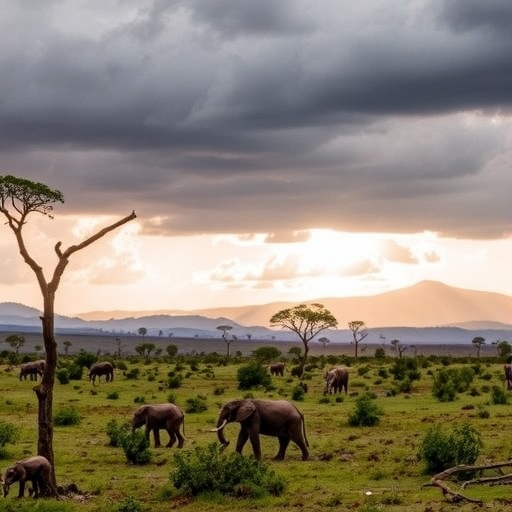
Conservation efforts across Africa have historically centered on the establishment and maintenance of protected areas—national parks, wildlife reserves, and other spatially designated zones intended to safeguard biodiversity. However, a paradigm-shifting commentary recently published in Biological Diversity by ecologist Luca Luiselli contends that this reliance on fenced reserves and rigid spatial targets, such as the global 30×30 initiative aiming to protect 30% of terrestrial habitats, is inadequate for the continent’s rich and complex ecosystems. Luiselli’s analysis elucidates that a majority of Africa’s biodiversity not only exists but thrives outside formal protected areas, calling for a radical reevaluation of conservation strategies and policy frameworks.
The intrinsic mosaic of African landscapes, encompassing sacred groves, traditional agricultural fields, pastoral expanses, and secondary regrowth forests, forms intricate ecological networks that support diverse species assemblages. These “working landscapes” have co-evolved alongside human societies for centuries, fostering resilience and connectivity critical for species survival amid accelerating environmental changes. For instance, endangered primate populations in Cameroon persist largely in unprotected forest fragments, while in Sierra Leone, 80% of field evidence for pygmy hippopotamus activity is documented outside designated reserves. This highlights the ecological importance of areas often overlooked or marginalized by conventional conservation paradigms.
Traditional conservation models, predicated on delineating fixed boundaries to exclude human activities, frequently disregard the dynamic and adaptive nature of African ecosystems. Many protected areas function as “paper parks” with insufficient enforcement, fragmented habitats, and vulnerability to anthropogenic pressures. Local communities are often excluded from resource management, which exacerbates social tensions and undermines long-term ecological stewardship. The 30×30 target reinforces a protection-at-any-cost mentality that may unintentionally prioritize geometric expansion of reserves over the nuanced realities of species persistence, habitat connectivity, and ecosystem functionality.
Luiselli’s commentary compellingly argues that while protected areas are essential components of biodiversity conservation, they alone cannot ensure the persistence of Africa’s unique flora and fauna. Instead, conservation success must be reframed through a lens of inclusive governance, legitimizing local land rights and empowering community-based management systems. Pastoralist landscapes, for example, serve as vital corridors facilitating wildlife movement and genetic exchange across arid regions. Simultaneously, indigenous land-use practices often sustain ecosystem services and biodiversity in mosaic agricultural systems, which are integral to regional ecological stability.
One critical insight from the study is the necessity to move beyond simplistic area-based metrics of conservation effectiveness. Biodiversity preservation is not solely a function of spatial coverage but depends on maintaining ecological connectivity, metapopulation dynamics, and social legitimacy. Climate change compounds these challenges by altering species distributions and ecosystem processes, demanding flexible, adaptive management strategies that transcend the physical boundaries of protected areas.
Integrating working landscapes into national and regional conservation portfolios involves reconstructing policy frameworks to acknowledge human-environment interactions as synergistic rather than antagonistic. Collaborative stewardship models that engage local communities as co-managers of natural resources have demonstrated success in conserving biodiversity while supporting livelihoods. Such approaches reconcile traditional ecological knowledge with modern conservation science, promoting resilience against climate variability and socio-economic shifts.
The fragmented and underfunded nature of many African protected areas further underscores the importance of diversified conservation strategies. Financial and institutional limitations constrain effective monitoring, enforcement, and habitat restoration efforts within reserves. By contrast, decentralized management in working landscapes can mobilize local capacities, fostering adaptive governance and more cost-effective conservation outcomes—a critical advantage in resource-limited settings.
Moreover, the study highlights the ecological significance of non-protected habitats in sustaining rare and endangered species. Connectivity between these habitats facilitates gene flow, reduces inbreeding depression, and maintains ecological processes essential for community dynamics. Ignoring these areas risks isolating populations within shrinking reserves, potentially accelerating biodiversity loss despite nominal increases in protected area coverage.
The commentary challenges policymakers, conservationists, and stakeholders to reconsider the conceptual underpinnings of biodiversity conservation in Africa. Emphasizing the integration of working landscapes necessitates interdisciplinary collaboration, including ecology, social sciences, and policy studies. It demands a shift from fortress conservation towards landscape-scale approaches that balance ecological integrity with human well-being.
In conclusion, Africa’s biodiversity conservation challenges are not confined within the boundaries of protected areas. The future of the continent’s natural heritage hinges on embracing complexity, inclusivity, and adaptability. Protecting only spatial enclaves may be insufficient to halt biodiversity declines; instead, a holistic stewardship of shared landscapes—where human livelihoods and ecological functions coexist dynamically—is paramount. This transformative vision advances both scientific understanding and practical policy, essential for mitigating biodiversity loss and fostering sustainable coexistence under a changing climate.
News Publication Date: May 28, 2026
Web References: http://dx.doi.org/10.1002/bod2.70028
References: Luiselli, Luca. 2026. “Africa’s Biodiversity Will Not Be Saved by Protected Areas Alone,” Biological Diversity: 1–7.
Cite Scienmag News
Margaret Porter. (May 28, 2026). Protecting Africa’s Biodiversity: Why Working Landscapes Matter Beyond Just Fenced Reserves. Scienmag. https://scienmag.com/protecting-africas-biodiversity-why-working-landscapes-matter-beyond-just-fenced-reserves/
Margaret Porter. "Protecting Africa’s Biodiversity: Why Working Landscapes Matter Beyond Just Fenced Reserves." Scienmag, 28 May 2026, https://scienmag.com/protecting-africas-biodiversity-why-working-landscapes-matter-beyond-just-fenced-reserves/. Accessed 4 September 2026.
Margaret Porter. "Protecting Africa’s Biodiversity: Why Working Landscapes Matter Beyond Just Fenced Reserves." Scienmag. May 28, 2026. https://scienmag.com/protecting-africas-biodiversity-why-working-landscapes-matter-beyond-just-fenced-reserves/


