


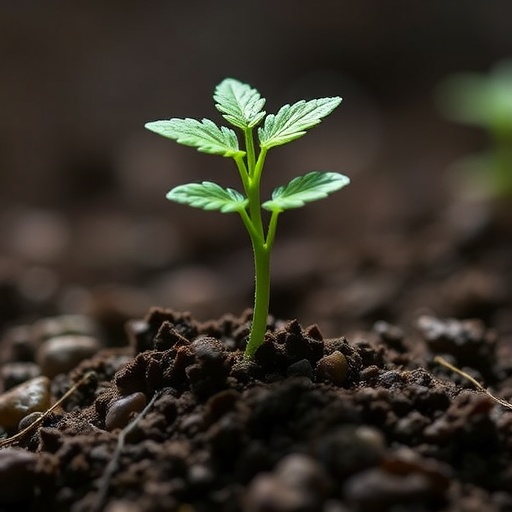
The emergence of seedlings from the soil marks a crucial juncture in the life cycle of plants—a phase that demands rapid cellular growth and remarkable physiological resilience. This vital developmental step hinges on the elongation of the hypocotyl, the stem-like structure that pushes through dense soil layers to access light and air essential for photosynthesis. However, this seemingly straightforward process conceals a staggering metabolic undertaking at the cellular level, one that is intimately linked with mitochondrial function and quality control.
Mitochondria, the powerhouses of plant cells, orchestrate the production of adenosine triphosphate (ATP) necessary to fuel rapid hypocotyl elongation. Yet, this intense mitochondrial respiration is a double-edged sword. While generating energy, it simultaneously produces reactive oxygen species (ROS), by-products that can inflict oxidative damage on cellular components. Given the essential role of mitochondria in this energy-intensive phase, plants have evolved sophisticated mechanisms to safeguard mitochondrial integrity, ensuring that only healthy, functional organelles persist during early seedling growth.
Recent research led by Tian, Z., Huo, Y., Li, C., and colleagues has unveiled a crucial molecular player involved in this protective mechanism: SPL2, a mitochondrial E3 ubiquitin ligase. This enzyme operates within mitochondria to regulate the degradation of specific outer mitochondrial membrane proteins, notably TRB1 and FIS1A. These proteins are not mere structural elements; they form part of a dynamic interface between mitochondria and the endoplasmic reticulum (ER), essential for the initiation of mitophagy—the selective autophagic degradation of damaged or dysfunctional mitochondria.
The study reveals that SPL2 coordinates mitochondrial protein turnover via ubiquitination, a process which tags proteins for degradation. By modulating the stability of TRB1 and FIS1A, SPL2 effectively fine-tunes the physical and functional connectivity between the ER and mitochondria at specialized contact sites. This ER-mitochondria interface emerges as a critical hub controlling mitophagy activation, thereby preserving mitochondrial quality during the intense energy demands of seedling emergence.
Intriguingly, the interaction between mitochondrial proteins TRB1 and FIS1A with the ER-localized VAP27-1 protein highlights a novel structural complex that governs ER-mitochondrial tethering. The study’s findings show that in the spl2 mutant, disruptions in ubiquitin-mediated protein degradation lead to a pronounced increase in ER-mitochondrial contacts. This enhanced tethering correlates with elevated mitophagy, suggesting a feedback mechanism where mitochondrial dysfunction triggers increased organelle turnover.
Conversely, overexpression of SPL2 dampens ER-mitochondrial interactions and suppresses mitophagy, emphasizing that SPL2 maintains a balance between organelle connectivity and the selective removal of damaged mitochondria. These insights into SPL2 function shed light on the delicate equilibrium plants maintain to optimize energy supply while mitigating oxidative stress during critical developmental windows.
Another striking observation is the temporal regulation of SPL2 expression. Post light perception, SPL2 levels rise significantly, aligning with a reduction in mitophagy activity. This correlation suggests that as seedlings transition from dark, subterranean growth to illuminated environments, mitochondrial quality control mechanisms recalibrate—a shift that likely supports the changing metabolic and developmental demands posed by photosynthetic activity.
The implications of these discoveries extend beyond the fundamental understanding of plant developmental biology. By elucidating how plants regulate mitochondrial dynamics and ER-mitochondrial communication through targeted protein degradation, this research opens new avenues for enhancing crop resilience. Manipulating SPL2 activity or its associated protein network could potentially improve seedling vigor, especially under environmental stresses that exacerbate mitochondrial damage.
Moreover, the interplay between ubiquitin-mediated protein degradation and organelle crosstalk resonates with broader themes in cell biology, where intracellular quality control systems govern cellular health. Similar mitochondrial-ER interactions are critical in animal cells for processes such as apoptosis and metabolic regulation, highlighting the evolutionary conservation of these mechanisms.
The deployment of advanced molecular tools and imaging techniques was pivotal in uncovering the SPL2-mediated pathways. Through biochemical assays, genetic mutants, and microscopic visualization, the researchers elucidated how protein ubiquitination dynamically sculpts organelle interactions that are otherwise challenging to dissect due to their transient and spatially confined nature.
Importantly, the study contextualizes mitophagy not merely as a degradative pathway but as an adaptive response intricately tied to developmental cues. The initiation of mitophagy at ER-mitochondrial contact sites reflects a spatially organized quality control strategy that maximizes efficiency and specificity in removing compromised mitochondria.
This research also prompts questions about the signaling pathways upstream of SPL2 regulation. How light perception translates into modulation of ubiquitin ligase expression warrants further exploration, as does the potential involvement of other post-translational modifications fine-tuning mitochondrial quality control machinery.
Beyond seedlings, the principles identified here may have relevance to other plant tissues and developmental stages where energy demand fluctuates dramatically. Whether SPL2 homologs or analogous systems function similarly in mature plants or under stress conditions such as drought and pathogen attack remains to be investigated.
In summary, the identification of SPL2 as a central regulator linking ubiquitin-dependent mitochondrial protein degradation with ER-mitochondrial interaction and mitophagy represents a leap forward in understanding plant developmental physiology. It underscores how cellular organelle communication and selective turnover mechanisms coalesce to surmount the metabolic challenges of early growth stages.
As plants emerge from the darkness of soil into the light, the orchestrated action of proteins like SPL2 ensures their survival and vigor, setting the stage for successful maturation and reproduction. This integrative insight into mitochondrial quality control reframes the cellular narrative of seedling emergence as a marvel of molecular coordination and environmental responsiveness.
With the burgeoning global need for sustainable agriculture, insights gleaned from such fundamental processes may inspire innovative strategies to enhance the robustness of crops against increasingly erratic climatic conditions. Indeed, tweaking mitochondrial quality control pathways could become an essential tool in the agricultural toolkit.
The study by Tian et al. thus resonates not just within the realm of plant biology but extends an invitation to the broader scientific community, urging a closer examination of organelle dynamics as a cornerstone of organismal adaptation and resilience. Understanding how ubiquitination governs organelle interplay may pave the way for breakthroughs across diverse biological systems, from single cells to complex multicellular organisms.
In conclusion, this research illuminates the molecular choreography underpinning one of nature’s most critical life transitions—the emergence of a seedling. By anchoring the process of hypocotyl elongation and mitochondrial health to ubiquitin-dependent degradation and ER-mitochondrial interplay, the study enriches our comprehension of plant survival mechanisms in a changing world.
Cite Scienmag News
Drew Townsend. (May 28, 2026). Ubiquitin Drives Seedling Growth via Mitochondrial Cleanup. Scienmag. https://scienmag.com/ubiquitin-drives-seedling-growth-via-mitochondrial-cleanup/
Drew Townsend. "Ubiquitin Drives Seedling Growth via Mitochondrial Cleanup." Scienmag, 28 May 2026, https://scienmag.com/ubiquitin-drives-seedling-growth-via-mitochondrial-cleanup/. Accessed 7 September 2026.
Drew Townsend. "Ubiquitin Drives Seedling Growth via Mitochondrial Cleanup." Scienmag. May 28, 2026. https://scienmag.com/ubiquitin-drives-seedling-growth-via-mitochondrial-cleanup/


