

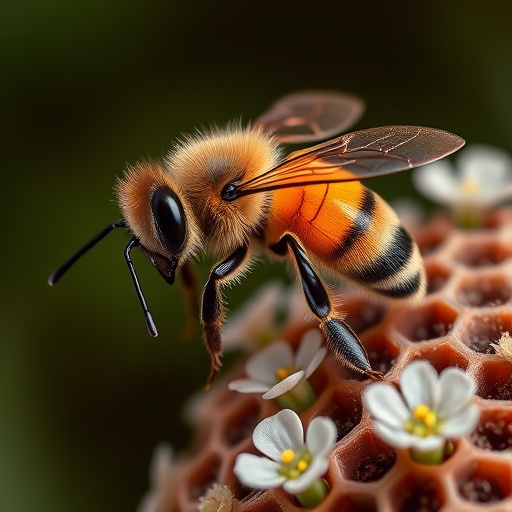
In a discovery that challenges the long-held boundary between vertebrate and invertebrate minds, scientists have captured the first evidence that bumblebees display emotion-like facial expressions in response to different tastes. Using high‑speed videography, researchers observed that after sipping a sugar solution the insects would extend their tongue‑like glossa in a manner unmistakably reminiscent of a satisfied “lip lick,” whereas bitter or salty solutions triggered vigorous head shaking and deliberate mouth wiping. The findings, published on July 6, 2026, in the Proceedings of the National Academy of Sciences, provide the first demonstration of orofacial affective evaluation in an invertebrate—a suite of behaviors previously thought exclusive to mammals.
The study, led by Fei Peng and Cwyn Solvi at Southern Medical University in Guangzhou, China, in collaboration with neuroethologist Andrew Barron of Macquarie University in Sydney, examined 18 colonies of the common buff‑tailed bumblebee (Bombus terrestris). The team presented individual bees with small droplets of either sucrose, quinine (bitter), or sodium chloride (salty) solutions immediately before filming the subsequent facial and oral movements at 500 frames per second. Every trial was analyzed frame by frame to quantify the duration and frequency of glossa protrusions, head rotations, and foreleg mouth‑cleaning motions, yielding a precise behavioral atlas of post‑ingestive reactions.
What emerged was a stark dissociation between mere feeding reflexes and genuine evaluative responses. Bees that encountered sugar water reliably performed prolonged glossa extensions after the droplet was fully consumed, often for several seconds without any further fluid present. This post‑consumption protrusion is functionally decoupled from the pumping mechanism of feeding and aligns with what researchers term a “liking” reaction—a hedonic response that in rodents and humans involves rhythmic tongue protrusions mediated by opioid and endocannabinoid circuits in the nucleus accumbens and ventral pallidum. Conversely, the aversive head shakes and mouth wipes occurred exclusively following bitter and salty tastants, patterns that mirror the disgust reactions orchestrated by the mammalian insular cortex and brainstem reticular formation.
These parallels are particularly striking because the bee brain weighs less than a milligram and contains approximately one million neurons—a number five orders of magnitude smaller than that of a mouse. Yet the behavioral logic appears conserved: the animal’s orofacial musculature acts as an external readout of an internal valuation process. “We don’t yet understand what the bees truly experience,” Barron notes, “but we can observe emotion‑like behaviors that give us a practical window into their inner life.” The distinction between reflexive “wanting” and evaluative “liking” is critical in affective neuroscience, and the study’s rigorous control for satiety, solution viscosity, and prior experience ensures that the observed expressions are not simple motor sequences triggered by fluid viscosity or ingestion mechanics.
The researchers further validated the specificity of the responses through a series of pharmacological and sensory manipulations. When bees were pre‑fed with a saturating dose of sucrose, the appetitive liking responses to sugar were diminished, indicating a central modulation rather than a hardwired reflex. Blocking gustatory receptors on the antennae and tarsi with a mild topical anesthetic sharply reduced both positive and negative expressions, confirming that the behaviors depend on the detection of chemosensory stimuli rather than post‑ingestive visceral feedback alone. Moreover, cross‑habituation experiments showed that repetitive exposure to bitter solutions gradually weakened the aversive shaking, a form of non‑associative learning that mirrors affective habituation in vertebrates.
“Facial expressions are an important window into the internal states of animals,” says Barron. “There has always been a tension between thinking of insects as animals or some sort of mini robots. This is another step towards showing there is an inner life to being a bee.” The implications extend far beyond a single species. Because the fundamental organization of the insect brain is highly conserved across orders, the orofacial affective circuitry identified in bumblebees likely exists in some form in flies, beetles, and other arthropods. That prospect raises thorny ethical questions about how humans treat the billions of insects used in agriculture, research, and pest control, and it may accelerate calls to reconsider invertebrate welfare in legislation.
Behind the behavioral data lies a profound neurobiological puzzle: how a brain roughly the size of a poppy seed can generate states that look so much like the vertebrate emotions we associate with limbic structures and layered cortex. The researchers hypothesize that the lateral horn of the insect protocerebrum, a multisensory integration hub analogous to the amygdala, may work in concert with the mushroom bodies—centers of learning and memory—to assign valence to gustatory signals and orchestrate the appropriate motor response. Future optogenetic and calcium‑imaging studies in bees and transgenic flies are expected to trace these circuits at cellular resolution, potentially bridging the gap between the physical mechanisms of neural activity and the subjective quality of experience.
For now, the image of a bee pausing after a sweet meal to slowly “lick its lips” while its antennae relax forward has become an emblem of a major shift in biology: the dissolution of the old Cartesian divide that cast insects as mere automata. As the authors note, the remarkable bee brain, despite its miniature dimensions, reliably produces a behavioural language of liking and disliking. That discovery not only reshapes our understanding of consciousness but also invites us to look at the small creatures around us with fresh eyes—and perhaps a new measure of respect.
Subject of Research: Animals (bumblebees, Bombus terrestris)
Article Title: Bumblebees’ orofacial reactions to tastes provide evidence for affective evaluation
News Publication Date: July 6, 2026
Web References: http://dx.doi.org/10.1073/pnas.2529114123
References: Peng, F., Solvi, C., Barron, A.B. et al. (2026) Bumblebees’ orofacial reactions to tastes provide evidence for affective evaluation. Proceedings of the National Academy of Sciences, DOI: 10.1073/pnas.2529114123
Image Credits: Bee Lab, Southern Medical University, Guangzhou, China
Keywords: bumblebee, affective evaluation, orofacial expression, insect consciousness, liking reaction, disgust, neuroethology, Bombus terrestris, gustatory behavior, invertebrate emotion


