


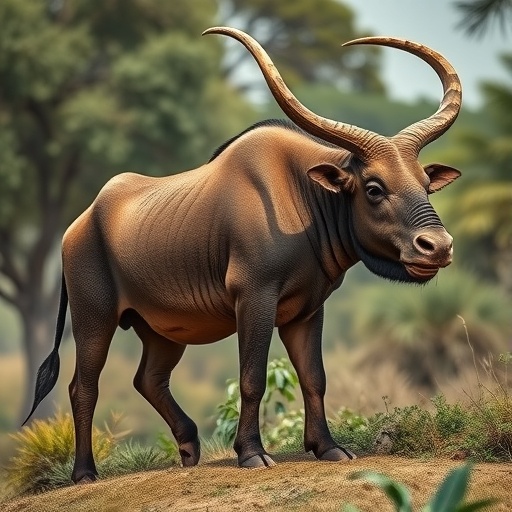
For millions of years, Africa was home to an extraordinary parade of giant plant-eaters: elephant relatives with unfamiliar tusks, massive rhinos, hippo-like grazers and other megaherbivores that transformed landscapes simply by feeding, trampling and moving through them. Yet the continent’s modern megaherbivore community is far less diverse than its fossil record suggests. A new study published in Nature Communications argues that the collapse was driven less by an acceleration of extinction than by a quieter evolutionary failure: new species stopped appearing at the rate they once did.
The finding challenges one of the most intuitive explanations for the disappearance of Africa’s large herbivores. When diversity declines, scientists often look first for an extinction pulse—an interval when species vanish unusually quickly because of climate change, habitat disruption, disease, competition or human pressure. Extinction is undoubtedly part of the story of Africa’s lost megafauna, but the new analysis suggests that the deeper long-term pattern was a reduction in speciation, the evolutionary process through which one lineage splits into two or more distinct species.
That distinction matters because biodiversity is shaped by two opposing forces. Extinction removes branches from the tree of life, while speciation creates new ones. A group can lose diversity even if extinction rates remain stable, provided that the formation of new species slows down. Over geological timescales, a modest decline in speciation can have enormous consequences: fewer new lineages emerge to replace those that disappear, and the evolutionary tree gradually becomes thinner.
The researchers, led by J. L. Cantalapiedra, I. A. Lazagabaster and F. Blanco, examined the evolutionary history of African megaherbivores to determine whether their diversity collapse was primarily an extinction story or a failure of evolutionary renewal. Their conclusion points toward lower speciation as the dominant driver. In other words, Africa’s giant herbivore lineages did not necessarily vanish because they were being eliminated at ever-higher rates; instead, the evolutionary engine that generated new forms was losing momentum.
Scientists reconstruct these dynamics using fossil occurrences, phylogenetic relationships and statistical models of diversification. Fossils provide evidence of when and where species existed, while evolutionary trees help estimate how lineages are related and when they may have diverged. By comparing the rates at which lineages originated and disappeared, researchers can test whether a diversity decline reflects rising extinction, falling speciation or a combination of both. Such analyses are especially valuable for megaherbivores, whose fossil record spans major environmental transitions across Africa.
The study’s message is particularly striking because large herbivores are often portrayed as evolutionary victims of increasingly severe environmental pressures. Changing rainfall regimes, the expansion and contraction of grasslands, shifts in forest cover and climatic instability all shaped African ecosystems. But the new interpretation suggests that these pressures may have influenced diversity not only by killing established species. They may also have reduced the opportunities for isolated populations to diverge, adapt and become new species.
Speciation usually requires populations to become genetically distinct. Geographic separation can play a major role: a mountain range, a changing river system, a fragmented habitat or a shifting climate zone may isolate groups long enough for natural selection and genetic drift to push them along different evolutionary paths. For very large mammals, however, the process may be unusually difficult. Megaherbivores often need extensive territories and abundant food, which can limit the number of viable populations available for long-term isolation. Their slow reproduction may further reduce the speed at which evolutionary differences accumulate.
This interpretation also changes how scientists think about the resilience of giant mammals. A lineage can appear stable for long periods while its future evolutionary potential quietly erodes. If fewer new species are forming, the group may become increasingly dependent on a small number of surviving branches. Any later environmental shock can then have an amplified effect, because there are fewer lineages left to absorb the damage. Diversity loss may therefore begin long before a dramatic extinction event becomes visible in the fossil record.
The findings have an urgent modern echo. Africa’s surviving megaherbivores face habitat fragmentation, poaching, climate change, altered fire regimes and conflict with expanding human populations. Conservation typically focuses on preventing the extinction of individual species, an essential goal. But the study highlights a broader question: are landscapes still connected and ecologically complex enough to support the long-term evolutionary diversification of large mammals? Protecting existing elephants, rhinos, hippos and other giants may preserve not only today’s species, but also the ecological conditions required for future evolutionary change.
The ancient collapse of African megaherbivore diversity was therefore not simply a story of giants being wiped out. It was also a story of evolution slowing down. By showing that lower speciation, rather than higher extinction alone, best explains the decline, the research offers a more nuanced view of how biodiversity disappears—and a powerful reminder that the loss of nature can involve not only the end of species, but the failure to create new ones.
Cite Scienmag News
Gavin Prescott. (July 31, 2026). Reduced speciation, not increased extinction, caused Africa’s megaherbivore diversity collapse. Scienmag. https://scienmag.com/reduced-speciation-not-increased-extinction-caused-africas-megaherbivore-diversity-collapse/
Gavin Prescott. "Reduced speciation, not increased extinction, caused Africa’s megaherbivore diversity collapse." Scienmag, 31 July 2026, https://scienmag.com/reduced-speciation-not-increased-extinction-caused-africas-megaherbivore-diversity-collapse/. Accessed 4 September 2026.
Gavin Prescott. "Reduced speciation, not increased extinction, caused Africa’s megaherbivore diversity collapse." Scienmag. July 31, 2026. https://scienmag.com/reduced-speciation-not-increased-extinction-caused-africas-megaherbivore-diversity-collapse/


