


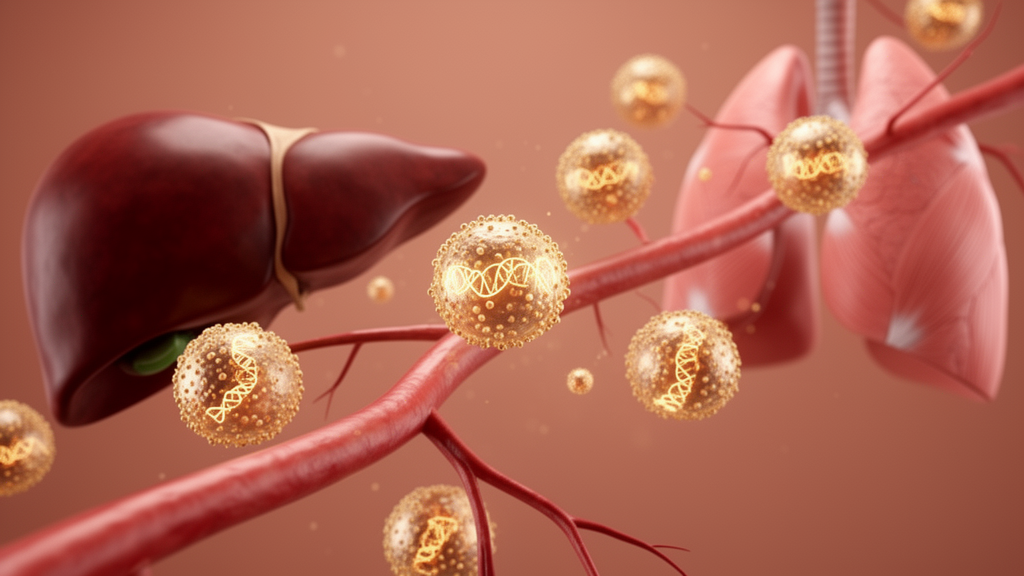
Lipid nanoparticles have become the workhorses of modern mRNA medicine, ferrying genetic instructions into cells with remarkable efficiency. Yet one stubborn problem has shadowed the technology since its earliest clinical successes: even when an mRNA injection is delivered locally, into a muscle, the brain, or the eye, a substantial fraction of the lipid particles ends up in the liver, where it can trigger unwanted protein production far from the intended site. A research team reporting in Science China Life Sciences now describes a systematically redesigned lipid formulation, dubbed SM102M, that dramatically curbs this hepatic spillover in mice while preserving, and in some contexts enhancing, expression at the site of injection.
The scale of the improvement is striking. After intramuscular injection, the new formulation reduced liver signal by roughly eighty-fold compared with the parent lipid recipe, and after intravenous injection the reduction was about seventy-two-fold. Crucially, these gains did not come at the expense of local expression: mRNA delivered into muscle still produced robust amounts of the encoded protein. For a field in which off-target expression has been a persistent safety and efficacy concern, the result offers a concrete demonstration that delivery precision can be engineered directly into the nanoparticle itself.
The achievement was not the product of a single lucky substitution. The researchers applied a statistical framework known as design of experiments, or DOE, to interrogate how each component of the lipid mixture, and each ratio between components, shaped delivery outcomes. Rather than adjusting one ingredient at a time, DOE allows scientists to explore combinations of changes simultaneously and to identify the formulation space where desirable properties converge. This systematic refinement retained SM102, the ionizable lipid that anchors the original formulation, but replaced cholesterol with beta-sitosterol, a plant-derived sterol, and recalibrated the proportions of a helper phospholipid and a polyethylene glycol, or PEG, lipid that stabilizes the particle surface.
Each of these changes carries mechanistic significance. Cholesterol has long been a standard structural component of lipid nanoparticles, but plant sterols such as beta-sitosterol differ subtly in molecular shape and behavior, and swapping them can alter how particles interact with proteins in the blood and with cell membranes. The PEG lipid, meanwhile, governs particle size, circulation half-life, and the immune recognition that can follow repeated dosing. By tuning these variables in a statistically guided fashion, the team arrived at a composition whose behavior in the body diverged meaningfully from the original SM102 recipe.
Follow-up experiments illuminated why the new formulation spares the liver. Nanoparticles built with the SM102M recipe differed in physical shape from their predecessors, and they escaped intracellular compartments within liver cells less efficiently, a property that suppresses endosomal release and therefore protein production in hepatic tissue. The particles also persisted in the body for a shorter time and bound less strongly to apolipoprotein E, or ApoE, a blood protein that acts as a molecular escort, shepherding lipid particles toward hepatocytes. Weakening this ApoE interaction effectively removes one of the liver’s principal homing signals. Paradoxically, despite this reduced liver tropism, SM102M delivered mRNA more efficiently into cells in culture, suggesting that the same structural changes that deflect the particles from hepatic uptake can enhance their performance once they reach a target cell population.
The durability of the effect across repeated doses may prove as important as the initial result. Because mRNA therapeutics provide only temporary instructions, many envisioned applications, from chronic muscle disorders to recurring vaccines, will require multiple administrations over time. In the study, SM102M maintained strong local expression and low liver signal across repeated injections, whereas the original SM102 formulation lost much of its local potency with successive doses. The redesigned particles also provoked less anti-PEG immunoglobulin G, an antibody response directed against the PEG coating that can accelerate particle clearance and raise the risk of infusion reactions. Blunting this immune activation could extend the practical dosing window for mRNA therapies that depend on PEG-stabilized nanoparticles.
The benefits extended beyond muscle. When the researchers injected the particles into a brain ventricle or into the vitreous cavity of the eye, SM102M produced protein expression concentrated within the intended anatomical region, with less unwanted liver expression than the reference formulation achieved. Local delivery to the central nervous system and to ocular tissues represents some of the most promising frontiers for mRNA medicine, from neurologic gene supplementation to retinal therapies, and both settings demand that expression remain confined to delicate, hard-to-reach structures. A formulation that keeps expression local could reduce the systemic exposure that complicates these applications.
The study’s methodological approach deserves attention as much as its headline numbers. Design of experiments has deep roots in industrial chemistry and process engineering, but its application to lipid nanoparticle optimization illustrates how modern drug delivery research increasingly resembles rational formulation engineering rather than trial-and-error screening. By mapping how multiple formulation variables interact, the technique can reveal compositional neighborhoods where liver accumulation, circulation time, cellular uptake, and immune reactivity are jointly optimized. The SM102M result suggests that the lipid nanoparticle design space contains substantial untapped room for tissue-selective tuning, and that systematic exploration of that space can yield formulations with properties quite different from the clinically established recipes.
Cautious interpretation remains warranted. All of the findings reported so far come from mouse experiments, and the biodistribution and immunology of lipid nanoparticles in humans can differ in important ways. The authors themselves note that further studies using therapeutic mRNA and established disease models will be needed to demonstrate genuine treatment benefits and longer-term safety before any translation toward human use. Liver accumulation, after all, is not merely a nuisance; it reflects the broader challenge of steering nanoscale carriers through the body’s filtration and clearance systems, and the mechanisms uncovered here, from ApoE binding to endosomal escape, will need to be validated across species and disease contexts.
Nevertheless, the work adds a compelling data point to a rapidly maturing field. Lipid nanoparticles already underpin approved vaccines and advancing gene-editing programs, and the ability to retune their tissue selectivity without abandoning proven core lipids could accelerate a new generation of locally targeted mRNA therapies. If the principles behind SM102M hold up in larger animal models and, eventually, in clinical settings, the lipid recipe that made mRNA medicine famous may be joined by a family of recipes designed not just to deliver, but to deliver precisely where the body needs it, and nowhere else.
Subject of Research: Redesigning lipid nanoparticles for tissue-selective local mRNA delivery with reduced liver accumulation
Article Title: A new lipid recipe helps mRNA delivery stay on target
Article References: A new lipid recipe helps mRNA delivery stay on target. (n.d.). Original publication
Image Credits: AI Generated
DOI: Not provided
Keywords: lipid nanoparticles, mRNA delivery, SM102M, design of experiments, liver accumulation, beta-sitosterol, ApoE, anti-PEG antibodies, local injection, brain delivery, ocular delivery, repeated dosing
Cite Scienmag News
Drew Townsend. (October 16, 2026). Redesigned lipid nanoparticles steer mRNA away from the liver and toward target tissues. Scienmag. https://scienmag.com/redesigned-lipid-nanoparticles-steer-mrna-away-from-the-liver-and-toward-target-tissues/
Drew Townsend. "Redesigned lipid nanoparticles steer mRNA away from the liver and toward target tissues." Scienmag, 16 October 2026, https://scienmag.com/redesigned-lipid-nanoparticles-steer-mrna-away-from-the-liver-and-toward-target-tissues/. Accessed 16 October 2026.
Drew Townsend. "Redesigned lipid nanoparticles steer mRNA away from the liver and toward target tissues." Scienmag. October 16, 2026. https://scienmag.com/redesigned-lipid-nanoparticles-steer-mrna-away-from-the-liver-and-toward-target-tissues/


