


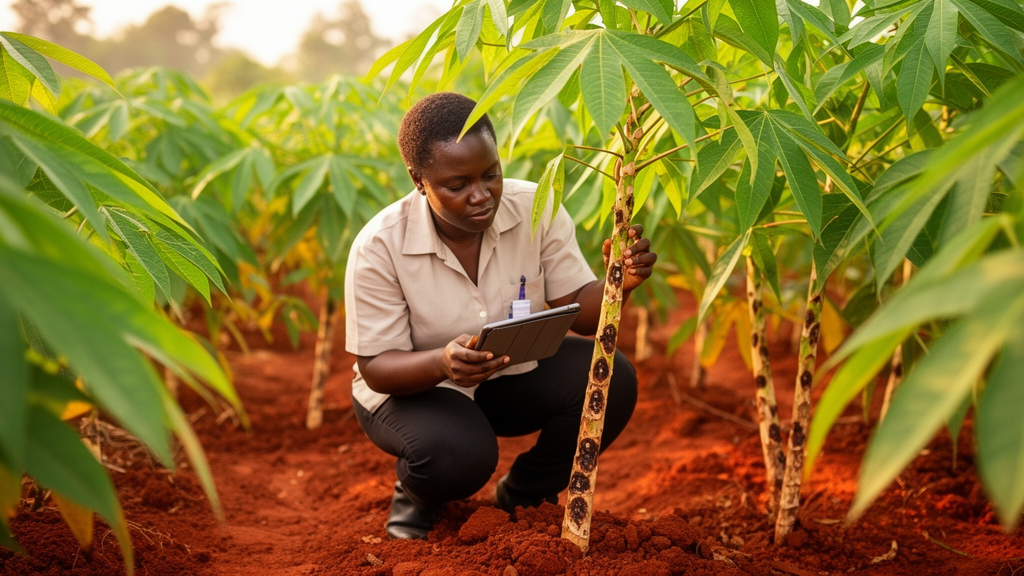
Cassava feeds hundreds of millions of people across tropical Africa, yet one of its most stubborn enemies operates largely unseen. Colletotrichum anthracnose, a fungal disease driven by humidity, rainfall, and warm nights, attacks leaves, petioles, and stems, eroding root yields and degrading the quality of planting material that farmers carry into the next season. In smallholder systems, the standard response is reactive: spray on a calendar or when symptoms appear, regardless of whether the weather actually favors infection. A new study published in Frontiers in Plant Physiology reports the first field pilot of a composite early-warning framework designed to break that pattern by measuring real infection risk hour by hour, and it comes with unusually candid caveats about what the data can and cannot yet prove.
The framework, called the Cassava Anthracnose Risk Index, or CARI, was developed and pilot-tested at the Council for Scientific and Industrial Research Crops Research Institute in Fumesua, Ghana, by a team spanning ScareCrow Intelligence in the United Kingdom, CSIR institutes in Ghana, and partner organizations in Kumasi. The researchers planted a one-acre rainfed plot in March 2025 with Debo, a widely grown local landrace known to be susceptible to anthracnose, deliberately choosing a farmers’ variety rather than a bred-for-resistance cultivar to maximize ecological realism. No mineral fertilizer was applied, and weed control consisted of three manual weeding events, mirroring minimal-input smallholder practice across the region.
Technically, CARI rests on two subscores. The Environmental Risk Subscore quantifies daily infection suitability on a 0 to 600 point scale built from six weighted components: relative humidity and leaf wetness carry the heaviest weight at 200 points as the primary driver of spore germination; rainfall events contribute 150 points by facilitating splash dispersal of conidia between plants; night temperature in the 20 to 30 degree Celsius optimum adds 100 points; and wind, canopy-soil moisture, and the canopy-to-air temperature differential each add 50 points. Crucially, the raw score is then moderated by a persistence factor that requires infection-favorable conditions, defined as nights between 20 and 30 degrees Celsius with relative humidity at or above 80 percent or leaf wetness present, to persist for a stage-specific minimum of 24, 36, or 48 consecutive hours depending on crop age. This mechanism is intended to prevent alerts from transient nocturnal humidity spikes, a near-daily occurrence in humid tropical systems.
Stage sensitivity is implemented through alert thresholds rather than varying component weights, so the same environmental measurement contributes the same maximum points regardless of developmental phase. Early growth stages demand a higher environmental score to trigger action because plants show limited symptom expression even under heavy infection pressure, while the maturity stage gates environmental alerts on the concurrent presence of confirmed symptoms to avoid false escalation from carry-over infections. The second subscore, the Visual Symptom Subscore, ranges from 0 to 40 points and derives from standardized weekly severity assessments on a 0 to 5 ordinal scale of 15 tagged sentinel plants per plot, integrated into a composite CARI score from 0 to 100 with four operational risk bands, from routine monitoring at the green end to targeted fungicide application and containment of infected stems at the red end.
The sensor infrastructure combined two commercially available systems operating in parallel: a NESA QUIDO compact agrometeorological station measuring air temperature to 0.05 degree resolution, relative humidity, rainfall, and binary leaf wetness at 15-minute intervals, and a SenseCAP Sensor Hub 4G data logger with a seven-in-one compact weather sensor providing cross-validated readings including wind speed, barometric pressure, and light intensity. Data flowed to cloud servers over GPRS and 4G LTE and were aggregated to hourly summaries for risk computation. A weighted Confidence Score tracked data reliability, reflecting weather completeness, sensor uptime, visual scoring completeness, timestamp stability, and automated integrity checks, with scores above roughly 75 percent indicating near-complete data and scores below 60 percent flagging outputs as indicative only.
The structured Stage 3 observation window ran from 26 December 2025 through 2 April 2026, spanning 98 calendar days, of which 73 yielded valid data. Twenty-five days were lost to a complete sensor outage between 16 January and 9 February 2026, attributable to a hardware commissioning issue resolved when the team returned to site on 10 February. Across the valid days, mean daily air temperature was 26.8 degrees Celsius, mean relative humidity 75.6 percent, and mean leaf wetness duration 4.7 hours concentrated in the pre-dawn window. A consistent diurnal humidity cycle dominated the record, with relative humidity peaking between 92 and 99 percent from 21:00 to 07:00 and collapsing to 40 to 65 percent at midday. Three substantial rainfall events punctuated the period, including 180.3 millimeters on 10 February following sensor restoration and a season maximum of 232.1 millimeters on 11 March.
The headline descriptive result is striking: CARI classified all 73 valid days as Low Risk and issued no Amber or Red alerts, including on 37 days when nocturnal relative humidity exceeded 85 percent for 4 to 10 consecutive hours, conditions that would have triggered a precautionary alert under a simple single-threshold humidity model. The persistence factor remained at its 0.3 baseline on 72 of 73 days. The single exception was 10 February 2026, when 14 consecutive infection-favorable hours pushed the persistence factor to 0.7 and the environmental subscore to 44 percent of maximum, the highest value in the record, driven by the 180.3 millimeter rolling rainfall accumulation. Even that peak remained below the 50 percent Stage 3 Amber threshold.
The only confirmed disease episode of the study unfolded between 11 and 24 February 2026. On 11 February, the first non-zero visual symptom record was captured through the CassAPI mobile scoring platform, with foliar and petiole lesions confirmed on all scored sentinel plants and an expert-verified mean severity of 2.71 on the 0 to 5 scale. An approximately one-day interval separated the peak environmental risk signal on 10 February from this confirmed symptom onset, consistent with the lower end of the 3 to 7 day infection-to-symptom range reported for Colletotrichum pathosystems under tropical conditions. The authors are emphatic, however, that this interval is reported as a descriptive observation only: the 25-day sensor outage immediately preceding the episode means antecedent conditions during the most likely infection window are unknown, the symptoms could plausibly reflect infection events at any point during the outage, and a single episode cannot establish a generalizable lag value. Notably, CARI did not issue an intervention recommendation during this episode because concurrent environmental risk remained well below the Amber co-condition threshold, and the episode resolved rapidly as the harmattan dry period of 17 to 19 February, with humidity dropping to 44 to 58 percent, arrested lesion development.
The pilot also surfaced a practical warning for AI-assisted deployment. AI-computed severity scores from CassAPI diverged substantially and consistently from expert-verified scores across all four scoring events, over-scoring by 0.72 to 2.08 points, a pattern consistent with the known tendency of image-based models to over-score visually dense lesion scenes. Because the expert score served as the reference standard, the headline results do not reflect this divergence, but the authors recommend that operational deployments either retain periodic expert verification, particularly during periods of elevated environmental risk, or implement an automated confidence flag surfacing outputs for review whenever AI-only severity exceeds a pre-specified threshold. Published decision support systems for Colletotrichum anthracnose in strawberry, citrus, and mango report fungicide reductions of 30 to 70 percent relative to calendar schedules, and a global meta-analysis of 80 field experiments found such systems can halve fungicide use without compromising control, but the authors stress these figures are cited only for benchmarking: no comparative fungicide trial was conducted here, and a calendar schedule of one spray every 10 days would have generated roughly 7 sprays over the 73-day window against zero CARI-triggered interventions.
The authors are careful to frame the entire study as proof of concept for technical operability rather than evidence of predictive accuracy. The dataset contains zero confirmed Amber or Red events and only four days with non-zero visual scores, precluding any sensitivity, specificity, or ROC analysis, and the component weights, persistence parameters, and alert thresholds were derived through expert elicitation rather than statistical optimization against outbreak data. Pathogen identification relied solely on morphology consistent with the Colletotrichum gloeosporioides species complex, leaving species-level identity provisionally confirmed pending molecular characterization using ITS, ACT, TUB2, and GAPDH loci. The study covers a single site, a single variety, and only the maturity growth phase, so none of the findings can be assumed to generalize across Ghana’s agroecological zones or cassava germplasm. A planned multi-season study aims to address these gaps with full-cycle sensor deployment from crop establishment, multi-location replication across the Guinea Savanna and Transition zones, molecular pathogen identification, statistical refinement of all parameters against confirmed disease events, accumulation of a dataset with statistically meaningful numbers of confirmed high-risk events, and a direct comparative field trial of CARI-guided versus calendar-based fungicide application. If that validation succeeds, the framework could offer smallholder cassava farmers across humid tropical Africa a pathway toward anticipatory, weather-informed crop protection that concentrates intervention on biologically meaningful risk windows rather than fixed schedules.
Subject of Research: Plant Pathology
Article Title: A stage-weighted environmental risk and visual severity integration model for climate-smart management of cassava anthracnose in humid tropical systems
Article References: Bulut, C., Onwona-Hwesofour Asante, K., Akon-Yamga, G., Adu-Gyamfi, M. O., Appiah-Kubi, Z., Odame Afari, S., Brett, J., Onwona Simpe, K., & Nutefe Kuavedzi, R. (2026). A stage-weighted environmental risk and visual severity integration model for climate-smart management of cassava anthracnose in humid tropical systems. Frontiers in Plant Physiology, 4, Article 1898224. https://doi.org/10.3389/fphgy.2026.1898224
Image Credits: AI Generated
DOI: 10.3389/fphgy.2026.1898224
Keywords: cassava anthracnose, Colletotrichum, early warning, decision support, climate-smart agriculture, precision plant pathology, Ghana, persistence factor, sentinel plants, IoT sensors, stage-weighted, environmental
Cite Scienmag News
Alan Morgan. (October 16, 2026). Cassava Anthracnose Early-Warning Index Shows Promise in Ghana Field Pilot. Scienmag. https://scienmag.com/cassava-anthracnose-early-warning-index-shows-promise-in-ghana-field-pilot/
Alan Morgan. "Cassava Anthracnose Early-Warning Index Shows Promise in Ghana Field Pilot." Scienmag, 16 October 2026, https://scienmag.com/cassava-anthracnose-early-warning-index-shows-promise-in-ghana-field-pilot/. Accessed 16 October 2026.
Alan Morgan. "Cassava Anthracnose Early-Warning Index Shows Promise in Ghana Field Pilot." Scienmag. October 16, 2026. https://scienmag.com/cassava-anthracnose-early-warning-index-shows-promise-in-ghana-field-pilot/


