


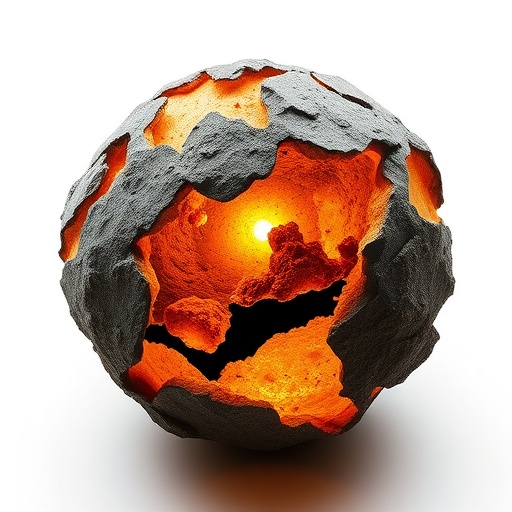
In a striking new study, researchers report that the early Earth may have grown through fast, high-impact collisions with embryos resembling enstatite chondrites—primitive building blocks that formed under highly reducing conditions. Published in Communications Earth & Environment, the work focuses on how such EH-like planetary embryos could act as impactors during Earth’s proto-planetary assembly, delivering both mass and energy on surprisingly short timescales.
The core idea is straightforward but consequential: if enstatite-chondrite-like embryos accreted rapidly, their collisions would not merely add material—they would reshape the thermal state and chemical evolution of the forming Earth. By treating these bodies as distinct impactors rather than a continuous background of debris, the authors connect impact dynamics to geochemical outcomes that can be read in Earth-like materials today.
To support this scenario, the study examines how rapidly accreting embryos could collide with the proto-Earth, concentrating gravitational energy into transient heating, fragmentation, and mixing. These effects matter because early impacts can drive silicate melting, modify volatile retention, and influence the segregation of core-forming elements through pressure- and temperature-dependent chemistry.
The model also emphasizes scaling relationships between embryo growth rates, impact velocities, and collision geometries. Faster accretion implies larger bodies in shorter intervals, which in turn raises the likelihood of energetic impacts capable of producing substantial mantle processing. Such impacts can promote chemical homogenization in localized regions, while also enabling differentiated pathways where some elements partition more strongly into metal or melt phases.
A key technical component is how impact-generated heating and subsequent cooling can affect the survival of distinct geochemical signatures. If EH-like embryos delivered material with characteristic compositions, then rapid accretion and frequent collisions would determine whether those signatures persist as recognizable reservoirs or become overprinted by repeated melting and re-equilibration.
Importantly, the paper frames these embryos as impactors during Earth’s formative epoch, aligning accretion physics with early planetary differentiation. The result is a coherent picture in which rapid growth of EH-like precursors helps explain why the proto-Earth may have experienced both energetic upheaval and selective chemical processing rather than uniform accretion alone.
By tying together dynamics and chemical evolution, the findings add a new route for interpreting early Earth history—one where the final outcome depends on how quickly building blocks assembled and how violently they struck. If confirmed across additional constraints, the EH-like impactor framework could sharpen our understanding of Earth’s origin and the conditions that shaped its interior.
The study’s DOI details the formal publication: https://doi.org/10.1038/s43247-026-03836-x.
Cite Scienmag News
Violet Maxwell. (July 26, 2026). Rapid Growth of Enstatite Chondrite-Like Embryos Driving Proto-Earth Impacts. Scienmag. https://scienmag.com/rapid-growth-of-enstatite-chondrite-like-embryos-driving-proto-earth-impacts/
Violet Maxwell. "Rapid Growth of Enstatite Chondrite-Like Embryos Driving Proto-Earth Impacts." Scienmag, 26 July 2026, https://scienmag.com/rapid-growth-of-enstatite-chondrite-like-embryos-driving-proto-earth-impacts/. Accessed 4 September 2026.
Violet Maxwell. "Rapid Growth of Enstatite Chondrite-Like Embryos Driving Proto-Earth Impacts." Scienmag. July 26, 2026. https://scienmag.com/rapid-growth-of-enstatite-chondrite-like-embryos-driving-proto-earth-impacts/


